

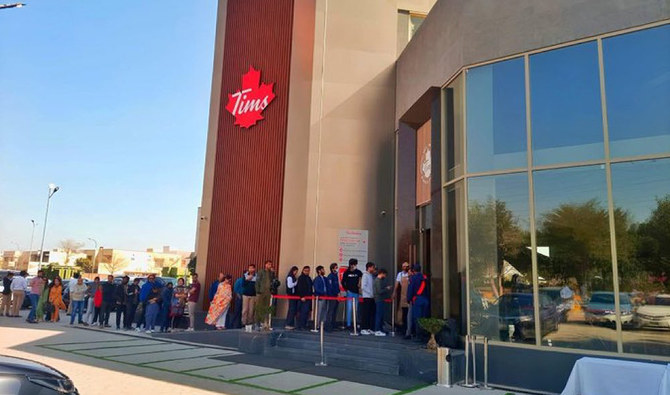
Coffee trumps economic crisis as Tim Hortons opens in Pakistan

People standing in a long queue outside the Canadian chain Tim Hortons as it opens its first branch in Lahore, Pakistan on February 11, 2023. (Photo courtesy: @DrYumnaZee/Twitter)
Short Url
Updated 14 February 2023
Follow

Coffee trumps economic crisis as Tim Hortons opens in Pakistan

  • Inflation is highest in over a decade but that hasn’t stopped scores of Pakistanis from thronging to cafe since it opened on Saturday
  • A small brewed coffee costs 350 rupees ($1.30), average government-mandated minimum wage is 25,000 rupees ($94) a month

LAHORE: Pakistanis are queuing for hours to grab coffee and pastries from Canadian chain Tim Hortons, which opened its first outlet in the South Asian country last week just as its economic crisis took a turn for the worse.

In less than a month, Pakistan’s currency has lost more than a quarter of its value against the US dollar, and fuel prices have risen by almost a fifth as the government implemented fiscal measures that are prerequisite to unlocking funds from an International Monetary Fund bailout.

Inflation in January spiked to 27 percent year-on-year, the highest in more than a decade, and the government only has enough foreign reserves to pay for just over three weeks of imports.

All that hasn’t stopped scores of Pakistanis from thronging to the cafe since it opened on Saturday at an upmarket Lahore shopping mall.

Tim Hortons is owned by Restaurant Brands International Inc. (RBI), , a Toronto-based company that also owns other fast food brands including Burger King and Popeyes.

“Higher prices don’t really matter for the class of people coming here,” Ahmad Javed, a medical student who used to go to Tim Hortons while he was living in Canada, told Reuters as he queued up.

“Rich people in Pakistan are getting richer, the poor are becoming poorer while the middle class is struggling.”

According to its online menu, a small brewed coffee costs 350 rupees ($1.30), while a large flavoured coffee is twice as much. By comparison, the average government-mandated minimum wage is 25,000 rupees ($94) a month.

With a population of more than 230 million and a $350-billion economy, Pakistan remains a growth market for fast-food companies. McDonald’s, Retail Food Group (RFG.AX)-owned Gloria Jean’s Coffee and Yum Brands Inc-owned Pizza Hut are among the international brands with outlets in Pakistan.

Tim Hortons is set to open another two outlets in Lahore, RBI said in a statement. Pakistani firm Blue Foods operates the franchise. Both companies declined to give any details about the outlet’s sales in the opening week.

For students such as Pareeshay Khan, the brand’s social media traction trumps the cost of the coffee:

“I’m here to taste the coffee that’s the top social media trend. I don’t know about the price, nor do I care.”

($1 = 266.5000 Pakistani rupees)



Pakistan consumer confidence rises by 4 percentage points in two years, survey shows

Updated 28 February 2026
Follow

Pakistan consumer confidence rises by 4 percentage points in two years, survey shows

  • Four in 10 Pakistanis believed the country is on the right track, with optimism higher among men
  • Economic concerns remained most worrying, but their quantum fell drastically across all issues

ISLAMABAD: Consumer confidence in Pakistan has risen by 4 percentage points from 31.5 to 35.5 over the last two years, which highlights improving public optimism under the government’s tenure, Ipsos market research firm said in a recent survey.

The survey was conducted through computer-assisted telephonic interviews (CATI) and included more than a thousand participants from all provinces and Azad Kashmir and Gilgit Baltistan regions on Feb. 2-14.

It comes at a time when Pakistan has undergone a difficult period of stabilization, though international rating agencies have acknowledged improvements after Islamabad began implementing structural reforms as part of its $7 billion International Monetary Fund (IMF) program.

The Ipsos survey revealed a “measurable” improvement in Pakistan’s economic sentiment, marked by a decline in inflation alongside notable reductions in poverty and unemployment, since the current government took charge two years ago.

“These findings point to a clear two-year transformation in the Consumer Confidence Index, demonstrating the perceived impact of consistent governance and policy measures,” read the key takeout in the survey.

“Sustained performance, coupled with transparent communication of achievements, will be essential to maintain momentum, reinforce optimism, and support further improvements in economic confidence.”

Four in 10 Pakistanis believed the country is on the right track, with optimism higher among men, while confidence in the country’s direction being right increased more than three times, from 12 percent to 40 percent, since the government came to power, according to the survey.

Economic concerns remained most worrying, but their quantum fell drastically across all issues since the first quarter of 2024. Inflation has dropped by 23 percent, unemployment by 10 percent, poverty by 20 percent, electricity prices by 34 percent and the burden of additional taxes was reduced by 18 percent in Q1 2026 as compared to Q1 2024.

“One in 3 Pakistanis expect the economy to strengthen,” the survey read. “Confidence to invest has grown steadily over two years, rising from 11 percent to 16 percent, with even stronger optimism among urban residents.”