

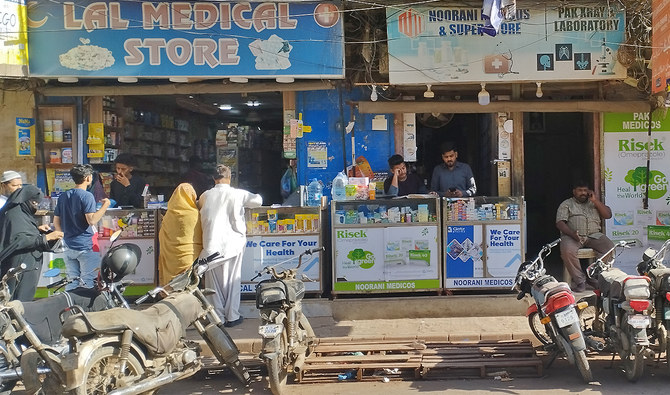

KARACHI: Diabetes and heart patient Nazakat Ali Khan has been managing his illnesses with the help of life saving medications for the past decade.
Today, however, the 57-year-old cameraman is one of millions of Pakistani patients who are at risk as the cost of critical medicines rises to unaffordable levels.
Faced with critically low US-dollar reserves, the Pakistan government has banned all but essential food and medicine imports until a lifeline bailout is agreed with the International Monetary Fund (IMF). Industries such as steel, textiles and pharmaceuticals are barely functioning, forcing thousands of factories to close, deepening unemployment.
Tauqeer ul Haq, the head of the Pakistan Pharmaceutical Manufacturers Association, told media this week 40 medicine factories were on the brink of closure because of a lack of key ingredients. The shortage of pharmaceutical raw materials and medicines has also driven up prices.
“For the last 10 years my medicines were affordable,” Khan told Arab News as he took out a stash of medicines from his backpack. “However, for around a year, medicines which were available for Rs100 have gone up to Rs300-350 and are also short in the market.”
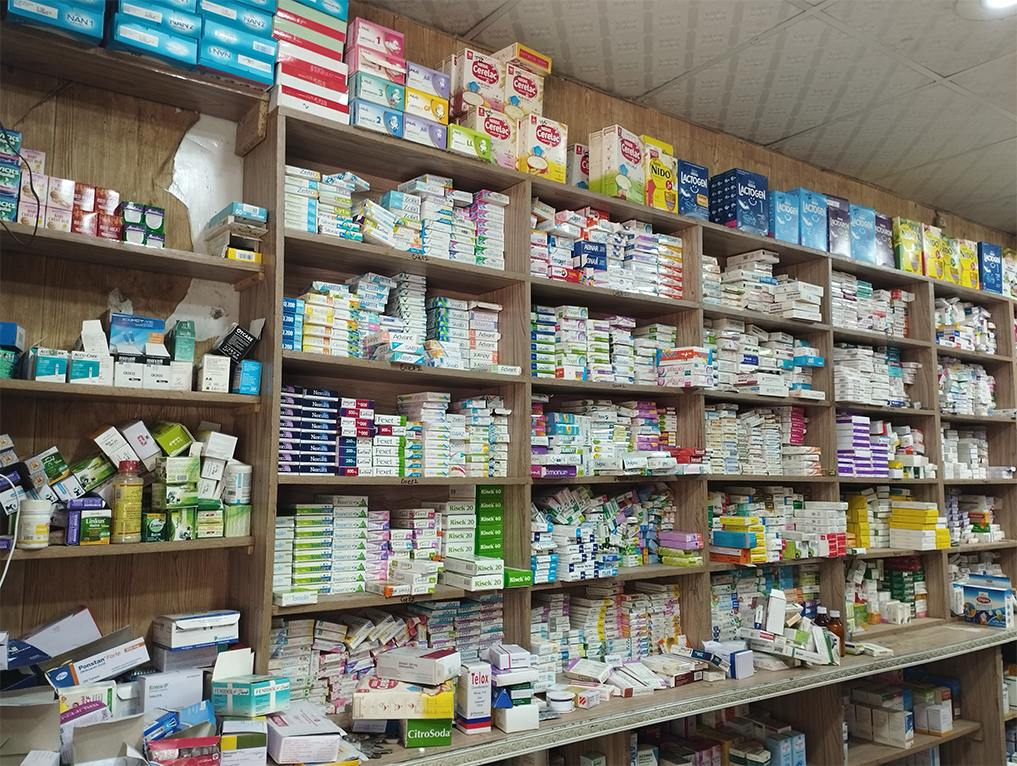
Medicines are stocked at a pharmacy in Karachi, Pakistan, on February 10, 2023. (AN photo)
Khan, who works for a privately owned news channel that broadcasts 24-hour news, said he has to carry a pack of medicines on him at all times as his job requires him to constantly stay alert and remain on standby to go out for coverage.
And while the prices of the medicines Khan needs have jumped by over 200 percent, his income has remained stagnant.
“I have to carry the medicines with me always,” the cameraman said. “Without them, I can’t move. And the problem is that the prices are too high and beyond affordability. The cost of medication is becoming more painful than the diseases.”
Pharmacists and drug sellers said prices had increased by up to 37 percent within a month of the raw material shortage created by import bans.
Arab News made repeated attempts but could not reach Health Minister Abdul Qadir Patel for comment.
“The prices of medicines, for instance, which were available for Rs400, have directly jumped by Rs100 and Rs150,” Malik Nasir, a pharmacy owner, told Arab News. “Within a month, prices of almost all medicines have increased and if they [suppliers] don’t want to supply medicines, they create [fake] shortages.”
Almost 20 percent of all medicines are in short supply in the market, creating problems not only for patients but also for sellers, Nasir added.
In Pakistan, the government regulates drug prices and no company can increase the rates on its own. But responding to reports of a current price hike, manufacturers and distributors denied involvement, saying this was the work of “black marketers.”
“The retail prices have not increased, but due to recent shortage of raw material amid LC [letter of credit] issues, the supply chain has been disturbed and taking advantage of the situation, some black sheep of the sector have increased the rates,” Abdul Samad Budhani, a spokesperson for the Pakistan Chemist and Druggists Association (PCDA), told Arab News.
While Budhani denied the rates had been increased by the government, he said manufacturers previously selling their products at lower prices due to competition had “legally” jacked up the prices.
Compounding these problems is the fact that drug prices are on the rise globally as well.
“The ingredients which were booked previously at $175 have now increased to $275 (up by 57 percent),” Dr. Sheikh Kaiser Waheed at the Pakistan Pharmaceutical Manufacturers’ Association (PPMA) told Arab News.
“Now, with a fixed price regime at home, companies are reluctant to book orders at such high rates. Looking at profitability, companies are not opening new LCs and production has already slowed down amid stock depletion.”
Waheed too conceded that the shortage of raw materials had resulted in the black marketing of medicines and created a serious crisis of the unavailability of essential medicines, including anaesthesia for surgical procedures, as well as certain cancer drugs.
“We have warned the government through a letter and given them seven days to facilitate availability of medicines as the companies are fast moving toward complete closure,” Waheed said, adding that the seven-day deadline ended today, Monday, February 13.
Meanwhile, ordinary citizens continue to suffer.
“The prices should increase by Rs2-3 but they increase by Rs10, Rs15, Rs20. Medicines should not be so expensive,” said Muhammad Naeem Khan, a heart patient. “We are poor and from where will the poor buy medicines, tell me?”
Many like cameraman Khan said they were now compelled to compromise on their health amid the price hikes.
“In the current circumstances, I am taking limited medicines,” he said. “I have other medicines prescribed but I can’t take them because my purchasing power has been exhausted.”


