

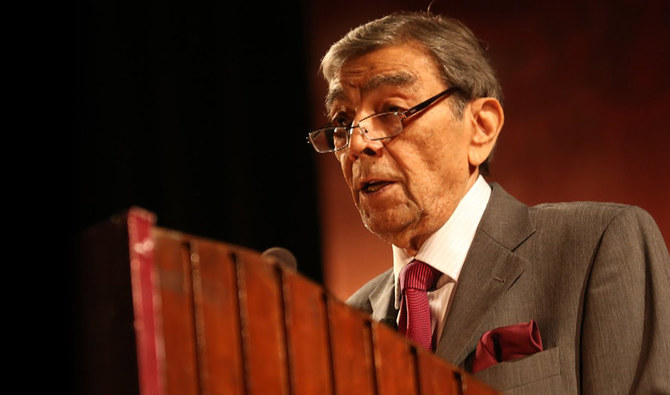

KARACHI: Zia Mohyeddin, a veteran British-Pakistani actor who made his Hollywood debut in the 1962 epic, “Lawrence of Arabia,” died on Monday at a hospital in Karachi.
Mohyeddin, 91, had been ill and was admitted to the intensive care unit of a private hospital in Pakistan’s commercial capital before he passed away on Monday morning.
Pakistanis across the country mourned his passing, with Prime Minister Shehbaz Sharif describing his art as “one of a kind.”
“Zia Sahib’s personality was full of wonderful qualities. He mesmerized people for more than half a century with his unparalleled skills in theatre, broadcasting and oratory and the magic of his voice. Hundreds of students under his tutelage will keep his legacy alive,” Sharif said on Twitter.
The Ministry of Information and Broadcasting said he was “a true icon of Pakistan’s art and culture,” adding that his contributions to the country and the arts would never be forgotten.
Born in the eastern Pakistani city of Faisalabad, Mohyeddin spent his early years in Lahore and was trained at London’s Royal Academy of Dramatic Art from 1953 to 1956. He began his career in theater, making his debut at London’s West End in 1960 through the role of Dr. Aziz in “A Passage to India.”
In the 1962 blockbuster “Lawrence of Arabia,” he played the ill-fated Arab guide named Tafas. Directed by David Lean, the British epic historical drama is widely regarded as one of the greatest films ever made and won seven Oscars at the 1963 Academy Awards.
He was also seen in Behold the Pale Horse in 1964 by director Fred Zinnemann, and in Immaculate Conception in 1992, directed by amil Dehlavi. He also authored three books, A Carrot is a Carrot, Theatrics and The God of My Idolatry Memories, and Reflections.
Mohyeddin returned to Pakistan in the late 1960s and gained national popularity through a television talk show, “The Zia Mohyeddin Show,” which ran from 1969 until 1973.
“Mr. Zia’s life will be celebrated by many. He lived a long, happy, and healthy life. He kept working ‘till his last days and has left so much meaning behind to be cherished and take inspiration from. Mr. Zia will keep living as an immortal voice,” Pakistani screenwriter Bee Gul told Arab News.
Mohyeddin was also widely known for his poetry and prose recitations as well as acting and theatre direction, and one of his last works was directing the first Urdu adaptation of Shakespeare’s “Romeo and Juliet,” which was performed last year at the National Academy of Performing Arts, an organization Mohyeddin helped set up in 2005.
Uzma Sabeen, who assisted Mohyeddin during the recent production and knew him for over 15 years, said she was proud to have worked with him.
“I was fortunate to have worked with him. We learnt a new thing from him every day,” she told Arab News. “He was a gentleman who respected everyone, particularly women. He was a very genuine artist and a genuine human being. We never saw him speaking ill. He was a very honest person.”
Mohyeddin was awarded the Hilal-e-Imtiaz, the second-highest civilian honor in Pakistan, for his contributions to the arts, in 2012.
“The world of arts bids farewell to a maestro - Zia Mohyeddin - broadcasting legend, poetic virtuoso, actor, and theatre director,” Pakistani actor Adnan Siddiqui said on Twitter.
“As we celebrate his life and legacy, and mourn his loss, we are reminded of the immense impact he has had on our cultural landscape.”
The Rekhta Foundation, an archive of Urdu poetry and literature, said the news of Mohyeddin’s death came as a “huge shock leaving a void that cannot be filled.”


