

World Bank to mobilize $10 toward climate action for every $1 received in grant money

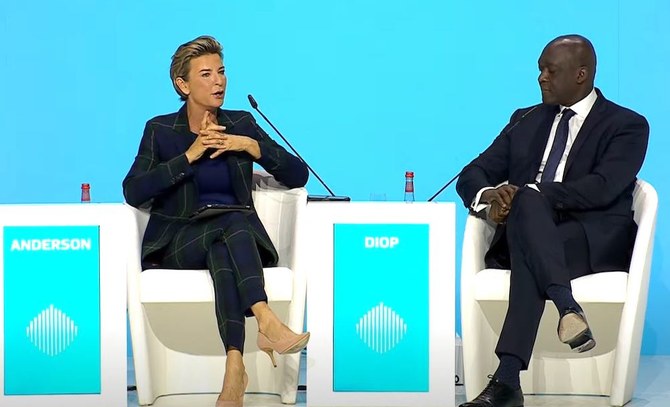
Makhtar Diop, managing director of the International Finance Corporation, said that the world doesn’t have a problem of resources but a problem of managing those resources. (Twitter: @DXBMediaOffice)
Short Url
Updated 13 February 2023
Follow

World Bank to mobilize $10 toward climate action for every $1 received in grant money

  • $1tn per year will be needed to exert energy transition in several countries, says International Finance Corporation managing director

DUBAI: For every $1 in grant money that the World Bank receives, it will mobilize $10 of its capital to invest in climate action, Makhtar Diop, managing director of the International Finance Corporation, told the World Government Summit on Monday.

“If we manage to have a bit more of investment of grant money, then we will be able to multiply investment significantly,” Diop told CNN’s Becky Anderson in a session titled “Investing in a sustainable future: the role of climate finance.”

Anderson said the climate crisis is one of the most pressing issues of our time.

“Mobilizing private capital alongside private policy is absolutely critical to transforming the world economy and putting us on a path to net zero by 2050. To reach that goal… as much as $9 trillion in investment is needed, every year. That’s one estimate. If you are more conservative, you might say it’s $6 or $7 (trillion), but that’s an awful lot of money, and 60 percent of those investment needs are in emerging markets. These markets are frankly starved of capital,” she said.

When asked about the funding gap for emerging markets and what should be done about it, Diop said: “The world doesn’t have a problem of resources but a problem of managing those resources to make sure we are using renewable energy…We also have a problem of managing the existing liquidity in the world and directing it to productive investment.”

Diop said it is estimated that $1 trillion per year will be needed to exert energy transition in many countries. What is missing, he explained, is a bankable project and liability for the private sector to assess the risk properly.

There are many factors, such as natural disasters and wars, that are rendering it difficult for investors to make decisions.

Diop said there is a need to de-risk those investments, which is what the IFC is trying to do by implementing a mechanism whereby bankable projects are brought together under one platform to simplify procedures.

Diop revealed that he is signing with the Abu Dhabi Development Fund an agreement to create a platform of $1.5 billion where both parties will co-invest in emerging countries around energy transition.

“Today, when we talk about green hydrogen, which is a new source of energy, it is mainly located in developing countries where you have the sun and hydro (power) in quantity,” said Diop.

These countries, he explained, “could become (exporters) of energy and (contribute) to the global public goods solution.”

Diop revealed that the World Bank Group is discussing an “evolution roadmap” to determine what more can be done to support energy transition and help countries fight climate change.

“This is a conversation that will require mobilizing more money because part of the resources of the WB Group are raised on the capital market and…not grant money,” he said.

What is needed, he explained, is certain technology that is currently expensive or the ability to invest in areas that are considered riskier in order to obtain more grant money.


UN chief condemns Israeli law blocking electricity, water for UNRWA facilities

Updated 01 January 2026
Follow

UN chief condemns Israeli law blocking electricity, water for UNRWA facilities

  • The agency provides education, health and aid to millions of Palestinians in Gaza, the West Bank, Jordan, Lebanon and Syria

United Nations Secretary General Antonio Guterres condemned on Wednesday a move by Israel to ban electricity or water to facilities owned by the UN Palestinian refugee agency, ​a UN spokesperson said.
The spokesperson said the move would “further impede” the agency’s ability to operate and carry out activities.
“The Convention on the Privileges and Immunities of the United Nations remains applicable to UNRWA (United Nations Relief and Works Agency for Palestine Refugees in the Near East), its property and assets, and to its officials and other personnel. Property used ‌by UNRWA ‌is inviolable,” Stephane Dujarric, spokesman for the ‌secretary-general, ⁠said ​while ‌adding that UNRWA is an “integral” part of the world body.
UNRWA Commissioner General Phillipe Lazzarini also condemned the move, saying that it was part of an ongoing “ systematic campaign to discredit  UNRWA and thereby obstruct” the role it plays in providing assistance to Palestinian refugees.
In 2024, the Israeli parliament passed a law banning the agency from operating in ⁠the country and prohibiting officials from having contact with the agency.
As a ‌result, UNRWA operates in East Jerusalem, ‍which the UN considers territory occupied ‍by Israel. Israel considers all Jerusalem to be part ‍of the country.
The agency provides education, health and aid to millions of Palestinians in Gaza, the West Bank, Jordan, Lebanon and Syria. It has long had tense relations with Israel but ties have deteriorated ​sharply since the start of the war in Gaza and Israel has called repeatedly for UNRWA to ⁠be disbanded, with its responsibilities transferred to other UN agencies.
The prohibition of basic utilities to the UN agency came as Israel also suspended of dozens of international non-governmental organizations working in Gaza due to a failure to meet new rules to vet those groups.
In a joint statement, Canada, Denmark, Finland, France, Iceland, Japan, Norway, Sweden, Switzerland and the United Kingdom said on Tuesday such a move would have a severe impact on the access of essential services, including health care. They said one in ‌three health care facilities in Gaza would close if international NGO operations stopped.