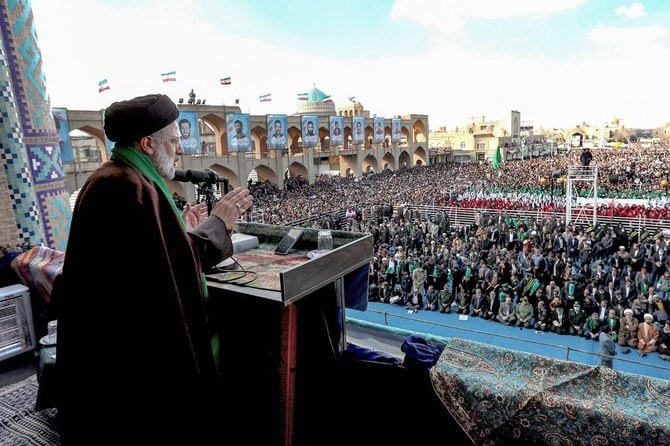

PARIS: Digital activists supporting anti-government protests in Iran said they hacked an online broadcast by state television of a speech by President Ebrahim Raisi on Saturday marking the 1979 Islamic Revolution.
The Edalat-e Ali group posted a video of the purported interruption of Raisi’s address on Twitter, in which it called on Iranians to withdraw their money from “corrupt” regime banks and to take to the streets next week.
“Death to Khamenei,” “Death to the Islamic Revolution,” and “Death to the Islamic republic,” it said on Twitter.
“Many compatriots approached us and asked us to echo the call (for protests) on February 16,” added the group, in its second such reported hacking of state television in support of months-long anti-government protests.
In October, Edalat-e Ali interrupted a live state television broadcast of Iran’s supreme leader Ayatollah Ali Khamenei meeting state officials, with text on the screen that read “the blood of our youths is on your hands.”
Iran erupted into nationwide protests in September, after the death of 22-year-old Mahsa Amini following her arrest for an alleged breach of the Islamic republic’s strict dress code for women.
The protests evolved into the biggest challenge for the clerical leadership since the revolution, before subsiding at the end of the year in the face of a deadly crackdown.
The regime has sought to portray the protest movement as “riots” backed by its Western enemies including the United States, Israel and Britain.
Speaking at a rally in Tehran’s Azadi Square on Saturday to mark the anniversary, Raisi said people had gathered to renew their “allegiance” to the revolution.
Oslo-based group Iran Human Rights says the regime’s security forces have killed at least 488 protesters in the crackdown, including 64 children and 39 women.
The non-governmental organization says thousands more have been arrested over the demonstrations and four have been executed, with at least another 107 facing the death penalty.
Iran says hundreds of people have been killed in the protests, including dozens of security personnel.
It recently freed jailed journalists and rights activists, many of whom were arrested during the protests that flared over Amini’s death in the custody of the notorious morality police.