

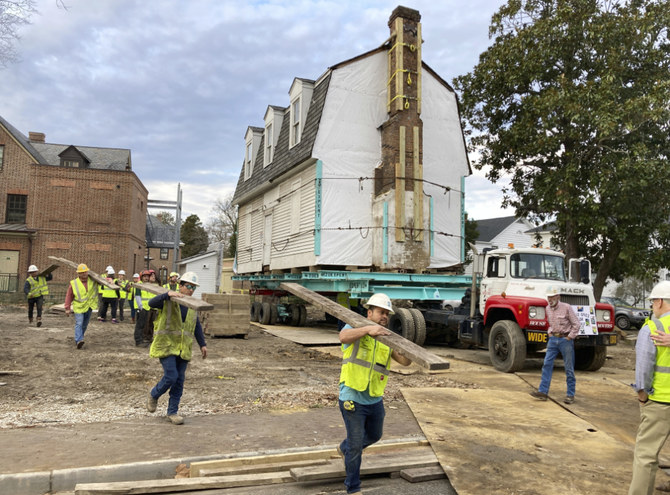

WILLIAMSBURG, Virginia: A building believed to be the oldest surviving schoolhouse for Black children in the US was hoisted onto a flatbed truck and moved a half-mile Friday to Colonial Williamsburg, a Virginia museum that continues to expand its emphasis on African American history.
Built 25 years before the American Revolution, the original structure stood near the college campus of William & Mary. The pinewood building held as many as 30 students at a time, some of them free Black children studying alongside the enslaved.
Hundreds of people lined the streets to celebrate its slow-speed trip into the heart of the living history museum, which tells the story of Virginia’s colonial capital through interpreters and restored buildings.

Employees of Colonial Williamsburg talk as what is believed to be the oldest schoolhouse for Black children in the United States is slowly moved down a street in Williamsburg, Va., to the living history museum, Friday Feb. 10, 2023. (AP)
For historians and descendants alike, the Bray School contradicts the belief that all enslaved Americans were uneducated. But the school’s faith-based curriculum — created by an English charity — also justified slavery and encouraged students to accept their fate as God’s plan.
“Religion was at the heart of the school, and it was not a gospel of abolition,” said Maureen Elgersman Lee, director of William & Mary’s Bray School Lab.
“There was this need to proselytize and to bring salvation while still not doing anything to destabilize the institution of slavery,” Lee said. “Save the soul, but continue to enslave the body. It was the here versus the hereafter.”
It was a brand of duplicity that fit easily into the larger contradictions of the country’s founding, when the Democracy being forged explicitly denied rights and freedoms to many of its people.
Williamsburg is less than 10 miles from Jamestown, which England established in 1607. The colony was supplied with enslaved Africans for labor just a dozen years later. A century and half after that, Black people, most of them still enslaved, represented just over half of Williamsburg’s 2,000 people.
The Bray School was established in 1760 at the recommendation of Benjamin Franklin, chairman of a London-based Anglican charity named after philanthropist Reverend Thomas Bray. The charity also set up schools in other cities, including New York and Philadelphia.
The curriculum ranged from spellers to the Book of Common Prayer. But even within the schools’ paternalistic framework, the education could still be empowering, perhaps even subversive.
“I was going through a facsimile of one of the books, and there are words like ‘liberty,’” Lee said. “What did learning those words do to expand these children’s sense of themselves? Their sense of the world?”
Isaac Bee, a Bray School student, would run away as an adult from a slave owner named Lewis Burwell. An ad that Burwell placed in The Virginia Gazette in 1774 offered a cash bounty for his return and warned that Bee could read.
The white teacher, a widow named Ann Wager, lived upstairs at the school, and taught an estimated 300 to 400 students, whose ages ranged from 3 to 10, according to surviving records.
The Williamsburg Bray School operated until 1774; only Philadelphia’s reopened after the Revolutionary War. The structure became a private home for many years before it was incorporated into William & Mary’s campus.
The former schoolhouse eventually was moved from its original spot to make way for a dormitory. The original structure had 1.5 stories, with a small upstairs. It was expanded over the years to include two full stories, and was last used as an office for ROTC, the college program that prepares military officers.
Historians believed they had identified the original Bray School building, but it wasn’t confirmed until 2021, through the use of dendrochronology, a scientific method that examines tree rings in lumber to determine the wood’s harvest date.
“This is a remarkable story of survival,” said Matthew Webster, Colonial Williamsburg’s executive director of architectural preservation and research. “And for us, it’s so important to put it back (to its original state) and tell the full and true story.”
The Bray School was exceptional: Although Virginia waited until the 1800s to impose anti-literacy laws, white leaders across much of Colonial America forbid educating enslaved people, fearing literacy would encourage their liberty. South Carolina criminalized teaching slaves to write English in 1740.
Inside the schoolhouse, the original post at the bottom of the walnut staircase still stands, its square top rounded and nicked from centuries of use, Webster said, adding that it’s a “very powerful piece for a lot of people.”
For Tonia Merideth, the Bray School Lab’s oral historian, the building stirred up many emotions upon her first visit. It was material proof against the narrative that her ancestors were illiterate and dumb.
“Everything that I learned about my ancestors was wrong,” she said. “They could learn. They did learn. They were able.”
Merideth added: “Regardless of the intentions of the school, the children were still taking that education and possibly serving it for their own good and aiding in their community.”
Merideth can trace her roots to the Armistead family, which enslaved people in the Williamsburg area and is known to have sent at least one child, named Locust, to the Bray School. But only three years of student lists have survived.
The moving of the Bray School is part of Colonial Williamsburg’s ongoing reckoning over its past storytelling of Black history and the nation’s origin story. The museum was founded in 1926 but did not tell Black stories until 1979.
In 2021, it uncovered the brick foundation of one of the nation’s oldest Black churches. Last year, archaeologists began to excavate graves at the site.
The Bray School’s new location is right next door.
“We’re going back and we’re getting that school and we’re getting that legacy,” Merideth said. “And we’re bringing it back to the historic area.”


