US fighter jet shoots down unidentified, cylindrical object over Canada

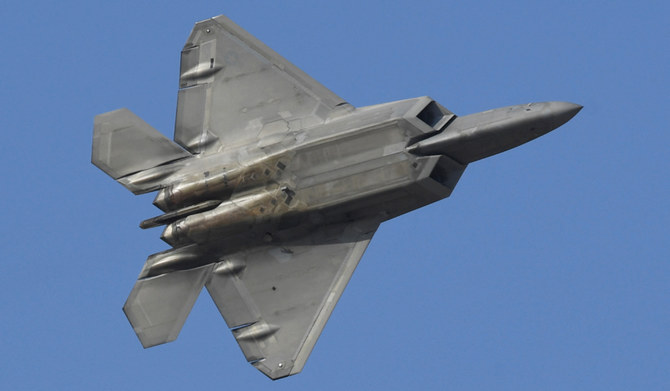
F-22 fighter jets have now taken out three objects in the airspace above the US and Canada over seven days. (AFP)
Short Url
Updated 12 February 2023
Follow

US fighter jet shoots down unidentified, cylindrical object over Canada

  • US and Canadian planes flew together to take on the object Saturday, the US Department of Defense said

WASHINGTON/OTTAWA: A US F-22 fighter jet shot down an unidentified cylindrical object over Canada on Saturday, the second such shootdown in as many days, as North America appeared on heightened alert following a week-long Chinese spying balloon saga that drew the global spotlight.
Canada Prime Minister Justin Trudeau first announced the shootdown over the Yukon territory in the country’s north and said Canadian forces would recover and analyze the wreckage.
Canadian Defense Minister Anita Anand declined to speculate about the origin of the object, which she said was cylindrical in shape. She stopped short of describing it as a balloon but said it was smaller than the Chinese balloon shot down off South Carolina’s coast a week ago, but similar in appearance. She said it was flying at 40,000 feet and posed a risk to civilian air traffic when it was shot down at 3:41 EST (2041 GMT).
“There is no reason to believe that the impact of the object in Canadian territory is of any public concern,” Anand told a news conference.
The Pentagon said the North American Aerospace Defense Command (NORAD) detected the object over Alaska late Friday evening. US fighter jets from Joint Base Elmendorf-Richardson, Alaska, monitored the object as it crossed over into Canadian airspace, where Canadian CF-18 and CP-140 aircraft joined the formation.
“A US F-22 shot down the object in Canadian territory using an AIM 9X missile following close coordination between US and Canadian authorities,” Pentagon spokesman Brig. Gen. Patrick Ryder said in a statement.
US President Joe Biden authorized the US military to work with Canada to take down the high-altitude craft after a call between Biden and Trudeau, the Pentagon said. The White House said Biden and Trudeau agreed to continue close coordination to “defend our airspace.”
“The leaders discussed the importance of recovering the object in order to determine more details on its purpose or origin,” the White House said in a statement.
A day earlier, Biden ordered another shootdown of an unidentified flying object near Deadhorse, Alaska. The US military on Saturday remained tight-lipped about what, if anything, it had learned as recovery efforts were underway on the Alaskan sea ice.
The Pentagon on Friday offered only a few details, including that the object was the size of a small car, it was flying at about 40,000 feet and could not maneuver and appeared to be unmanned. US officials have been trying to learn about the object since it was first spotted on Thursday.
“We have no further details at this time about the object, including its capabilities, purpose, or origin,” Northern Command said on Saturday.
It noted difficult arctic weather conditions, including wind chill, snow, and limited daylight that can hinder search and recovery efforts.
“Personnel will adjust recovery operations to maintain safety,” Northern Command said.
On Feb. 4, a US F-22 fighter jet brought down what the US government called a Chinese surveillance balloon off the coast of South Carolina following its week-long journey across the United States and portions of Canada. China’s government has said it was a civilian research vessel.
Some US lawmakers criticized Biden for not shooting down the Chinese balloon sooner. The US military had recommended waiting until it was over the ocean out of fear of injuries from falling debris.
US personnel have been scouring the ocean to recover debris and the undercarriage of electronic gadgetry since the shootdown of the 200-foot-tall (60-meter-high) Chinese high-altitude surveillance balloon.
The Pentagon has said a significant amount of the balloon had already been recovered or located, suggesting American officials may soon have more information about any Chinese espionage capabilities aboard the vessel.
Sea conditions on Feb. 10 “permitted dive and underwater unmanned vehicle (UUV) activities and the retrieval of additional debris from the sea floor,” Northern Command said.
“The public may see US Navy vessels moving to and from the site as they conduct offload and resupply activities.”


Venezuelans await political prisoners’ release after government vow

Updated 6 sec ago
Follow

Venezuelans await political prisoners’ release after government vow

  • Rights groups estimate there are 800 to 1,200 political prisoners held in Venezuela

CARACAS: Venezuelans waited Sunday for more political prisoners to be freed as ousted president Nicolas Maduro defiantly claimed from his US jail cell that he was “doing well” after being seized by US forces a week ago.
The government of interim president Delcy Rodriguez on Thursday began to release prisoners jailed under Maduro in a gesture of openness, after pledging to cooperate with Washington over its demands for Venezuelan oil.
The government said a “large” number would be released — but rights groups and the opposition say only about 20 have walked free since, including several prominent opposition figures.
Rights groups estimate there are 800 to 1,200 political prisoners held in Venezuela.
Rodriguez, vice president under Maduro, said Venezuela would take “the diplomatic route” with Washington, after Trump claimed the United States was “in charge” of the South American country.
“Venezuela has started the process, in a BIG WAY, of releasing their political prisoners. Thank you!” Trump said in a post late Saturday on his Truth Social platform.
“I hope those prisoners will remember how lucky they got that the USA came along and did what had to be done.”
Maduro and his wife Cilia Flores were captured in a dramatic January 3 raid and taken to New York to stand trial on drug-trafficking and weapons charges, to which they pleaded not guilty.

Anxiety over prisoners

A detained police officer accused of “treason” against Venezuela died in state custody after a stroke and heart attack, the state prosecution service confirmed on Sunday.
Opposition groups said the man, Edison Jose Torres Fernandez, 52, had shared messages critical of Maduro’s government.
“We directly hold the regime of Delcy Rodriguez responsible for this death,” Justice First, part of the Venezuelan opposition alliance, said on X.
Families on Saturday night held candlelight vigils outside El Rodeo prison east of Caracas and El Helicoide, a notorious jail run by the intelligence services, holding signs with the names of their imprisoned relatives.
Prisoners include Freddy Superlano, a close ally of opposition figurehead Maria Corina Machado. He was jailed after challenging Maduro’s widely contested re-election in 2024.
“He is alive — that was what I was most afraid about,” Superlano’s wife Aurora Silva told reporters.
“He is standing strong and I am sure he is going to come out soon.”
Maduro meanwhile claimed he was “doing well” in jail in New York, his son Nicolas Maduro Guerra said in a video released Saturday by his party.
The ex-leader’s supporters rallied in Caracas on Saturday but the demonstrations were far smaller than Maduro’s camp had mustered in the past, and top figures from his government were notably absent.
The caretaker president has moved to placate the powerful pro-Maduro base by insisting Venezuela is not “subordinate” to Washington.

Pressure on Cuba

Vowing to secure US access to Venezuela’s vast crude reserves, Trump pressed top oil executives at a White House meeting on Friday to invest in Venezuela, but was met with a cautious reception.
Experts say Venezuela’s oil infrastructure is creaky after years of mismanagement and sanctions.
Washington has also confirmed that US envoys visited Caracas on Friday to discuss reopening their embassy there.
Trump on Sunday pressured Caracas’s leftist ally Cuba, which has survived in recent years under a US embargo thanks to cheap Venezuelan oil imports.
He urged Cuba to “make a deal” or face unspecified consequences, warning that the flow of Venezuelan oil and money to Havana would stop now that Maduro was gone.
Cuba’s President Miguel Diaz-Canel retorted on X that the Caribbean island was “ready to defend the homeland to the last drop of blood.”
“No one tells us what to do.”
Venezuela’s government in a statement called for “political and diplomatic dialogue” between Washington and Havana.
“International relations should be governed by the principals of international law — non-interference, sovereign equality of states and the right of peoples to govern themselves.”