

Saudi Arabia’s 6th relief plane arrives in Gaziantep to assist earthquake victims

1 / 5
Saudi Arabia’s KSrelief operates an air bridge to assist those affected by 7.8 magnitude earthquake in Turkiye. (SPA)
2 / 5
Saudi Arabia’s KSrelief operates an air bridge to assist those affected by 7.8 magnitude earthquake in Turkiye. (SPA)
3 / 5
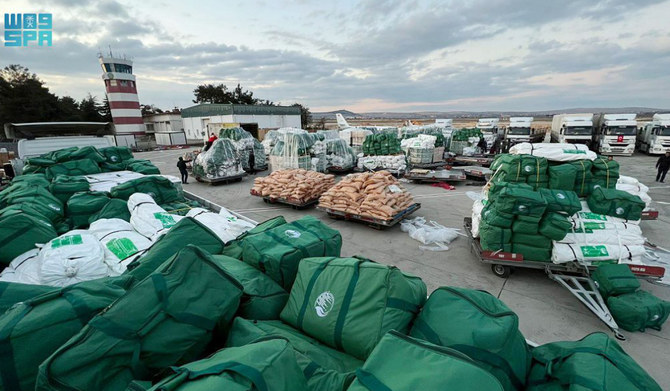
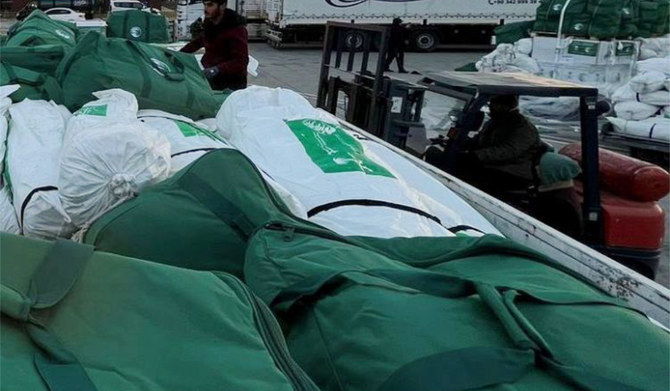
The sixth plane contained 98 tons of aid, including food items, tents, blankets, rugs, shelter bags and medical supplies. (SPA)
4 / 5
The fourth and fifth planes, carrying rescue teams and equipment including tools, pumps and medical supplies, landed at the Gaziantep airport in Turkiye. (SPA)
5 / 5
Saudi Arabia’s KSrelief operates an air bridge to assist those affected by 7.8 magnitude earthquake in Turkiye. (SPA)
Short Url
Updated 11 February 2023
Follow

Saudi Arabia’s 6th relief plane arrives in Gaziantep to assist earthquake victims

  • Aid includes food and beverages, tents, blankets, medical supplies
  • A statement from the Saudi embassy in Turkiye said that the body of a missing Saudi female was found under the rubble of a building in Antakya

RIYADH: The sixth Saudi relief plane arrived at Gaziantep Airport in Turkiye, carrying 98 tons of relief aid, in implementation of the directives by King Salman and Crown Prince Mohammed bin Salman.

The aid provided by the Kingdom includes food and beverages, tents, blankets, rugs, shelter bags and medical supplies.

After the 7.8 magnitude earthquake hit Turkiye and Syria on Feb. 6, the King Salman Humanitarian Aid and Relief Center began operating an air bridge to assist those affected.

On Friday, the fourth and fifth planes, carrying rescue teams and equipment including tools, pumps and medical supplies, landed at the Gaziantep Airport in Turkiye.

The Saudi search and rescue teams came from the General Directorate of Civil Defense, the Saudi Red Crescent Authority and various volunteer groups.

HIGHLIGHT

A statement from the Saudi Embassy in Turkiye said that the body of a missing Saudi female was found under the rubble of a building in Antakya, where she lived. The deceased’s body was identified in the presence of a representative from the embassy and some of her family members, the statement noted.

The third cargo plane loaded with relief supplies from Saudi Arabia also arrived at Gaziantep Airport on Friday, carrying 104.6 tons of items including foodstuff, tents, blankets, rugs, shelter bags and medical supplies.

Samer Al-Jutaily, KSrelief’s official spokesman, reported live on Friday from Gaziantep, saying that “the city has been damaged along with other big cities such as Antakya and the surrounding areas.”

Al-Jutaily said that KSrelief’s medical and rescue volunteers, who arrived on Friday in Gaziantep, are receiving basic equipment that will help in extracting the victims from beneath the rubble.

“More than 10 people are trapped alive under the rubble and the volunteering teams are trying as much as possible to get these people out,” he reported. Another building is believed to have about 60 or more persons stuck under the wreckage.

Al-Jutaily spoke about the dire situation on the ground. “They desperately need your help, and together we will save these lives. With this gift from the leadership of the Kingdom of Saudi Arabia and from the Saudi people, we can make a difference in the lives of these people, and we will provide them with help and heal their wounds,” he said.

The first KSrelief plane landed at Adana Airport in Turkiye on Feb. 9.

Head of KSrelief’s emergency relief department Fahad Al-Osaimi said that the organization’s mission is to provide humanitarian aid and “direct support through rescue teams and medical teams,” as well as through projects that will be implemented “in all areas affected by the earthquake.”

Meanwhile, a statement from the Saudi Embassy in Turkiye said that the body of a missing Saudi female was found under the rubble of a building in Antakya, where she lived.

The deceased’s body was identified in the presence of a representative from the embassy and some of her family members, the statement noted.


Experimental farm in Al-Lith looks into future of Saudi Arabian agriculture

Updated 02 February 2026
Follow

Experimental farm in Al-Lith looks into future of Saudi Arabian agriculture

  • Research initiative reflects strategic transformation

JEDDAH: An experimental farm in Saudi Arabia’s Al-Lith Governorate is one of the research initiatives reflecting the strategic transformation taking place in the Kingdom’s agricultural sector.

The farm uses highly efficient, sustainable production models that combine scientific research with commercial application, contributing to strengthening the country’s food security system and the sustainability of water resources.

Located in the Ghumaiqa Center on an area of about 10 hectares, the cutting-edge farm is a testing platform for modern agricultural technologies that tackle the challenge of water scarcity.

The farm includes developed open fields and modern greenhouses, supported by smart irrigation encompassing drip and sprinkler irrigation alongside surface and subsurface technologies.

All the systems operate via smart controls that enable the monitoring of water consumption and ensure improved efficiency, thereby achieving a balance between agricultural production and water conservation.

The farm also uses treated and diluted low-salinity seawater.

It aims to diversify agricultural water sources, reduce reliance on freshwater, and open new horizons for agriculture in coastal and semi-arid environments.

A view of the experimental farm in Al-Lith. (SPA)

The project represents a promising investment opportunity in the field of smart agriculture, enabling the development of commercially scalable production models, particularly for high-value vegetables and fruits, while reducing operational costs associated with water and energy, enhancing the economic feasibility of future agricultural projects.

In addition, the project contributes to transferring and localizing agricultural expertise, supporting local food supply chains, and creating an attractive environment for agricultural investment.

This aligns with Sustainable Development Goals and enhances the efficiency of the private sector in adopting innovative agricultural solutions.

Yahya bin Abdulrahman Al-Mahabi, the director of the Ministry of Environment, Water and Agriculture office in Al-Lith Governorate, told the Saudi Press Agency that the project represented the future of agriculture in the Kingdom.

He explained that the vision was based on investing in technology, enhancing the return on water per unit, and integrating scientific research with investment opportunities.

Al-Mahabi spoke of the experimental farm as a modern, scalable and replicable model applicable in several regions of the Kingdom, particularly in coastal environments.

Al-Mahabi highlighted the Ministry of Environment, Water and Agriculture’s commitment to supporting distinctive projects that contributed to achieving food security while developing rural areas and enhancing agricultural production efficiency, in line with the objectives of the Kingdom’s Vision 2030.