

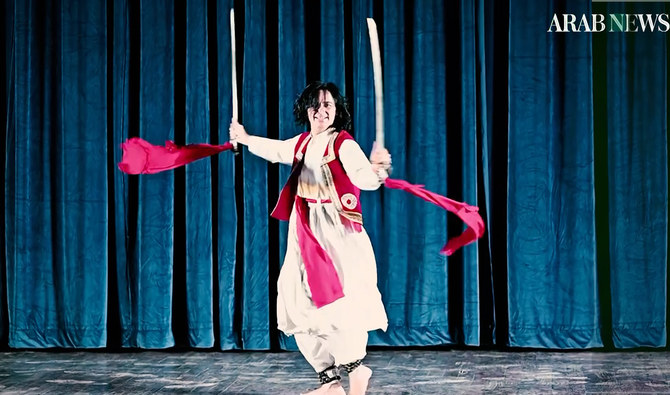

KARACHI: The descendent of a 17th century Pashtun warrior-poet is channeling his ancestor’s evolutionary words into a new “dance of peace” that he has created by fusing the rhythms of Indian Kathak with a martial dance form his tribe has been performing for centuries.
Meet Khanzada Asfandyar Khattak, the 12th generation descendent of Khushal Khan Khattak, widely regarded as the father of Pashto literature. The poet served as a military commander in the Mughal empire but later led a revolution against the regime, reuniting and empowering Pashtun tribes among whom his revolutionary poetry is still popular today.
Since he was a child, Khattak’s great grandson Asfandyar has been practicing the Khattak Attan, a swift martial dance usually performed with a sword and a handkerchief by Pashtun tribesmen. The centuries-old dance form used to be part of war-preparation exercises and to this day is considered an integral part of Pashtunwali, the Pashtuns’ common code of social values, and the group’s collective identity.
When he enrolled in graduate school, Asfandyar also began to learn Kathak and today, when he performs, he combines the Indian dance form’s emphasis on powerful, stamping footwork with the swift use of swords and handkerchiefs to create a “Khattak-Kathak combination” he calls his “dance of peace.”
“This sword which I use in my Khattak-Kathak combination, it’s actually to fight against the negativity in our society, all the injustice in our society, and the handkerchiefs have the purpose of spreading love,” Asfandyar, 40, said in an interview to Arab News during a visit to Karachi this week from Islamabad where he runs a not-for-profit dance school.
While learning the Khattak Attan was part of his childhood, Asfandyar has trained in Kathak with greats like Indu Mitha and Nighat Chaudhry, both Presidential Pride of Performance award winners, and Saima Khushnood, who is affiliated with the film industry of Pakistan.
“When I learnt Kathak, I thought to myself that because I am Afghan, because I am Pathan, Pashtun and Khattak, why not bring my own color to this Kathak,” Asfandyar said.
“So, I fused Kathak dance with my own tribal Khattak dance. I brought in swords, I brought in red handkerchiefs.”
Asfandyar has also introduced other innovations, such as swapping traditional Khattak robes for a Mongolian Turk Mughal dress, and wearing ankle bracelets with jingle bells called ghungroo that are integral to Kathak.
The poetry Asfandyar dances to is that of his ancestor Khushal Khan Khattak, which he said carried powerful messages that gave him the courage to keep “following my passion.”
He recited one of the poet’s most famous Pashto couplets, about rebelling against moral censure: “Sheikh zamong roja kra za ba dakay pialay akhlam, har saray peda de khpal khpal kar lara kana” (“Let the pious fast and pray, I’ll have goblets full of wine instead”).
“I think that he was a very revolutionary poet and his poetry gives me the willpower to dance more and more,” Asfandyar said. “Maybe God created Khushal Khan Khattak for his poetry, and to fight for the rights of his countrymen and his tribesmen. And maybe God created me for dance.”
And there is a purpose to his performances, said the dancer, who uses his craft as a form of activism, to create awareness about human and women’s rights and climate change.
“In this I bring in topics of human rights, I bring in topics of climate change, I bring in topics like floods, our country was badly affected by floods [recently],” he said. “Through dance, through music, through art, you can give people a purpose, you can just touch their hearts. To touch their hearts I use Khattak and Kathak.”
And Asfandyar takes Kathak’s roots in storytelling very seriously.
The dance form originated within Hindu temples that brought to life epic tales from the holy scriptures of Mahabharata and Ramayana, which became popular when Indian bards traveled the length and breadth of the country during the medieval era, expertly combining poetry with rhythmic movement of the body to bring to life storied tales of war, romance, brotherhood and more.
The story Asfandyar wants to tell with his fusion dance is one of harmony, of showing that even weapons can be instruments of peace:
“A weapon when it’s used for hatred, when it’s used for war, I’m against that, I think that any weapon or any tool should be used for love, and these swords which I use are for love or for oneness. Life is too short and we need to live in peace and harmony.”


