

Crisis-hit Pakistan’s macro-economic indicators 

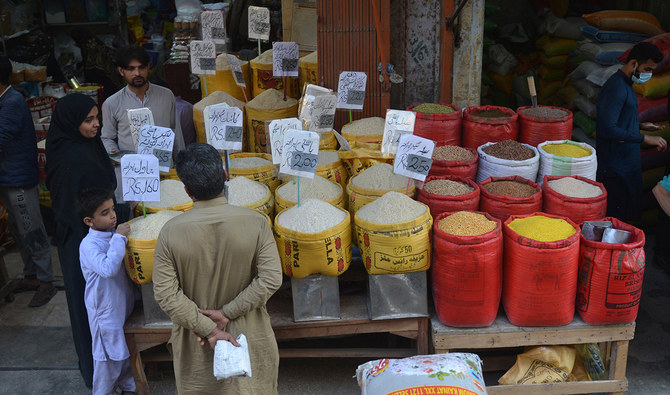
People buy pulses and grains at a wholesale market in Karachi on February 1, 2023. (Photo courtesy: AFP/FILE)
Short Url
Updated 10 February 2023
Follow

Crisis-hit Pakistan’s macro-economic indicators 

  • Pakistan’s foreign exchange reserves have fallen to the lowest level in 10 years 
  • Inflation, current account deficit, currency depreciation remain other top issues 

The International Monetary Fund has asked for more time for negotiations with Pakistan over a deal that would unlock much-needed funds from a $6.5 billion program. 

Below are four key economic indicators of the cash-strapped country. 

Forex reserves 

Pakistan’s foreign exchange reserves have fallen to the lowest level in 10 years and cover only three weeks’ worth of imports. In the week ending Jan. 27, the central bank’s foreign currency reserves shrank to $3.09 billion, down $592 million from previous week. 

Inflation 

Inflation has averaged at a record high 25.4 percent for the seven months of the current fiscal year that started last July compared to 10.3 percent in the same period in the previous fiscal year. The consumer price index rose 27.5 percent year-on-year in January, the highest in nearly half a century. 

Last month, the central bank raised its key interest rate by 100 basis points to 17 percent in a bid to rein in persistently high inflation, and said achieving price stability was key to attaining sustainable economic growth in the future. The bank has raised the key rate by a total 725 bps since January 2022. 

Current account deficit 

Pakistan’s current account deficit shrank to around $400 million in December 2022 from $1.9 billion a year earlier, as the government slashed imports in a bid to avert an external payments crisis. 

Pakistani rupee 

The rupee reached a record low of 276.58 to the dollar in the inter-bank market on Feb. 3. The rupee has dropped over 35 percent in the last 12 months. 


Ramadan tests Pakistan’s daily wage workers but faith endures

Updated 8 sec ago
Follow

Ramadan tests Pakistan’s daily wage workers but faith endures

  • Reduced work hours during fasting month cut already fragile incomes
  • Charities, local businesses step in as laborers try to support families back home

ISLAMABAD: Abdul Waqif grips a worn-out shovel and digs into the earth beneath the harsh midday sun, his body bent with age but still moving steadily. Moments later, the 70-year-old hoists a heavy bag of cement onto his shoulders and carries it toward an under-construction house, all while fasting.

For Waqif and thousands of daily wage laborers across Pakistan, Ramadan is not just a month of spiritual devotion. It is also a month of shrinking incomes.

Waqif migrated from Mohmand tribal district in northwestern Pakistan to Islamabad two decades ago in search of work. Like many laborers from rural and former tribal areas, he left behind limited local opportunities to earn a living in larger cities such as Islamabad, Lahore and Karachi.

In Pakistan, daily wage workers, particularly in construction and manual labor, are among the most economically vulnerable. They are paid only for days worked, receive no job security or benefits, and often rely on informal arrangements. Any slowdown in economic activity directly affects their ability to feed their families.

Economic activity typically slows during Ramadan, when Muslims fast from dawn to sunset. Employers often reduce work hours or postpone physically demanding projects to ease the burden on fasting workers. While intended as a gesture of consideration, it means fewer working hours and fewer earnings.

For laborers such as Waqif, who earns between Rs1,000-1,200 [$3.59-4.31] per day, even a slight reduction in work can be devastating.

His suhoor, the pre-dawn meal before fasting begins, usually consists of a few chapatis from a nearby hotel. The hunger and thirst that follow him through the day are constant companions as he lifts bricks and mixes cement in the heat.

But so is his faith.

“Allah gives me courage. I am hungry and thirsty, but I keep working,” Waqif said while wiping the sweat off his brow.

Back in Mohmand district, his wife, four daughters and two sons depend on the money he sends home. Every rupee matters.

“I support them with this work,” Waqif said. “I eat three meals a day here and I also have to save money for my children and send it to them.”

The reduction in work during Ramadan weighs heavily on him.

“I don’t find much work in Ramadan, and I’m worried for my family,” Waqif said.

‘HONEST LIVING’

Finding food for suhoor is sometimes a challenge. On some mornings, someone offers him a piece of flatbread. Other times, he buys what little he can afford from a nearby eatery.

Muhammad Sajid, owner of Al-Hadi restaurant in Islamabad’s G-15 sector, says he tries to ease that burden by offering meals to laborers at half price.

“We don’t let anyone go hungry,” Sajid told Arab News. “We offer sehri and iftar as much as anyone can afford.”

The restaurant serves tea, yogurt, several types of curries and parathas.

Charity groups also expand operations during Ramadan, when community support traditionally increases. The Junaid Welfare Foundation runs a roadside dastarkhwan, or communal meal spread, serving hundreds daily.

Haq Rawan Shareefi, a manager at the foundation, said around 500 people are provided iftar meals each day. The cost of one person’s iftar is Rs200 [$0.72].

“That means, on iftar and sehri, our expenses range from Rs150,000 [$538.97] to Rs200,000 [$718.63],” Shareefi said.

For Waqif, breaking his fast at sunset brings temporary relief from the physical strain of the day. But the financial uncertainty remains.

“I ask Allah for this,” he said. “May Allah give me strength to earn honest living for my children.”