Syria earthquake survivor: ‘Horror similar to doomsday, God help us’

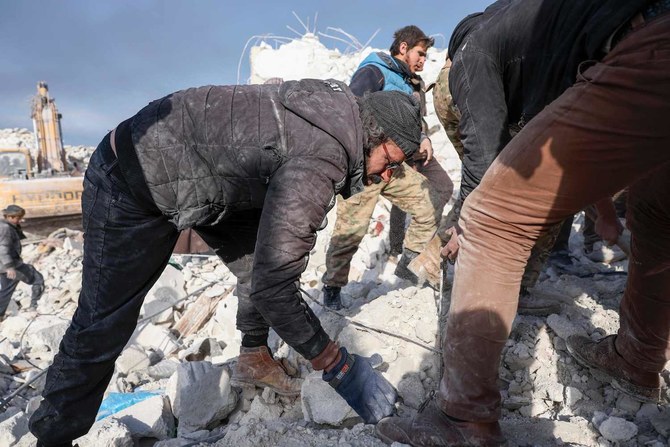
A Syrian man assists rescuers clear debris as he looks for family members still trapped in the rubble in the village of Besnaya, in Syria’s Idlib province. (AFP)
Short Url
Updated 10 February 2023
Follow

Syria earthquake survivor: ‘Horror similar to doomsday, God help us’

  • Yet to recover from the damages of the war, the natural tragedy has added a new layer of pain for displaced people
  • Time is ticking and the lack of advanced equipment and resources has complicated local rescue efforts

IDLIB: Search and rescue efforts are continuing in northwestern Syria, over 72 hours since an earthquake claimed the lives of over 1,900 people in the country, and left over 2,500 injured.

Experts expect these numbers to rise as hundreds of families remain missing under the rubble of toppled buildings.

One survivor from the city of Dana described to Arab News what he witnessed on Monday morning.

Mohamed Tata was woken by a rumbling sound and a powerful shake at 4:15 a.m. local time on Monday.

Moments later, he could hear a building falling. He was unsure whether it was the one he was in or the one next to it. It was only after the second shake that he rushed downstairs with his children.

“Are we shaking? Is the earth beneath us shaking? When we reached the street, we saw our neighbors and the buildings flattened to the ground. Men, women and kids crying and shouting. It was like a scene from doomsday” he told Arab News.

He recalled the screams of helpless children trapped underneath the rubble. “Heartbreaking, totally heartbreaking,” he said.

For some Syrians like Tata, the earthquake evoked a fear worse than that experienced during the 12-year civil war when cities and towns faced bombardment.

He told Arab News, “I went through the Aleppo bombing ... Planes used to bomb and shells hit the buildings … But I never felt fear in this way.”

Tata is one of the millions of Syrians internally displaced by the war.

“We left Aleppo and our friends and relatives there and we came here and got to know new friends and relatives only to lose them again. They are gone” said Tata as he broke down in tears.

Over the last few days, survivor accounts have become an accurate mirror of Syria’s plight.

Yet to recover from the damages of the war, the natural tragedy has added a new layer of pain to a wound that has not fully healed.

Obada Zikra, a member of the Syrian Civil Defense team from the town of Harem, had been working since the early hours of Monday when the magnitude 7.8 quake first hit.

“A humanitarian catastrophe has occurred,” he told Arab News.

Time is ticking and the lack of advanced equipment and resources has complicated local rescue efforts.

“We are facing great difficulties with the use of heavy machinery due to the large geographical area that has been affected,” he continues.

Zikra told Arab News that over 400 buildings have toppled to the ground.

In a desperate attempt to save survivors, many civilians have volunteered to work around the clock, getting hands-on with the debris.

Local rescue teams and survivors have sent pleas for more help from foreign governments and organizations.

“We appeal to the international community and all humanitarian organizations capable of helping to continue providing assistance to the Syrians afflicted by this catastrophe”, Zikra said.

The disaster has only exacerbated pre-existing difficulties. Syria’s political position and divisions caused by the country’s 12-year conflict have made it extremely difficult for international support to pour in.

In the wake of the current crisis, it is nearby neighbors that have rushed to its assistance.

Saudi Arabia is one of the many Arab countries to have responded rapidly with quake relief. The UAE has also dispatched a rescue team to help with the search in addition to the aid pledged.


Iran FM tells UN all military bases of ‘hostile forces’ legitimate targets

Updated 28 February 2026
Follow

Iran FM tells UN all military bases of ‘hostile forces’ legitimate targets

  • UN chief condemns escalation, calls for immediate return to negotiating table
  • Emergency session of Security Council set to convene on Saturday in New York

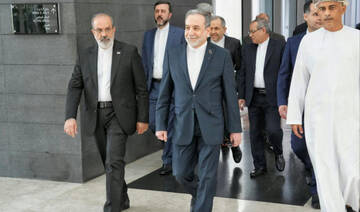
NEW YORK: Iran will use “all necessary defensive capabilities and means” to confront attacks by the US and Israel, and will treat “all bases, facilities, and assets of the hostile forces in the region” as legitimate military targets under its right to self-defense, Foreign Minister Abbas Araghchi said on Saturday.

In a letter to UN Secretary-General Antonio Guterres and the president of the Security Council, Araghchi said US and Israeli airstrikes are “a clear violation” of the UN Charter and amount to “an open armed aggression” against Iran.

Tehran is exercising its “inherent and lawful right of self-defense” under the UN Charter, he added.

The letter, seen by Arab News, accused the US and Israel of launching coordinated, large-scale attacks on Iranian territory, targeting defensive facilities and civilian sites in several cities.

Araghchi said Iran will continue to act “decisively and without hesitation until the aggression ceases fully and unequivocally,” adding that the US and Israel “shall bear full and direct responsibility for all ensuing consequences, including any escalation arising from their unlawful actions.”

He called on the 15-member Security Council to convene an emergency meeting to address a “breach of peace which is a real and serious threat to international peace and security,” and urged UN member states to “unequivocally condemn this act of aggression.”

An emergency session of the council is set to convene in New York on Saturday, requested by France, Bahrain, Colombia, China and Russia.

The Russian mission at the UN said in a statement that during the meeting, Moscow will demand that the US and Israel “immediately cease their illegal and escalatory actions and embark on a path toward a political and diplomatic settlement.” It added that “Russia is willing to provide all necessary assistance in this process.”

Meanwhile, Guterres condemned the military escalation, saying “the use of force by the United States and Israel against Iran, and the subsequent retaliation by Iran across the region, undermine international peace and security.”

The UN Charter clearly prohibits “the threat of the use of force against the territorial integrity or political independence of any state, or in any other manner inconsistent with the Purposes of the United Nations,” Guterres said in a statement.

He called for an immediate cessation of hostilities and de-escalation, and an immediate return to the negotiating table, adding that “failing to do so risks a wider regional conflict with grave consequences for civilians and regional stability.”

UN human rights chief Volker Turk also deplored the escalation and warned that civilians are the ones who end up paying “the ultimate price.”

He said: “Bombs and missiles are not the way to resolve differences but only result in death, destruction and human misery.”

Turk called for restraint and implored the parties “to see reason, to de-escalate, and (return) to the ‘negotiating table’ where they had been actively seeking a solution only hours earlier.”