BESNAYA, Syria: Malek Ibrahim made it out of his home after the earthquake hit Syria and thought he could breathe a sigh of relief. But 30 relatives were still unaccounted for elsewhere.
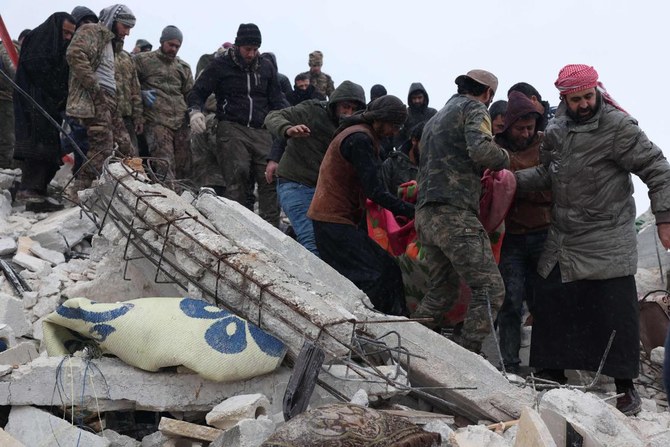
For the past two days, Ibrahim has been doggedly tearing at the rubble with his hands as he searches for family members who were buried when Monday’s deadly earthquake struck both Syria and Turkiye.
So far, he has managed to retrieve 10 bodies, helped by residents and rescuers in Besnaya, a village in the northwest on the Turkish border that was hard-hit by the disaster.
His uncle, his cousin and their families were all trapped under the debris.
“The whole family is gone. It’s complete genocide,” said the 40-year-old covered in dirt.
He, his wife and his children managed to get out of their home in Idlib city alive.
But he said he had little hope that any of his extended family members pinned down by the collapsed building in Besnaya had survived.
“Every time we recover a body, I remember the beautiful times that we spent together,” he said, weeping as he used a pickaxe to remove yet more wreckage.
Piles of rubble are now strewn across a once quiet and idyllic landscape dotted with olive trees.
“We used to have fun and joke around, but never again... I will never see them again.”
The earthquake killed more than 11,700 people, including more than 2,600 in war-torn Syria.
When the 7.8-magnitude quake hit at dawn on Monday, Ibrahim, his wife and eight children fled their home in Idlib, in the rebel-held northwest.
They had moved there from the southern part of the province after violence in Syria’s long-running war which has killed around half a million people and displaced millions more since 2011.
Ibrahim’s family stayed outside in the street for hours in the pouring rain, as dozens of buildings crumpled to the ground.
As soon as he heard that his family’s building in Besnaya had collapsed, he rushed the 40 kilometers (25 miles) from Idlib city.
“We dig without sleep, hoping that someone may be alive,” he said, although he knows in his heart that the chances of this are slim.
“It’s a feeling I can’t describe, a tragedy,” he said, “We are a doomed people in every sense of the word.”
The earthquake flattened entire blocks of buildings in Besnaya.
Dozens of residents, fighters and rescuers gathered on top of the ruins, digging through the rubble and calling out to any survivors underneath — in the hope that someone will respond.
They have cried with joy when they rescue a survivor, and consoled families anxiously awaiting news of trapped relatives.
Some 20 kilometers to the south, in the village of Ramadiya, Ayman Diri wept as he looked for his brother and eight nephews in the rubble.
After digging for hours, rescuers pulled out the body of his 12-year-old nephew.
Diri said he refused to give up hope that someone might be alive, especially after he managed to rescue others trapped under the collapsed building with the help of rescuers.
“All we can do is hope for the best... although we can see the state of the building,” he said, gazing at the pulverised concrete slabs.
“May God have mercy on my brother, whether he is alive or dead.”


![]()

Syrian man digs for 30 relatives buried by quake
Short Url
https://arab.news/yex8k
Syrian man digs for 30 relatives buried by quake
- So far, he has managed to retrieve 10 bodies, helped by residents and rescuers in Besnaya
- He, his wife and his children managed to get out of their home in Idlib city alive


Latest updates


© 2026 SAUDI RESEARCH & PUBLISHING COMPANY, All Rights Reserved And subject to Terms of Use Agreement.