

Saudi Hajj and Umrah Ministry showcases latest services at LEAP

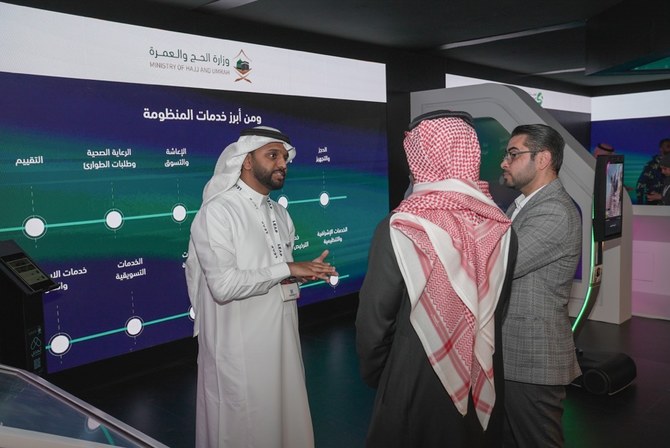
Visitors at the tech LEAP 2023 conference in Riyadh visit the Saudi Hajj and Ministry's booth to view its latest digital solutions. (Supplied)
Short Url
Updated 08 February 2023
Follow

Saudi Hajj and Umrah Ministry showcases latest services at LEAP

  • Digital measures to ease travel for visitors, pilgrims Visas allow touring of Kingdom’s cultural, spiritual sites

JEDDAH: The Saudi Ministry of Hajj and Umrah is showcasing its latest services for pilgrims at the LEAP 2023 conference in Riyadh.

This is the second time the ministry is participating in the tech conference, which has been organized by the Ministry of Communications and Information Technology in collaboration with the Saudi Federation for Cybersecurity, Programing, and Drones at the Riyadh Front Exhibition and Conference Center.

The four-day conference will conclude on Thursday.

According to the Hajj and Umrah Ministry, several initiatives have been introduced to ensure pilgrims can have a safe, secure and spiritually fulfilling journey to Makkah and Madinah.

The ministry’s pavilion at LEAP is displaying a number of digital solutions, which visitors can access via an interactive screen.

The ministry recently announced new measures that would allow visitors, with any type of visa, to perform Umrah, with no age restrictions, or the need for female worshippers to have a male guardian.

About 10 days ago, the Kingdom’s Foreign Ministry launched an electronic service that would allow passengers stopping over in the Kingdom to obtain entry visas. This would allow people to perform Umrah, visit the Prophet’s Mosque in Madinah, and tour the country.

The Hajj and Umrah Ministry said the Umrah visa’s validity has been extended from 30 days to 90 days, allowing holders to visit the Kingdom’s spiritual and cultural sites.

Speaking at the Hajj Expo 2023 held in Jeddah, Minister of Hajj and Umrah Tawfiq Al-Rabiah had said the number of people participating in this year’s Hajj would return to pre-pandemic levels.


Saudi program opens doors to historical research for local, international scholars

Updated 10 sec ago
Follow

Saudi program opens doors to historical research for local, international scholars

  • Starting in May, Darah’s International Visitor Program offers access to rare manuscripts, archival photos, and oral histories

Riyadh: The first session of the International Visitor Program for local and international researchers, organized by the King Abdulaziz Foundation for Research and Archives, known as Darah, will begin in May.

According to Turki Al-Shuwaier, CEO of Darah, the program is a strategic initiative aimed at supporting researchers from within and outside the Kingdom, enabling them to conduct qualitative studies that leverage Darah’s research resources and specialized expertise.

He told Arab News: “The program contributes to strengthening cooperation with academic institutions, research centers, and archival libraries locally and internationally, as well as promoting specialized knowledge production and providing a stimulating environment for the development of research and knowledge paths.”

The program seeks to foster constructive scientific cooperation and open new horizons for documenting national history, giving researchers access to rare documents, historical manuscripts, archival photographs, and oral recordings.

Al-Shuwaier said the program aims to support methodological diversity in handling historical sources and encourage the use of modern academic approaches that contribute to developing knowledge about the history of the Kingdom, the Arabian Peninsula, and the Arab and Islamic worlds.

He added: “Darah seeks to enable researchers to make the most of their research residency at the foundation, and we are keen to provide the necessary academic support and scientific supervision by our specialists, ensuring a successful research experience for all.”

The program targets a diverse range of qualified researchers, including faculty members, graduate students, and specialists in relevant fields. It lasts between one and three months and is extendable “according to a scientific evaluation mechanism.”

Al-Shuwaier noted that Darah is leveraging its capabilities to support serious scientific research, concluding: “Through this program, we seek to contribute to enriching historical knowledge and promoting awareness of the importance of heritage and history in shaping the future.”