

Former military ruler Gen. Musharraf buried in Karachi amid tight security measures

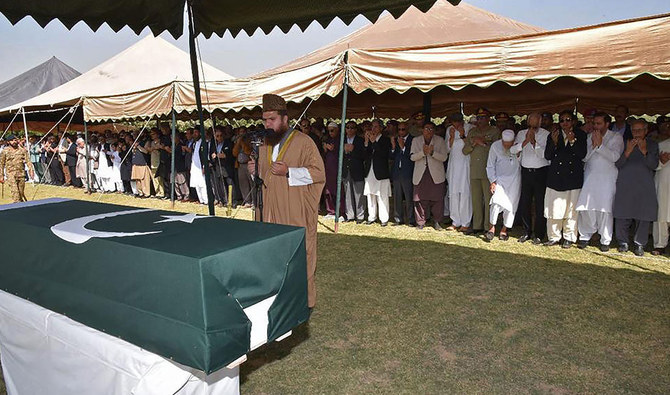
This handout photograph taken on February 7, 2023 and released by Pakistan's Inter-Services Public Relations (ISPR) shows military officials and others offering funeral prayers in front of the coffin of former military ruler Pervez Musharraf, in Karachi. (AFP/Pakistan's Inter-Services Public Relations (ISPR)
Short Url
Updated 07 February 2023
Follow

Former military ruler Gen. Musharraf buried in Karachi amid tight security measures

  • Top military leadership, former army chiefs and politicians attend the funeral at Malir garrison
  • In 1999, after a military career spanning 38 years, Musharraf took power in Pakistan in a bloodless coup

KARACHI: Top military leaders and politicians attended the funeral prayers of former Pakistani president and army chief, General Pervez Musharraf, at a military garrison in the seaside metropolis of Karachi, before he was laid to rest in an army graveyard.

In 2022, Musharraf’s family said he had been hospitalized due to complications from a rare organ disease called amyloidosis. He died on Sunday at a Dubai hospital, aged 79. 

Musharraf’s body and his family reached Karachi via a special flight from Dubai on Monday night, state-run Radio Pakistan reported. 

Strict security arrangements were made for the funeral which media was not allowed to cover. Army and paramilitary forces were deployed outside Malir cantonment and around the military graveyard to prevent any media or members of the public from entering. 

Dr. Muhammad Amjad, former chairman of the Musharraf’s All Pakistan Muslim League, told Arab News the Chairman Joint Chiefs of Staff Committee, General Sahir Shamshad, former army chiefs Generals Ashfaq Parvez Kayani and Qamar Javed Bajwa, former governor Moinuddin Haider and other ex-military officers attended the funeral. 

“Leaders of the PMLN, PTI and MQM also attended,” said Amjad, referring to three major political parties in Pakistan. 

In 1998, after a military career spanning 37 years, Prime Minister Nawaz Sharif, the brother of Pakistan’s current prime minister, appointed Musharraf as army chief. The following year, he seized power and toppled Sharif’s government, citing the deteriorating political and economic conditions in Pakistan. 

In 2002, Musharraf was appointed president, a title he held in addition to army chief, after winning more than 90 percent of the vote in a controversial national referendum. He stepped down as army chief in 2007 and as president in 2008. 

Musharraf subsequently lived in London but returned to Pakistan in 2013 aiming to contest elections later that year. However, he instead faced a slew of court cases and was subsequently banned for life from holding public office. 

In 2016, he left Pakistan for medical treatment in Dubai, where he died on Feb. 5. 


Pakistan PM calls PIA privatization ‘vote of confidence’ as government pushes reforms

Updated 4 sec ago
Follow

Pakistan PM calls PIA privatization ‘vote of confidence’ as government pushes reforms

  • The loss-making national flag carrier was sold to a Pakistani consortium for $482 million after two failed attempts
  • Finance minister vows to continue economic reforms, engage international partners through trade and investment

KARACHI: Prime Minister Shehbaz Sharif said on Tuesday the privatization of state-owned Pakistan International Airlines marked a “vote of confidence” in the country’s economy, as the government presses ahead with structural reforms aimed at easing pressure on public finances and attracting investment.

The sale of the loss-making national carrier by a Pakistani consortium, which secured a 75 percent stake for Rs135 billion ($482 million), follows two previous attempts to privatize PIA. The development comes as Pakistan seeks to build on macroeconomic stabilization after a prolonged balance-of-payments crisis, with authorities trying to shift the economy toward export-led growth and policy continuity.

“It was our firm commitment to the people of Pakistan that speedy and concrete steps would be taken to privatize loss-making state-owned enterprises that have been a burden on the economy,” Sharif said in a post on X. “The successful completion of the transparent and highly competitive bidding process for the privatization of PIA marks an important milestone in fulfilling that commitment.”

“The strong participation of our leading business groups and some of Pakistan’s most seasoned and respected investors is a powerful vote of confidence in our economy and its future,” he added.

https://x.com/cmshehbaz/status/2003498418984128908?s=46&t=SApcAZAv0zK56lMSgiF_fg

The government has made privatization of state-owned enterprises a key pillar of its reform agenda, alongside changes to taxation, energy pricing and trade policy, as it seeks to stabilize the economy and restore investor confidence.

Meanwhile, Finance Minister Muhammad Aurangzeb told an international news outlet Pakistan had reached a critical turning point, with macroeconomic stability and sustained reforms helping shift the economy from stabilization toward growth.

“Macroeconomic stability, sustained reforms and policy continuity are restoring confidence, shifting the economy from stabilization to export-led growth,” he said in an interview with USA Today, according to a statement issued by the finance ministry, adding that the government was opening new opportunities for domestic and global investors.

Aurangzeb said inflation had eased sharply, external balances had improved and foreign exchange reserves had risen above $14.5 billion, while Pakistan had recorded both a primary fiscal surplus and a current account surplus for the first time in several years.

The finance minister noted that economic growth remained insufficient to meet the needs of a fast-growing population, pointing out the importance of continuing structural reforms and encouraging investment in sectors such as agriculture, minerals, information technology and climate resilience.

Despite ongoing risks from global commodity prices, debt pressures and political uncertainty, Aurangzeb said the government remained committed to staying the reform course and engaging international partners through trade and investment.