

World powers rush to offer Turkiye, Syria aid over quake

1 / 4
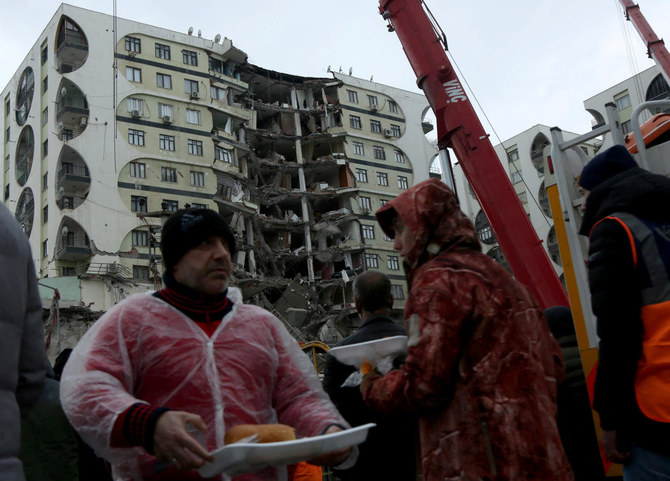
People receive food as they wait near a damaged building following an earthquake in Diyarbakir, Turkey February 6, 2023. (Reuters)
2 / 4
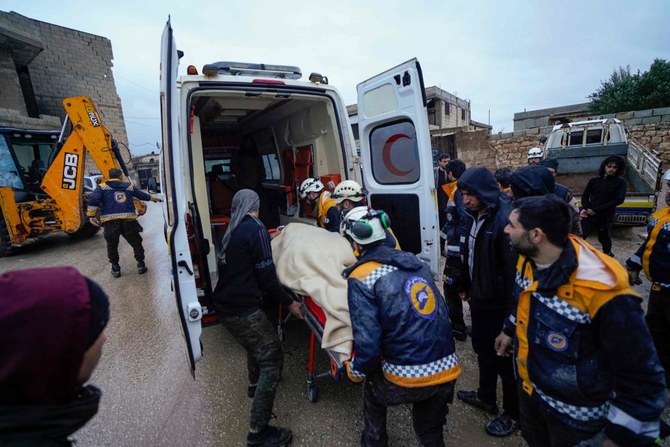
Members of the Syrian civil defence, known as the White Helmets transport a casualty pulled from the rubble into an ambulance, following an earthquake in Shalakh village in Idlib's eastern countryside, early on February 6, 2023. (AFP)
3 / 4
People search for survivors under the rubble following an earthquake in Diyarbakir, Turkiye February 6, 2023. (Reuters)
4 / 4
This aerial view shows residents helped by bulldozers, searching for victims and survivors in the rubble of collapsed buildings, following an earthquake in the town of Sarmada in the countryside of the northwestern Syrian Idlib province, early on February 6, 2023. (AFP)
Short Url
Updated 07 February 2023
Follow

World powers rush to offer Turkiye, Syria aid over quake

  • Britain was sending 76 search-and-rescue specialists to Turkiye, a minister said
  • The European Union has mobilized search and rescue teams for Turkiye after the stricken country requested EU assistance

PARIS: Countries around the world mobilized rapidly to send aid and rescue workers on Monday after a massive earthquake killed more than 2,300 people in Turkiye and Syria.
The pledges of assistance came from countries across Europe, Asia, the Middle East, as well as North America.
Here are some of the chief pledges of support.

The European Union has mobilized 10 search and rescue teams for Turkiye after the stricken country requested EU assistance, EU foreign policy chief Josep Borrell and EU crisis management commissioner Janez Lenarcic said.
The EU’s Copernicus satellite system has been activated to provide emergency mapping services, it said adding the bloc was ready to support those affected in Syria too.

The UN General Assembly observed a minute of silence in tribute to the victims.
“Our teams are on the ground assessing the needs and providing assistance. We count on the international community to help the thousands of families hit by this disaster, many of whom were already in dire need of humanitarian aid in areas where access is a challenge,” UN Secretary-General Antonio Guterres said.

Two of India’s National Disaster Response Force teams comprising 100 personnel with dog squads and equipment were ready to be flown to the affected area, the foreign ministry said. Doctors and paramedics with medicines were also being readied.
Prime Minister Narendra Modi said he was “anguished” and “deeply pained” by the deaths in Turkiye — with whom India has frosty relations — and Syria.

Germany — home to about three million people of Turkish origin — will “mobilize all the assistance we can activate,” Interior Minister Nancy Faeser said.
Germany’s Federal Agency for Technical Relief “can set up camps to provide shelter as well as water treatment units,” she said. Generators, tents and blankets are also being readied.

President Vladimir Putin promised to send Russian teams to both countries in telephone calls with Syria’s Bashar Assad and Turkiye’s Recep Tayyip Erdogan.
“In the nearest hours, rescuers from the Russian emergency ministry will take off for Syria,” the Kremlin said. The defense ministry said 300 military personnel deployed in Syria were helping with the clear-up effort.

Ukrainian President Volodymyr Zelensky said that his war-torn country was “ready to provide the necessary assistance to overcome the consequences of the disaster.”

Kyriakos Mitsotakis, prime minister of Turkiye’s historic rival Greece, whose relations with Ankara have suffered from a spate of border and cultural disputes, pledged to make “every force available” to aid its neighbor.

Israel’s Prime Minister Benjamin Netanyahu said he had approved the sending of aid to Syria — whose government does not recognize Israel — after receiving a request through diplomatic channels.
The government will also send humanitarian assistance to Turkiye, he said.

NATO chief Jens Stoltenberg voiced “full solidarity” with ally Turkiye, saying he was in touch with Turkiye’s top leadership and “NATO allies are mobilizing support now.”

Prime Minister Ulf Kristersson of Sweden, whose bid to join NATO is meeting Turkish resistance, sent his “deepest condolences” to Erdogan. “We stand ready to offer our support,” Kristersson tweeted.

Polish firefighters flew from Warsaw to the Turkish city of Gaziantep. “Our team will be working non-stop, 24 hours a day, in two locations,” said Andrzej Bartkowiak, chief commandant of the state fire service.

Qatar said it would send 120 rescue workers to Turkiye, alongside “a field hospital, relief aid, tents and winter supplies.”
Emirati President Sheikh Mohamed bin Zayed Al-Nahyan offered “assistance” in telephone calls with his Syrian and Turkish counterparts, Emirates News Agency reported.

Prime Minister Justin Trudeau tweeted: “our hearts go out to those who lost loved ones. Canada stands ready to provide assistance.”

President Emmanuel Macron said France stood ready to provide emergency aid to Turkiye and Syria. “Our thoughts are with the bereaved families,” he tweeted.

Foreign minister James Cleverly said the UK was sending a team of 76 search and rescue specialists, equipment and rescue dogs. Britain was also sending an emergency medical team to assess the situation on the ground.

The government in Japan — which frequently suffers earthquakes — is dispatching the Japan Disaster Relief Rescue Team to Turkiye.

Iran is ready to provide “immediate relief aid to these two friendly nations,” President Ebrahim Raisi said, offering condolences on the “heartbreaking incident.”


In Gaza hospital, patients cling to MSF as Israel orders it out

Updated 2 sec ago
Follow

In Gaza hospital, patients cling to MSF as Israel orders it out

KHAN YUNIS: At a hospital in Gaza, wards are filled with patients fearing they will be left without care if Doctors Without Borders (MSF) is forced out under an Israeli ban due to take effect in March.
Last month, Israel announced it would prevent 37 aid organizations, including MSF, from operating in Gaza from March 1 for failing to provide detailed information on their Palestinian staff.
“They stood by us throughout the war,” said 10-year-old Adam Asfour, his left arm pinned with metal rods after he was wounded by shrapnel in a bombing in September.
“When I heard it was possible they would stop providing services, it made me very sad,” he added from his bed at Gaza’s Nasser Hospital.
Israel’s Ministry of Diaspora Affairs and Combating Antisemitism, which oversees NGO registrations, has accused two MSF employees of links to Palestinian militant groups Hamas and Islamic Jihad, allegations MSF vehemently denies.
The ministry’s decision triggered international condemnation, with aid groups warning it would severely disrupt food and medical supplies to Gaza, where relief items are already scarce after more than two years of war.
Inside the packed Nasser Hospital in southern Gaza, one of the few medical facilities still functioning in the territory, MSF staff were still tending to children with burns, shrapnel wounds and chronic illnesses, an AFP journalist reported.
But their presence may end soon.
The prospect was unthinkable for Fayrouz Barhoum, whose grandson is being treated at the facility.
“Say bye to the lady, blow her a kiss,” she told her 18-month-old grandson, Joud, as MSF official Claire Nicolet left the room.
Joud’s head was wrapped in bandages covering burns on his cheek after boiling water spilled on him when strong winds battered the family’s makeshift shelter.
“At first his condition was very serious, but then it improved considerably,” Barhoum said.
“The scarring on his face has largely diminished. We need continuity of care,” she said.

- ‘We will continue working’ -

AFP spoke with patients and relatives at Nasser Hospital, all of whom expressed the same fear: that without MSF, there would be nowhere left to turn.
MSF says it currently provides at least 20 percent of hospital beds in Gaza and operates around 20 health centers.
In 2025 alone, it carried out more than 800,000 medical consultations and over 10,000 deliveries.
“It’s almost impossible to find an organization that will come here and be able to replace all what we are doing currently in Gaza,” Nicolet told AFP, noting that MSF not only provides medical care but also distributes drinking water to a population worn down by a prolonged war.
“So this is not really realistic.”
Since the start of the war in October 2023, triggered by Hamas’s deadly attack on southern Israel, Israeli officials and the military have repeatedly accused Hamas of using Gaza’s medical facilities as command centers.
Many have been damaged by two years of bombardments or overcrowded by casualties, while electricity, water and fuel supplies remain unreliable.
Aid groups warn that without international support, critical services such as emergency care, maternal health, and paediatric treatment could collapse entirely, leaving hundreds of thousands of residents without basic medical care.
Humanitarian sources say at least three international NGO employees whose files were rejected by Israeli authorities have already been prevented from entering Gaza through the Kerem Shalom crossing.
“For now, we will continue working as long as we can,” said Kelsie Meaden, an MSF logistics manager at Nasser Hospital, adding that constraints were already mounting.
“We can’t have any more international staff enter into Gaza, as well as supplies... we will run into shortages.”