‘Meri Shadi Meri Marzi,’ a play rife with political allegory and satire, resumes shows in Karachi

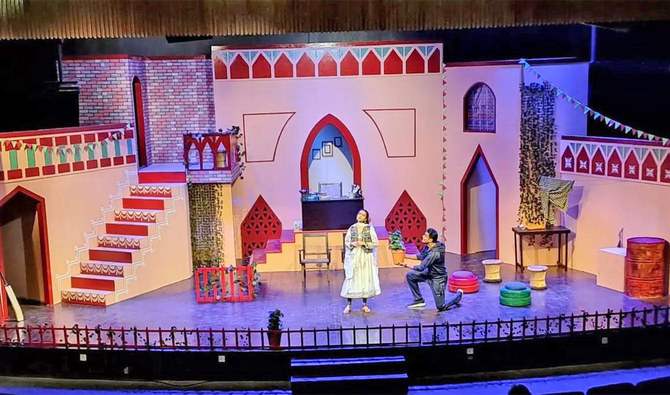
Imtiaz (Zohaib Zubair) proposes to Pakeeza (Wafa Sohail) in a scene from theatre play 'Meri Shadi Meri Marzi - a political allegory' staged at the IBA Auditorium in Karachi, Pakistan on February 5, 2023. (Photo courtesy: Stage Nomad Productions).
Short Url
Updated 06 February 2023
Follow

‘Meri Shadi Meri Marzi,’ a play rife with political allegory and satire, resumes shows in Karachi

  • The theater play was launched in November 2022 but had to be halted and tweaked due to ‘political turmoil’ in the country
  • The story, which resembles national political scene, involves a young woman and her life’s ambitions cut short by family politics

KARACHI: The theater play ‘Meri Shadi Meri Marzi,’ which used political metaphors and satire to tell the tale of a young woman whose ambitions are cut short by family drama, has resumed in Karachi after its shows were disrupted because the makers felt the country’s changing political dynamics required a rewriting of the script. 

The story is centered on Pakeeza, a young woman living with her father, sister and grandmother, whose plans for her own life are interrupted when her family arranges a marriage with her cousin Guddu, who lives in Britain and whose father has financially helped Pakeeza’s family in the past. 

Pakeeza then meets Imtiaz and a love story unfolds, even as Guddu along with his relatives arrives in Pakistan to make sure the marriage goes ahead, triggering manipulation and conspiracies in the form of family politics — with allusions to politics on a national level — while love tries to find a way through these family pressures. 

The play launched in November 2022 but was shut down when the makers felt that the original script, written by Ashar Naeem, had to be tweaked according to the rapidly changing dynamics of Pakistan’s politics. With a revised script, the play, led by director Faheem Azam, returned to the stage on January 20 and is playing at the Arts Council. It will continue until March 19. 

The key technique in the play is to borrow from prominent political figures and their famous speeches, but in a more familial setting, adding to the humor. 

“Whatever is happening in Pakistan is much like what’s happening at our homes. The attitude we have at home is our attitude as a nation,” Naeem, who penned a stage play for the first time, told Arab News after the performance. 

“We do the same at home such as ‘might is right’, the one with money has the power to take decisions, etc. We need to fix things at home so it reflects in our nation.” 

“It’s been over a year since the play was written and the country’s political situation has changed since then,” the writer said, explaining why the script needed to be revised. 

Azam went with an “up-front” approach to introduce characters to the viewers, saying he added narrations and introductions to cut down on the time that it would have taken to introduce them through scene-by-scene characterization. 

“I wanted it to be pleasing to the eyes and soft on the ears so they have a cinematic experience,” the director told Arab News. “I have treated emotions delicately to make it memorable for viewers.” 

At a show on Sunday, ‘Meri Shadi Meri Marzi’ left many viewers in fits of laughter and several felt its use of political metaphors was apt. 

“Considering the scenario in Karachi and the tough schedule people have, a two-hour entertainment like this is a welcome change,” Sibte Hassan, 33, told Arab News. 

“The acting of all artistes was very good, particularly Adnan Aziz, who essayed the role of Guddu. His character was the heart and soul of the play. I enjoyed the show.” 

Simran Bherwani, a 23-year-old law student, said she enjoyed the comedy in the play, in addition to the setup and dance: 

“Overall, the show was up to the standard. It was relevant, going with the title, something youngsters can relate to.” 


Pakistan, seven Muslim nations back Palestinian technocratic body, stress Gaza-West Bank unity

Updated 15 January 2026
Follow

Pakistan, seven Muslim nations back Palestinian technocratic body, stress Gaza-West Bank unity

  • The National Committee for the Administration of the Gaza Strip was announced on January 14
  • Muslim nations call for consolidation of the ceasefire and unimpeded humanitarian aid into Gaza

ISLAMABAD: Pakistan and seven other Muslim-majority countries on Thursday welcomed the formation of a temporary Palestinian technocratic body to administer Gaza, stressing that it must manage daily civilian affairs while preserving the institutional and territorial link between the Gaza Strip and the West Bank amid the ongoing peace efforts.

In a joint statement, the foreign ministers of Pakistan, Egypt, Jordan, Saudi Arabia, Qatar, Türkiye, Indonesia and the United Arab Emirates said the newly announced National Committee for the Administration of the Gaza Strip would play a central role during the second phase of a broader peace plan aimed at ending the war and paving the way for Palestinian self-governance.

“The Ministers emphasize the importance of the National Committee commencing its duties in managing the day-to-day affairs of the people of Gaza, while preserving the institutional and territorial link between the West Bank and the Gaza Strip, ensuring the unity of Gaza, and rejecting any attempts to divide it,” the statement said.

The committee, announced on Jan. 14, is a temporary transitional body established under United Nations Security Council Resolution 2803 and is to operate in coordination with the Palestinian Authority, the ministers said.

The statement said the move forms part of the second phase of US President Donald Trump’s Comprehensive Peace Plan for Gaza, which the ministers said they supported, praising Trump’s efforts to end the war, ensure the withdrawal of Israeli forces and prevent the annexation of the occupied West Bank.

The top leaders of all eight Muslim countries attended a meeting with Trump in New York last September, shortly before he unveiled the Gaza peace plan.

The ministers also called for the consolidation of the ceasefire, unimpeded humanitarian aid into Gaza, early recovery and reconstruction and the eventual return of the Palestinian Authority to administer the territory, leading to a just and sustainable peace based on UN resolutions and a two-state solution on pre-1967 lines with East Jerusalem as the Palestinian capital.