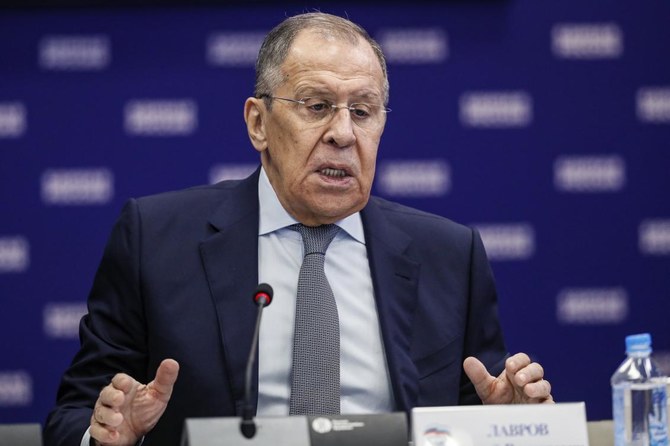
BAGHDAD: Russian Foreign Minister Sergei Lavrov arrived in Iraq on Sunday for talks on energy and food security in view of the Ukraine conflict, an Iraqi foreign ministry spokesman said.
He landed in Baghdad late on Sunday at the head of a large delegation that includes “oil and gas companies and investors,” Ahmed Al-Sahhaf told AFP.
On Monday, Lavrov will meet his Iraqi counterpart Fuad Hussein, the state news agency INA quoted Sahhaf as saying.
He will also meet Prime Minister Mohammed Shia Al-Sudani, President Abdul Latif Rashid, and parliament speaker Mohammed Al-Halbussi.
INA quoted Sahhaf as saying Lavrov’s visit “confirms Iraq’s openness to all of its partners and friends.”
He also underlined the importance of “attracting investment... notably in energy.”
Sahhaf had previously told AFP that Lavrov and Hussein “will also discuss transformations related to the security and stability of the region, and the Iraqi point of view regarding military operations in Ukraine.”
He noted that Baghdad favored “any dialogue making it possible to defuse this escalation and alleviate crises... particularly in the food and energy sectors.”
His remarks came amid soaring food and energy prices on international markets since Russia’s invasion of Ukraine last year.
Iraq, a close ally of Iran, also has strategic relations with the United States, which still has soldiers in the country as part of the international coalition facing the Daesh group.


Russia’s Lavrov in Iraq for energy talks
https://arab.news/j6v6x
Russia’s Lavrov in Iraq for energy talks

- Visit will focus on encouraging investment opportunities between two countries, particularly energy sector


El-Sisi hails development of Egypt-EU relations
- El-Sisi and Kallas both stressed the need for full implementation of the Gaza ceasefire agreement to ensure regular and unrestricted flow of humanitarian aid into the enclave
CAIRO: Egyptian President Abdel Fattah El-Sisi on Saturday praised the development of his country’s relationship with the European Union, “emphasizing the importance of sustaining efforts to deepen cooperation, especially after relations were elevated to a comprehensive strategic partnership,” according to state media.
El-Sisi made the remarks during a meeting with the EU’s High Representative for Foreign Affairs and Security Policy and Vice-President of the European Commission Kaja Kallas.
El-Sisi and Kallas both stressed the need for full implementation of the Gaza ceasefire agreement to ensure regular and unrestricted flow of humanitarian aid into the enclave.
“During the meeting, Kallas expressed the European side’s appreciation for the ongoing cooperation with Egypt in various fields,” presidential spokesman Mohamed El-Shennawy said.
This cooperation was reflected in the holding of the first Egypt-EU summit in Brussels in October 2025, Kallas said.
The meeting addressed various other aspects of bilateral relations, with El-Sisi emphasizing the importance of implementing the outcomes of the first Egypt-EU summit and enhancing consultation and coordination on issues of mutual concern, particularly in political and security spheres, to support regional security and stability, according to the spokesman.
EU Special Representative for the Middle East Peace Process Christophe Bigot was also present at the meeting, along with Rosamaria Gili, the deputy managing director for the Middle East and North Africa at the European External Action Service; Egyptian Foreign Minister Badr Abdelatty; head of the EU delegation to Egypt Ambassador Angelina Eichhorst; Christine O’Dwyer, a member of Kallas’ cabinet; and other senior EU officials.
Abdelatty said on Thursday that Egypt expects the remaining €4 billion ($4.66 billion) of a previously announced macro-financial assistance package from the EU to be disbursed in three tranches by 2027, and that he hoped the first tranche would be released “in the coming days” after Cairo completed its fifth and sixth program reviews with the International Monetary Fund, Reuters reported.
In 2024, the EU announced a €7.4 billion funding package for Egypt, including €5 billion in concessional loans. The package also includes investments and grants, and was partly a response to Egypt’s worsening financial position following the Gaza war, Red Sea tension and the economic fallout from the war in Ukraine.