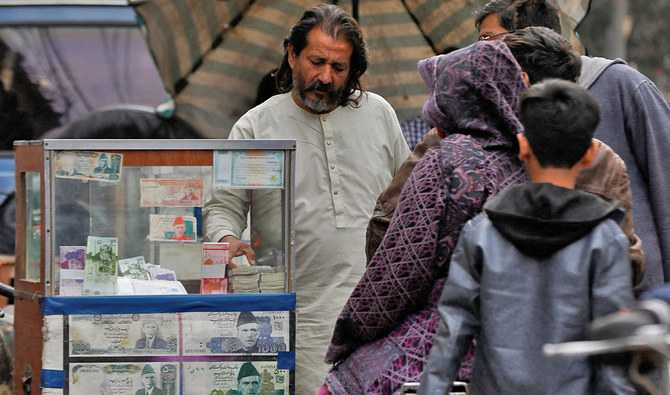

KARACHI: With Pakistan’s national currency hitting a series of historic lows against the US dollar since the removal of an artificial upper cap on the exchange rate, financial experts fear that ensuing unemployment and poverty could lead to mass social unrest across the country.
The Pakistani rupee has plunged by 16.5 percent to Rs276.58 since January 25 as pressure continues to build for import payments amid the country’s fast depleting foreign currency reserves.
The official reserves have declined to $3 billion, hitting the lowest level since 2000-01 when the forex with the central bank only stood at $1.6 billion. On average, Pakistan needs at least $5 billion to cover one month of import payments.
Speaking to Arab News, local currency dealers blamed the upper limit on the exchange rate in the interbank and open markets to keep the value of US dollar artificially low for causing major devaluation of the national currency.
“When we capped [the exchange rate] to keep [the value of the greenback] low, our inward remittances moved to the grey market and exporters also stopped their payments because the [dollar] rate was low in the bank and it was too high in the grey market,” Zafar Sultan Paracha, general secretary of Exchange Companies Association of Pakistan (ECAP), told Arab News in an interview on Friday.
“When we suddenly removed the cap after a long time, the dollar, I would say, came out with fury,” he added. “It seems that it has still not calmed down.”
The extreme shortage of dollar liquidity compelled the government to restrict import of goods, including industrial raw material and essential items, while commercial banks stopped issuing letters of credit (LCs) which left importers struggling to arrange the greenback for already placed orders.
Many Pakistani industries were either forced to shut down their production facilities or scale down operations, paving the way for mass layoffs.
“Because of the slowdown in the overall economic activity, decades high inflation and overall low production by the economy, it is expected that unemployment will increase and we are witnessing that at the moment as well,” Tahir Abbas, head of research at Arif Habib Limited, told Arab News.
The South Asian nation is currently experiencing one of the highest inflation rates that was gauged at 27.6 percent in January 2023. Previously, such levels were recorded in 1975.
Abbas said he feared the situation could lead to social unrest in the country.
“It is advisable for the government to resume the IMF [International Monetary Fund] program as soon as possible,” he continued.
The government began talks with the IMF last week in a bid to win approval for the disbursement of $1.1 billion under a bailout program the country signed with it in 2019 to stave off economic meltdown.
While the talks are scheduled to last until February 9, Prime Minister Shahbaz Sharif has already said the visiting mission of the international lender was giving tough time to the country.
However, finance minister Ishaq Dar has repeatedly said the situation is under control and the government hopes to maintain a substantially high dollar reserve by the end of the current fiscal year.
Economists said the country needed to complete the IMF program by June and should not go back to the fund for future bailouts since its programs reduce the pace of economic growth.
“The IMF program by design leads to reduced economic growth which leads to unemployment and increased poverty,” Dr. Ashfaque Hasan Khan, senior economist and former member of the government’s Economic Advisory Council, told Arab News.
“Such situation leads to deterioration of law and order and such signs are already visible in Karachi where muggings and snatchings at gunpoint have significantly increased,” he added.