NEW YORK: He had been brought from the battlefields of Syria to a New York lockup, a US citizen charged with serving as a sniper and weapons trainer for the Daesh group.
And even in jail, Ruslan Maratovich Asainov kept a makeshift version of the militants’ black flag right above the desk in his cell, according to trial testimony this week.
“What’s the big deal? It’s mine. It’s religious,” then-jail lieutenant Judith Woods recalled him saying when she went to confiscate the hand-drawn image in 2020.
Years after the fall of the extremist group’s self-proclaimed Islamic caliphate, the trial is a reminder of the enduring and far-reaching fallout of a war that drew tens of thousands of foreign fighters to Syria and Iraq. Their home countries are still contending with what should become of them.
Jurors, who are expected to start deliberating as soon as Monday, have gotten a refresher course Daesh’s gruesome rule and its sophisticated, social-media-savvy recruitment of distant supporters to come and take up arms. Prosecutors say Asainov did so and rose through the group’s ranks, eventually becoming an “emir” who taught other members to use weapons.
In post-arrest videos shown at his trial, he gives his occupation as “a sniper” to FBI agents and readily tells them that he provided instruction in everything from rifle maintenance to ballistics to adjusting for weather effects — and, of course, “how to actually pull the trigger.”
“Oh, it’s a long lesson,” he explains, sitting on a bed in a room where he was being held. “I would give, like, a three-hour lesson, just on that, just to pull the trigger.”
Jurors have seen photos alleged to be of Asainov in camouflage, aiming a rifle, and the handmade flag that Woods said she took from his cell. Witnesses have included his flabbergasted ex-wife, who testified that he morphed from a Brooklyn family man into a zealot. She said he weighed in from Syria to complain about their daughter donning a Halloween costume and sent a photo of the bodies of what he said were comrades killed in a battle, according to the Daily News of New York.
Asainov chose not to testify. One of his lawyers, Susan Kellman, has said he went to Syria because he wanted to live under Islamic law. He has pleaded not guilty — a plea that Kellman entered on his behalf because, she said, he didn’t abide by the American legal system.
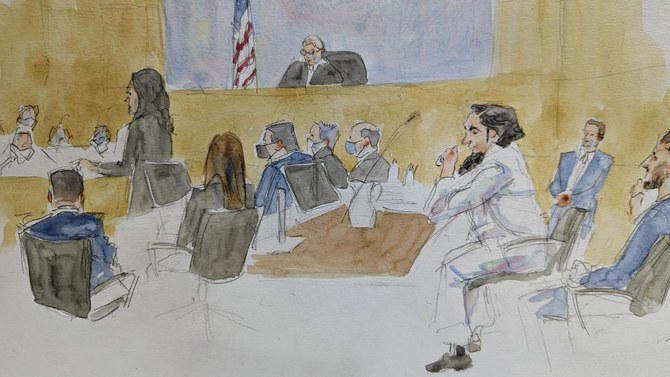
Nonetheless, the 46-year-old Asainov listened politely to government witnesses on a day this week, alternately stroking his beard and folding his arms across his chest.
Daesh fighters seized portions of Iraq and Syria in 2014 and declared the establishment of a so-called Islamic caliphate there, at a time when Syria was already convulsed by civil war. Fighting laid waste to multiple cities before Iraq’s prime minister declared the caliphate vanquished in 2017; the extremists lost the last of their territory two years later, though sporadic attacks persist even now.
During the height of the fighting, as many as 40,000 people from 120 countries showed up to join in, according to the United Nations. There is no comprehensive US statistic on Americans among those foreign fighters; a 2018 report by George Washington University’s Program on Extremism found at least 64 who had joined jihadist fighting in Iraq and Syria since 2011.
Since Daesh’s defeat, some foreign members and their families have lingered in detention facilities in Syria because their countries refused to take them back. Other accused foreign fighters have returned to their countries, including some who were prosecuted.
Recent US cases include a Kansas mother who led an all-female Daesh battalion, a Minnesota man who served in a battalion that prepared foreign fighters for suicide attacks in Europe, and a Detroit-area convicted this week of training with and then spending more than two years with the group.
Born in Kazakhstan, Asainov is a naturalized US citizen. He lived in Brooklyn starting in 1998, married and had a child.
Then he flew to Istanbul on a one-way ticket in December 2013 and made his way to Syria to join what he later described in a message as “the worst terrorist organization in the world that has ever existed,” authorities say.
“You heard of Daesh,” he said in another text message in January 2015, according to prosecutors’ court filings. “We will get you.”
By that April, Asainov told an acquaintance — in fact, a government informant — that he’d been fighting in Syria for about a year, according to court papers. They say that in various exchanges, he urged the informant to come to Syria and help with Daesh’s media operations, asked for $2,800 to buy a rifle scope, and sent photos of himself with fatigues and rifle, saying he “didn’t mean to show off” but was showing what was “just normal” in his new life.
Authorities announced in July 2019 that US-backed forces in Syria had captured Asainov and turned him over to the FBI.
He faces charges that include providing material support to a US-designated foreign terrorist organization. If convicted, he could be sentenced to life in prison.


![]()

Job: ‘Sniper’: Accused Daesh fighter on trial in US
Short Url
https://arab.news/wndp8
Job: ‘Sniper’: Accused Daesh fighter on trial in US
- Ruslan Maratovich Asainov kept a makeshift version of the militants' black flag right above the desk in his cell
- The trial is a reminder of the enduring and far-reaching fallout of a war that drew tens of thousands of foreign fighters to Syria and Iraq


Latest updates


© 2026 SAUDI RESEARCH & PUBLISHING COMPANY, All Rights Reserved And subject to Terms of Use Agreement.