

IMF giving Pakistan tough time over unlocking funds, PM says 

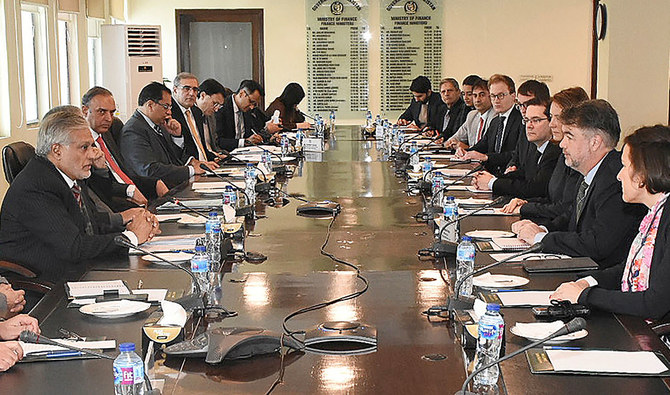
This handout photograph released by the Pakistan Press Information Department (PID) on January 31, 2023, shows Pakistan’s Finance Minister Ishaq Dar (L) meeting with a International Monetary Fund (IMF) review mission led by IMF mission official Nathan Porter (2R) at the Finance Ministry in Islamabad. (AFP)
Short Url
Updated 03 February 2023
Follow

IMF giving Pakistan tough time over unlocking funds, PM says 

  • An IMF mission is currently visiting Pakistan to discuss fiscal consolidation measures 
  • A review for the release of $2.5 billion funds to Pakistan has been pending since Nov 

ISLAMABAD: Pakistan Prime Minister Shehbaz Sharif said on Friday the International Monetary Fund was giving his country a tough time over unlocking stalled funding from a $6.5 billion bailout at a time the South Asian economy faces an “unimaginable” situation. 

Sharif made the comments in a meeting of civil and military leaders in the northwestern city of Peshawar he chaired to prepare a response to Monday’s mosque bombing that killed more than 100 people. 

“Our economic situation is unimaginable,” the premier said. “As you know, the IMF mission is in Pakistan, and that’s giving us a tough time,” he said. 

“You all know we are running short of resources,” Sharif said, adding Pakistan at present was facing an economic crisis. 

IMF’s Pakistan representative did not immediately respond to Reuters request for comment. 

The IMF mission is visiting Pakistan to discuss fiscal consolidation measures the institution needs from Pakistan to clear a 9th review of its Extended Fund Facility, aimed at helping countries facing balance-of-payments crises. 

Pakistan is in a $6.5 billion IMF program. 

An IMF delegation is in Pakistan to restart talks stalled since November for $2.5 billion funds yet to be disbursed. 


Pakistan’s capital picks concrete over trees, angering residents

Updated 10 sec ago
Follow

Pakistan’s capital picks concrete over trees, angering residents

  • Between 2001 and 2024, Islamabad lost 14 hectares of tree cover, according to Global Forest Watch 
  • Officials justify removing trees to tackle seasonal pollen allergies that are especially acute in spring

ISLAMABAD: Pakistan’s capital Islamabad was once known for its lush greenery, but the felling of trees across the city for infrastructure and military monuments has prompted local anger and even lawsuits.

Built in the 1960s, Islamabad was planned as a green city, with wide avenues, parks and tree-lined sectors.

Many residents fear that vision is steadily being eroded, with concrete replacing green spaces.

Muhammad Naveed took the authorities to court this year over “large-scale tree cutting” for infrastructure projects, accusing them of felling “many mature trees” and leaving land “barren.”

The World Wide Fund for Nature (WWF) blamed major infrastructure development, including road construction and monuments, for the mass razing of trees and natural vegetation in Islamabad.

Between 2001 and 2024, the capital lost 14 hectares of tree cover, equal to 20 football pitches, according to Global Forest Watch, though the figure does not account for tree cover gains during the same period.

For Kamran Abbasi, a local trader and resident since the 1980s, it feels like “they are cutting trees everywhere.”

“It is not the same anymore,” he told AFP.

“Trees are life. Thousands are cut to build one bridge.”

SMOG AND POLLEN

Meanwhile, air quality in Islamabad continues to deteriorate.

Pollution is a longstanding problem, but plants can help by filtering dirty air, absorbing harmful gases and cooling cities.

“Forests act as powerful natural filters... cleaning the air and water, and reducing the overall impact of pollution,” Muhammad Ibrahim, director of WWF-Pakistan’s forest program told AFP.

There were no good air quality days in Islamabad last month, with all but two classed as “unhealthy” or “very unhealthy” by monitoring organization IQAir.

While some trees are felled for infrastructure, officials justify removing others to tackle seasonal pollen allergies that are especially acute in spring.

That problem is largely attributed to paper mulberry trees, which were planted extensively during the city’s early development.

“The main reason is pollen allergy,” said Abdul Razzaq, an official from the Capital Development Authority (CDA) in Islamabad.

“People suffer from chest infections, asthma and severe allergic reactions. I do too,” he told AFP.

The government plans to remove 29,000 pollen-producing trees and plants, according to a recent WWF report.

However, critics argue that pollen allergies are an excuse to justify broader tree-cutting, particularly linked to military and infrastructure projects.

The solution lies not in indiscriminate tree removal, but careful urban planning, experts say, replanting with non-allergenic species — and greater transparency around development projects in the capital.

CAPITAL UNDER AXE

In recent months, large bulldozers have been spotted levelling former green belts and wooded areas, including near major highways.

According to WWF and unnamed government officials, some of the cleared land is tapped for monuments commemorating the brief but intense armed conflict between Pakistan and neighboring India last May.

Other plots were razed to make way for military-linked infrastructure.

“We know that trees are being cut for military-related projects, but there is not much we can do,” a government source told AFP, requesting anonymity for security reasons.

“The people in power, the military, can do whatever they want.”

Pakistan’s powerful military has ruled the country for decades through coups and is deeply involved in the country’s politics and economy, analysts say.

At a proposed military monument site along the city’s express highway, WWF recorded more than six hectares of land clearing last year, with work continuing in 2026.

It saw “no active plantation... indicating that the clearing is infrastructure driven.”

The military did not respond to AFP’s request for comment.

Naveed’s court case seeking to halt the widespread felling, which is still being heard, argues there is “no excuse” for the tree loss.

“If a monument is deemed essential, why was it not placed in any existing park or public place?” he argues.

In reply to Naveed’s petition, authorities said roads and infrastructure projects were approved under regulations dating back to 1992.