

After deadly Peshawar bombing, top security body to meet today on steps to eradicate militancy

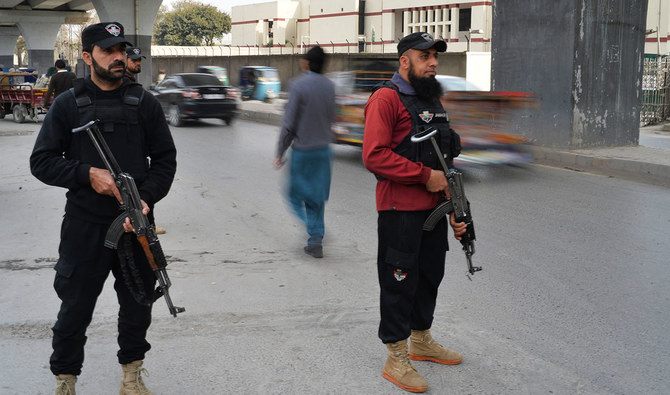
Policemen stand guard along a street in Peshawar on February 1, 2023, days after a mosque suicide blast inside a police headquarters. (AFP)
Short Url
Updated 03 February 2023
Follow

After deadly Peshawar bombing, top security body to meet today on steps to eradicate militancy

  • Meeting comes days after a suicide bomber killed over 100 people in the northwestern Pakistani city 
  • The attack, one of the deadliest in Peshawar in a decade, has raised alarm after years of relative calm

ISLAMABAD: Pakistani civilian and military officials will meet in the northwestern city of Peshawar on Friday to discuss step to root out militancy, the state media reported, days after a suicide bomber killed more than a hundred people, mostly police, and injured over 220 others in the city. 

Monday’s attack, one of the deadliest in Peshawar in a decade, came amid an uptick in militant attacks on police and security forces in the northwestern Khyber Pakhtunkhwa and southwestern Balochistan provinces. 

Pakistan’s defense and interior ministers in speeches to parliament this week blamed the Pakistani Taliban, who maintain sanctuaries in neighboring Afghanistan, for orchestrating the bombing. 

The Pakistani Taliban, or the Tehreek-e-Taliban Pakistan (TTP), are a separate group but allied with the Afghan Taliban and have carried some of the deadliest attacks in the South Asian country since late 2000s. 

Pakistani officials will meet at the KP governor’s residence and consider capacity building of the police department, among other measures, against the renewed militant threat in the province. 

“Meeting of Apex Committee will be held in Peshawar today to consider steps to eradicate terrorism and upgrade the Counter-Terrorism Department and police in wake of the recent terrorist incident in the provincial capital, the state-run Radio Pakistan broadcaster reported on Friday. 

“All stakeholders including Rangers and officers of the intelligence institutions will attend the committee’s meeting at the Governor House in Peshawar.” 

Pakistan has seen a surge in militant attacks since November, when the Pakistani Taliban ended a cease-fire with government forces, which was brokered by the Afghan Taliban in May. 

While Islamabad demanded the Afghan Taliban to take action against the TTP, Afghanistan’s Taliban-appointed foreign minister urged Pakistani authorities to look domestically for the reasons behind violence in their country instead of blaming Afghanistan. 

On Thursday, Pakistan’s foreign ministry spokesperson Mumtaz Zahra Baloch dismissed the Afghan Taliban’s criticism and said her government expected “cooperation” from Kabul. 

“We take the loss of innocent lives very seriously and would expect our neighbors to do the same,” Baloch said at a weekly press briefing. “Pakistan expects sincere cooperation” from Afghanistan. 

The provincial apex committees were established as part of the then government’s counter-terrorism measures after the massacre of nearly 150 people, mostly children, at a military-run school in Peshawar in December 2014. 

As subsequent military operations pushed militants out of Pakistan, these committees gradually became dormant. 


Security forces kill four militants in Pakistan’s volatile southwest, military says

Updated 13 January 2026
Follow

Security forces kill four militants in Pakistan’s volatile southwest, military says

  • Balochistan, Pakistan’s largest province by land area bordering Iran and Afghanistan, has long been the site of a low-level insurgency
  • The Balochistan government has recently established a threat assessment center to strengthen early warning, prevent ‘terrorism’ incidents

ISLAMABAD: Pakistani security forces gunned down four militants in an intelligence-based operation in the southwestern Balochistan province, the military said on Tuesday.

The operation was conducted in Balochistan’s Kalat district on reports about the presence of militants, according to the Inter-Services Public Relations (ISPR), the Pakistani military’s media wing.

The “Indian-sponsored militants” were killed in an exchange of fire during the operation, while weapons and ammunition were also recovered from the deceased, who remained actively involved in numerous militant activities.

“Sanitization operations are being conducted to eliminate any other Indian-sponsored terrorist found in the area,” the ISPR said in a statement.

There was no immediate response from New Delhi to the statement.

Balochistan, Pakistan’s largest province by land area bordering Iran and Afghanistan, has long been the site of a low-level insurgency involving Baloch separatist groups, including the Balochistan Liberation Army (BLA) and the Balochistan Liberation Front (BLF).

Pakistan accuses India of supporting these separatist militant groups and describes them as “Fitna Al-Hindustan.” New Delhi denies the allegation.

The government in Balochistan has also established a state-of-the-art threat assessment center to strengthen early warning and prevention against “terrorism” incidents, a senior official said this week.

“Information that was once scattered is now shared and acted upon in time, allowing the state to move from reacting after incidents to preventing them before they occur,” Balochistan Additional Chief Secretary Hamza Shafqaat wrote on X.

The development follows a steep rise in militancy-related deaths in Pakistan in 2025. According to statistics released by the Pakistan Institute for Conflict and Security Studies (PICSS) last month, combat-related deaths in 2025 rose 73 percent to 3,387.

These included 2,115 militants, 664 security forces personnel, 580 civilians and 28 members of pro-government peace committees, the think tank said.
