DUBAI: Baghdad-born artist Suad Al-Attar was a trailblazer for women in her homeland. In the 1960s, while still a teenager, she reportedly became the first female artist to have a solo exhibition in Iraq.
Her mystical paintings — reflecting on themes of love, loss, and longing — have since been acquired by the British Museum and the Arab Museum of Modern Art, and displayed at Leighton House, the Barbican Centre, and the UNESCO Center in Paris.
Now, the artist’s granddaughter, UK-based art historian Nesma Shubber, is publishing a 100-image monograph looking back at Al-Attar’s long life and career. It is based on interviews with her grandmother, now in her early eighties but still active as an artist.

The artist’s granddaughter is publishing a 100-image monograph looking back at Al-Attar’s long life and career. (Supplied)
“To walk into her flat and see her painting these masterpieces is actually quite a privilege to have experienced,” Shubber told Arab News.
Al-Attar was, it seems, destined to be an artist. When she was a child, her mother, who briefly studied painting in Beirut, presented Al-Attar with her own paintbox. Her brother would also chaperone her on trips to the riverside to create drawings and paintings of sunsets. Her late sister Layla was also a significant figure in Iraq’s art scene — a talented artist herself, and the director of the Iraqi National Art Museum.
With the approval of Al-Attar’s parents, a room in their residence was turned into her makeshift studio. “By her own admission, she wouldn’t have really gone so far into the art world if it wasn’t for them proactively encouraging and supporting her,” added Shubber.

Suad in 1954, aged 14 - the image originally appeared in Ahal Al Nafat magazine. (Supplied)
In 1957, Al-Attar exhibited her work at her high-school graduation show, boosting her confidence, at a time when the country was culturally booming. “Iraq, in those times, was one of the forefront Middle Eastern countries for artistic creation and production,” explained Shubber. “I think at that early exhibition, she really felt like she was a part of something. She was on a path to something great.”
1976 was a life-changing year for Al-Attar. Like many other Iraqis, her family left the country and moved to the UK. She has lived and worked in London ever since. Being away from her homeland has had a major impact on her art, as have the decades of conflict that it has suffered.
The 2003 US invasion of Iraq, in particular, informed her powerful pen drawings and watercolors of women screaming as bombs were falling. “She kind of repeated (this motif). I think it was fixed in her head,” said Shubber.
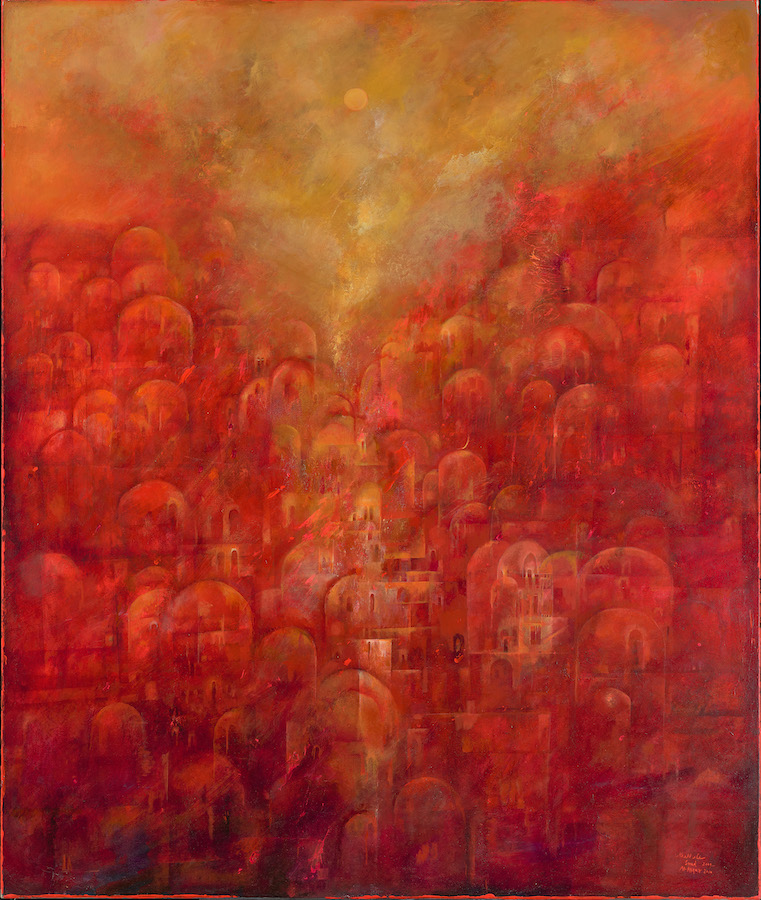
Homage to Medinat Al-Salam, 2010. (Supplied)
In general, though, Al-Attar’s other-worldly paintings transport the viewer to a peaceful, dreamlike world of united lovers, mythological creatures, idyllic visions of Iraq, and paradisiacal gardens.
Her work is often symbolic, using motifs from Mesopotamian history. Her use of such symbols, reflecting an era of ancient glory, was particularly heightened during the turbulent Nineties with the outbreak of the Gulf War. It’s a nostalgic reminder of what used to be — creating a vision of home for herself .
There is a sense of melancholy and longing in Al-Attar’s work. On the back of a painting created in 2000, entitled “Tender Embrace,” she has written a few lines from an Arabic poem: “How many tears we shed the night we parted/Excusing our sorrow by saying ‘It’s only the rain.’”
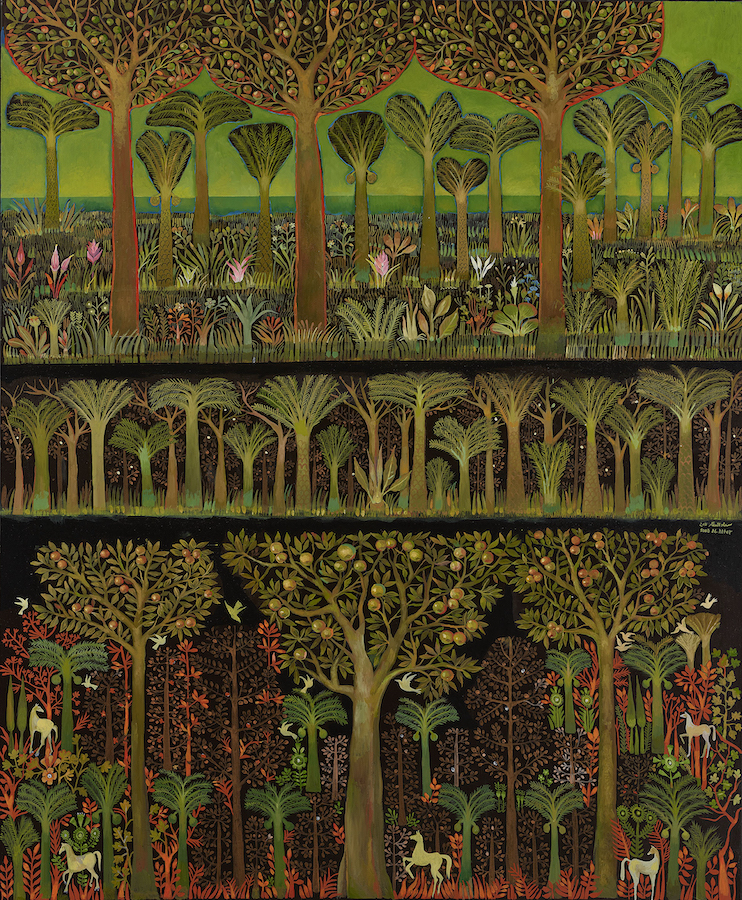
Visions from Garden of Eden 1, an oil painting from 2011. (Supplied)
Though Al-Attar is well known in the Arab world, she hasn’t chased international recognition. “She never employed PR or a manager,” said Shubber. “She told me that she doesn’t regret that. What she wants isn’t aligned with that need.”
When researching her 216-page monograph, as well as interviewing Al-Attar, Shubber looked through old catalogs and exhibition invitations. The book includes a selection of vintage snapshots of Al-Attar with voluminous hair and kohl-lined light eyes. “Obviously, she’s a glamorous person,” Shubber said. “She is stylish beyond the canvas. Design, style, and color translated into her home life.”
For Shubber, working on this book has reaffirmed what she saw in her grandmother all along. “The one thing that I was in awe of, all over again, was just how prolific she has been — she has made so many paintings,” she said. “It really is her essence. She was born to do it.”