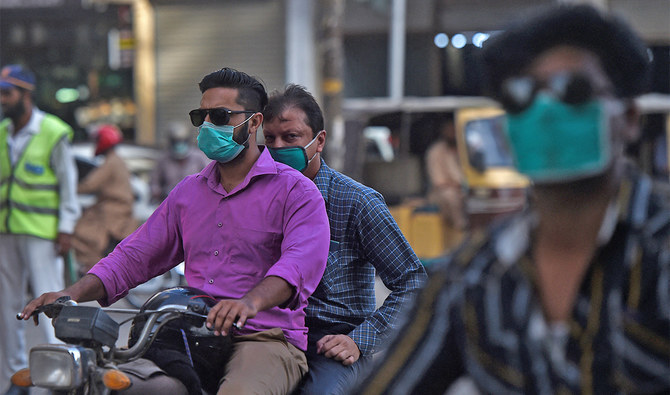

KARACHI: Pakistan reported its first case of BF.7 coronavirus sub-variant in its southern port city of Karachi on Tuesday, making experts urge people to exercise caution since the new strain can spread more rapidly and pose serious health problems to people with weak immune system.
The country reported its first case of COVID-19, an infectious disease caused by the SARS-CoV-2 virus, in Karachi on February 26, 2020, when a young pilgrim arriving from Iran tested positive for the disease. Since then, Pakistan has reported 30,640 deaths due to the virus in which about 27 percent – or 8,254 – were witnessed in the southern Sindh province.
According to the latest situation report circulated by the provincial health authorities in Sindh, the last death caused by the disease was recorded in the country on January 23. Pakistan witnessed the highest number of deaths in a single month due to COVID-19 in February last year when the toll reached 228.
The coronavirus positivity ratio has also significantly increased from 8.70 percent on January 24 to 16.76 percent in the beginning of this week. According to an official report, 12 COVID-19 patients are currently under treatment in different hospitals – with one of them on a life-saving ventilator – while 362 others in isolation at home.
“A genomic survey that the Dow University of Health Sciences (DUHS) has sent to the health department confirms one case of BF.7,” Mehar Khurshid, Sindh health department spokesperson, told Arab News without divulging further details.
BF.7, an omicron sub-variant, has been detected in various countries, such as the United States, Germany, France, Denmark, India and Malaysia. Its symptoms include fever, sore throat, runny nose, fatigue, vomiting and diarrhea.
Some experts believe despite its immune-evasive characteristics and worrying signs about its growth in China, the variant may remain fairly steady elsewhere.
“The Chinese situation and BF.7’s high reproduction rate might be partly due to a low level of immunity in China from the previous infection and possibly vaccination,” Vinod Balasubramaniam, senior lecturer in Microbiology at the Monash University in Malaysia, wrote in a recent article.
Data analyzed by experts show BF.7 is quicker to transmit than other sub-variants. It has a smaller incubation period with a greater capacity to affect people who have previously been infected by the coronavirus.
Dr. Faisal Mahmood, head of infectious diseases at the Aga Khan University Hospital who also treated Pakistan’s first COVID-19 patient, said the sub-variant was “contagious and can spread rapidly.”
“Like precious variants, it can cause severe disease among those who are not up to date in their vaccines, those who are elderly or those having weak immune system,” he told Arab News while urging people to ensure they had taken booster shots.
“It should be ensured that vaccines and boosters are up to date,” he continued. “To those over 65 years or with a low immunity, the new vaccine which gives immunity against the variant should be administered,” he said, adding that people who were unwell should only go to crowded places with face masks.
“Wear a mask if you are at risk of getting a severe infection or you take care of someone who is at high risk,” he added.
Mahmood said it was true that many people only got mild coronavirus infection, though he noted the virus could still cause great discomfort to other individuals.
“This includes symptoms which are severe like high fever and body aches and, in some cases, hospitalization and death,” he said. “In this sense, it is not like common cold.”