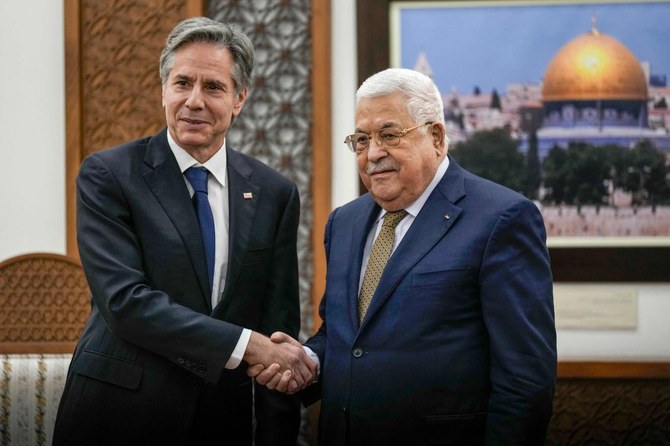

RAMALLAH: As he completed a two-day visit to Israel and the occupied West Bank on Tuesday, US Secretary of State Antony Blinken met Palestinian President Mahmoud Abbas in Ramallah and called for a de-escalation of tensions, but offered no new US initiative to help achieve this.
There were no signs he was making progress on even the modest goal of halting the latest wave of violence, much less of addressing the broader issues surrounding potential peace talks.
Abbas placed all of the blame for the spike in violence on Israel and berated the international community for not doing more to put pressure on Israeli authorities.
Both Blinken and William Burns, the head of the CIA who met Abbas on Jan. 29, urged him to take action against Palestinian military groups and reduce the levels of violence against Israel.
Blinken called for calm on both sides following the incident last week when a Palestinian gunman killed seven people outside a synagogue in Jerusalem, and amid anger among Palestinians over the actions of Israeli forces and settlers in the occupied West Bank.
He took that message into the meeting with Abbas and warned all parties against taking any action that could threaten a two-state solution that results in the establishment of an independent Palestinian state alongside Israel.
Blinken criticized Israel for its actions that Washington believes create barriers to the two-state solution. In particular, he highlighted “settlement expansion, the legalization of (settlement) outposts, demolitions and evictions, disruptions to the historic status of the holy sites and, of course, incitement and acquiescence to the violence.”
After the meeting with Abbas, Blinken said the US would provide an additional $50 million for the UN’s agency for Palestinians and announced that he had reached an agreement with the Israeli government to provide 4G telecoms services for the Palestinian people.
Abbas called for “the complete cessation of unilateral Israeli actions, which violate the signed agreements and international law.” He reiterated the longstanding demand by Palestinians for Israel to end its occupation of their territory.
“We are now ready to work with the US administration and the international community to restore political dialogue in order to end the Israeli occupation of the land of the State of Palestine on the 1967 borders, with East Jerusalem as its capital,” he said.
“The continued opposition to the efforts of the Palestinian people to defend their existence and their legitimate rights in international forums and courts is a policy that encourages the Israeli occupier to commit more crimes and violates international law.
“Our people will not accept the continuation of the occupation forever, and the regional security will not be strengthened by violating the sanctity of the holy sites, trampling on the dignity of the Palestinian people and ignoring their legitimate rights to freedom, dignity and independence.”
The Palestinian leadership told Blinken that if calm is to be restored, Israel must halt its unilateral measures, stop its construction of settlements in the West Bank, end Israeli army incursions into Palestinian cities, and prevent attacks and violence by Israeli settlers against Palestinians in the West Bank.
The Palestinians also demand that Israel release withheld Palestinian Authority tax revenues and provide a political horizon for resolving the conflict.
Senior Palestinian sources said US understanding and support for the Palestinian demands could prevent further escalation and build confidence, which might persuade Abbas to resume security coordination with Israel, which he halted on Jan. 26 following the killing of nine Palestinians in Jenin.
Mahmoud Al-Aloul, a Fatah leader, said the Palestinian leadership no longer has any confidence or hope in American policy because it is seen as only concerned with protecting and supporting the Israeli occupation.
He added that Blinken’s visit came after Palestinians decided to confront the “crimes and attacks of the occupation and its settlers, which have recently intensified.”
Political analyst Majdi Halabi told Arab News that Blinken’s visit was crucial because it would contribute to the efforts to calm the situation and reduce tensions between Palestinians and Israelis.
“Abbas cannot prevent individual attacks by Palestinians against Israeli targets,” Halabi said. “He can influence the Lions’ Den group because it includes elements of the Fatah organization that he heads.”
He added that the US can also put pressure on Israel to stop demolitions of Palestinian homes in the West Bank and Jerusalem, reduce the number of arrests of Palestinians, and limit settlement expansions. Washington could do this, if it wanted to, because Israel needs US financial help and its assistance to confront Iran, he said.
Palestinian political analyst Nabil Amr said the Americans can only offer advice to both sides and talk about the need for calm and preserving the two-state solution. Meanwhile, “the pressure is inevitably on the Palestinian side,” he added.
The Americans “are no longer able to influence the Israeli government, and the Israelis do not listen to them and take advantage of their support to fuel their war against the Palestinians,” Amr said.
Washington “is making demands the Palestinians cannot fulfill even if they accept them, such as preventing individual operations against Israelis. Those who carried out the recent attacks against Israeli targets had no connection with the Palestinian organizations but were individuals, so how can the Palestinian Authority prevent them?” he added.
Amr strongly criticized the current US policy on the conflict, describing it as “managing crises without a political horizon.”