

International mining firm pays $3 million to Balochistan under Reko Diq agreement

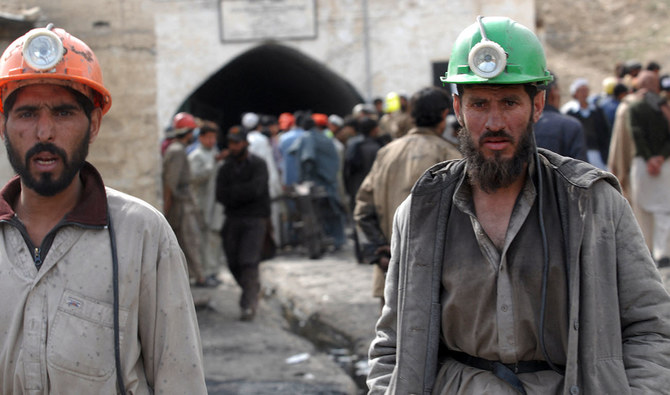
This picture taken on January 30, 2023 shows resident SalCoal miners leave after being brought to the surface during the rescue operation at a coal mine outside Quetta on March 5, 2009. (AFP)
Short Url
Updated 31 January 2023
Follow

International mining firm pays $3 million to Balochistan under Reko Diq agreement

  • Barrick Gold says the project benefits will begin to reach residents of Balochistan before the mine goes into production
  • Reko Diq is the world’s largest underdeveloped site of copper and gold deposits which is located in Pakistan’s southwest

ISLAMABAD: An international mining company developing the world’s largest site of copper and gold deposits in Pakistan’s southwest announced on Tuesday it had paid $3 million to the government in Balochistan after agreeing to a timetable to disburse the committed funds to the province last month.

Barrick Gold Corporation said in a statement its new agreement to work on Reko Diq ensured the benefits from the project started accruing to the people of Balochistan well before the mine went into production through advance royalties and social development funds.

Pakistan’s mineral-rich Balochistan is the country’s largest but least developed province, and home to both religious militants and separatist Baloch groups who have engaged in insurgency against the government for decades, demanding a greater share of the region’s resources.

Last month, political parties in Balochistan held protests while demanding a greater share for the province in the project.

“Reko Diq Pakistan Country Manager Ali E. Rind handed over the cheque for $3 million to Secretary, Mines and Minerals Development Department, Mr. Saidal Khan Luni,” the company said in its statement.

“During peak construction, the project is expected to employ approximately 7,500 people and once in production it will create around 4,000 long-term jobs,” it added. “Barrick’s policy of prioritizing local employment and suppliers will have a positive impact on the local economy.”

The company also maintained it was working to set up community development committees to identify priority projects focused on food security, environmental management and access to education, health care and potable water.

It informed that it planned to finish the Reko Diq feasibility study update by the end of next year, with 2028 targeted for first production.

The Barrick Gold statement said the company wanted to carry out the construction activities in two phases, beginning with a plant that would be able to process approximately 40 million tons of ore per annum which could be doubled in five years following first production from phase one.

“With its unique combination of large scale, low strip and good grade, Reko Diq will be a multi-generational mine with a life of at least 40 years,” it added.


Pakistan launches double-decker buses in Karachi after 65 years to tackle transport woes

Updated 31 December 2025
Follow

Pakistan launches double-decker buses in Karachi after 65 years to tackle transport woes

  • Karachi citizens will be able to travel in double-decker buses from Jan. 1, says Sindh government
  • City faces mounting transport challenges such as lack of buses, traffic congestion, poorly built roads

ISLAMABAD: The government in Sindh province on Wednesday launched double-decker buses in the provincial capital of Karachi after a gap of 65 years, vowing to improve public transport facilities in the metropolis. 

Double-decker buses are designed to carry more passengers than single-deck vehicles without taking up extra road space. The development takes place amid increasing criticism against the Sindh government regarding Karachi’s mounting public transport challenges and poor infrastructural problems. 

Pakistan’s largest city by population faces severe transportation challenges due to overcrowding in buses, traffic congestion and limited bus options. Commuters, as a result, rely on private vehicles or unregulated transport options that are often unsafe and expensive.

“Double-decker buses have once again been introduced for the people of Karachi after 65 years,” a statement issued by the Sindh information ministry said. 

Sindh Transportation Minister Sharjeel Inam Memon and Local Government Minister Syed Nasir Hussain Shah inaugurated the bus service. The ministry said the facility will be available to the public starting Jan. 1. 

The statement highlighted that new electric bus routes will also be launched across the entire province starting next week. It added that the aim of introducing air-conditioned buses, low-fare services, and fare subsidies is to make public transport more accessible to the people.

The ministry noted that approximately 1.5 million people travel daily in Karachi using the People’s Bus Service, while around 75,000 passengers use the Orange Line and Green Line BRT services.

“With the integration of these routes, efforts are being made to benefit up to 100,000 additional people,” the ministry said.