


RAMALLAH: Israeli and Palestinian human rights organizations have criticized punitive measures taken by the Israeli government against Palestinians as fears grow of escalation after the deadliest unrest for years in Jerusalem and the West Bank.
Multiple Palestinians have been arrested after seven people were killed and five others wounded in two separate shootings in Jerusalem on Friday and Saturday.
Various groups said the Israeli action amounted to collective punishment and is illegal under international law.
The Palestinian Authority also condemned Israel’s actions, calling it collective punishment.
The Ministry of Foreign Affairs called the arrests a gross violation of international law and the Geneva Convention, adding that the collective punishment as an extension of the occupation policy aimed at removing the Palestinian presence from Jerusalem.
Shawan Jabarin, director of Al-Haq Palestinian Human Rights organization, told Arab News: “These collective punishments are war crimes that the Israeli government takes against the Palestinians, as it punishes people who have nothing to do with those who carry out attacks against the Israeli occupiers.
“The one who carried out the attack was killed, so why should his family be punished? And why, if a Palestinian act against the Israelis, (will) the entire society will be punished,” he added.
Taysir Khaled, a member of the Palestine Liberation Organization, held the Israeli government fully responsible for the deterioration of conditions and massacres perpetrated by Israeli forces in the occupied Palestinian territories.
He added that the decision of the Israeli Cabinet to distribute more weapons to settlers in the occupied West Bank, including Jerusalem, and to call on the occupation police to take up arms, constituted a green light for Jewish terrorist organizations — which take settlements and outposts as safe havens under the protection of the occupation army — to commit more crimes.
Jessica Montel, director of the Israeli HaMoked human rights organization, said that members of Israel’s Cabinet were threatening a range of measures, all of which constituted collective punishment against innocent people solely because they are related to the man who perpetrated the deadly attack on Friday night.
Israel’s new government is actively working to undermine jurists’ authority and the judiciary's independence, Montel told Arab News, further eroding the possibility of defending Palestinians’ human rights.
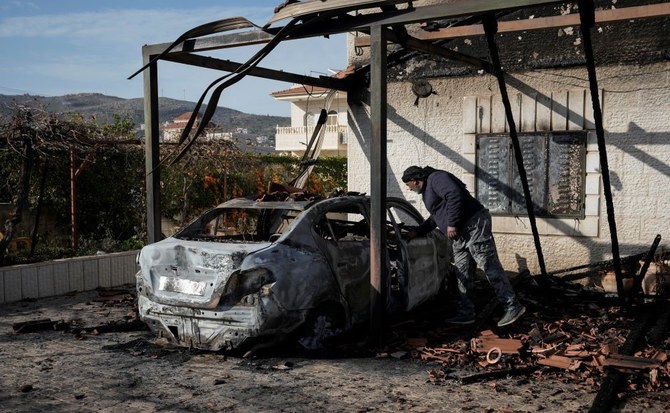
In what is believed to be an act of revenge for the recent attacks in Jerusalem, Israeli settlers assaulted Palestinians and their properties on Saturday evening across the occupied territories, official Palestinian sources confirmed on Sunday.
The settlers launched attacks against dozens of Palestinian targets from the north to the south of the West Bank, which resulted in burning a house in the village of Turmusaya, northeast of Ramallah, in addition to nine vehicles, as well cutting down trees, smashing cars, wounding civilians with stones, and spraying them with pepper gas.
Villagers in Turmusaya reported that several settlers closed a street in the town and set fire to a car, which then spread to the nearby house.
Ghassan Daghlas, who monitors settler activity for the Palestinian authorities, said 144 reports of attacks by settlers were recorded from 6 p.m. on Jan. 28 to 2:30 a.m on Jan. 29 across the West Bank.
Daghlas said Israeli settlers destroyed 120 vehicles, burned six cars in Majdal Bani Fadel, and attacked 22 shops in Hawara, as well as several roads and junctions in the West Bank.
He said that what distinguished these attacks from previous attacks was the large number of settlers engaged in them, with some attacking groups consisting of up to 60 people.
Daghlas said the violence on Saturday was characterized by its ferocity, and in one incident, a Palestinian car was set on fire with the owner inside it.
He claimed that the Israel Defense Forces were present near some of the attacks but did not prevent them.
Younes Arar, head of the International Relations Unit of the Wall and Settlement Resistance Commission of the PA, told Arab News that the pace of settler attacks increased this week after the right-wing Israeli government came to power at the end of December.
According to Moataz Bisharat, the official in charge of settlement affairs in Tubas, a group of settlers closed the Ain Al-Hilweh junction and attacked vehicles with stones.
Settlers also destroyed vegetable stands near the entrance to the villages of Ein Al-Bayda and Bardala in the northern Jordan Valley.
The Palestinian Authority’s Ministry of Health also announced the death of 24-year-old Omar Al-Saadi on Sunday after he was shot by the IDF last Thursday in Jenin.
Nine citizens, including an elderly woman, were killed last Thursday by IDF fire in Jenin. More than 20 civilians were injured, three of whom were left in serious condition.


