

At least 50 killed in two separate transport incidents in Pakistan 

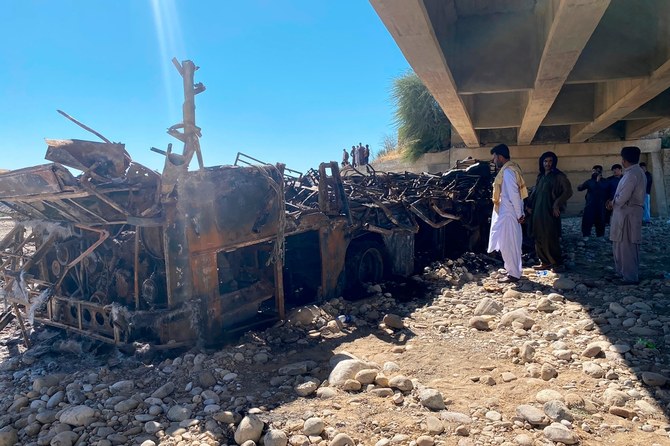
People look at the burnt wreckage of a bus after an accident in Bela, Lasbela, Balochistan, Pakistan, Sunday, Jan. 29, 2023. (AP Photo)
Short Url
Updated 30 January 2023
Follow

At least 50 killed in two separate transport incidents in Pakistan 

  • A passenger bus fell into a ravine and caught fire in Balochistan’s Bela area, killing at least 40 people 
  • In second mishap, 10 children were killed after their ferry capsized in country’s northwest on Sunday 

KARACHI: At least 50 people were killed in two separate transport disasters in Pakistan on Sunday, officials said, renewing a debate about poor transport safety protocols in the South Asian country.  

In the first incident, a passenger bus fell into a ravine and later caught fire in the Bela area of Pakistan’s southwestern Balochistan province, where road accidents claim thousands of lives annually.   

Balochistan, a mountainous, desert region bordering Afghanistan and Iran, is Pakistan’s largest but most impoverished province, with a staggering 40,000-km network of road infrastructure.   

According to the motorway police, 6,000 to 8,000 people die each year in accidents across the Balochistan province, mainly on single-lane roads that have infamously come to be known as “killer highways.”   

“A bus going from Quetta to Karachi plunged into a ravine and caught fire at around 3 a.m.,” Hamza Anjum Nadeem, the Bela assistant commissioner, told Arab News. “At least 39 bodies have been recovered and a search for others is underway.”  

Anjum later confirmed the death of another passenger, taking the count to 40. Of these, 38 dead bodies were being moved to the southern port city of Karachi, 177 km away from Bela, for medico-legal formalities, Karachi Police Surgeon Dr. Summaiya Syed told Arab News.  

Balochistan is the epicenter of the $64 billion China-Pakistan Economic Corridor, a road and infrastructure development plan, which aims to ultimately provide the shortest route for Chinese cargo headed for the Middle East, Africa and Central Asia. 

Major roads are slated for construction under the CPEC, including the road from Balochistan’s Khuzdar district to the Chinese-funded, deep-water port of Gwadar. But for now, the absence of dual carriageways, inadequate training of drivers, and a lack of highway patrols mean thousands continue to die on these roads each year.

In another incident, 10 children died when their boat capsized in Tanda Dam lake near Kohat in the country’s northwest, according to police.  

All of the dead recovered so far were aged between 7 and 14 years, local police official Mir Rauf told the AFP news agency. Rauf said 11 children had been rescued from the water, with six in critical condition. The boat was carrying between 25 and 30 students on a day trip from a local madrassa when it overturned.  

“A rescue operation is underway,” Rauf said. Mass drownings are common in Pakistan when aged and overloaded vessels lose their stability and pitch passengers into the water. In July, 18 women drowned when an overcrowded boat carrying a wedding party across the Indus river in Punjab province capsized.  

The South Asian country also has poor road safety controls, and thousands of lives are lost to road crashes each year, particularly in the southwestern Balochistan province.  

According to the National Road Safety Strategy 2018-2030, a report administered by the Asian Development Bank that cited police data, 6,548 people died at the scene of an accident on Pakistan’s roads in 2016. Of these, 355 fatalities happened on national highways and 6,003 on provincial roads.  

At least seven people were killed and 15 others were injured after a passenger bus collided with a truck in Balochistan’s Killa Saifullah district this month. In June last year, 22 people were killed when a passenger bus veered off a narrow road and fell into a ravine in the same district.


Venezuela to debate historic amnesty bill for political prisoners

Updated 57 min 9 sec ago
Follow

Venezuela to debate historic amnesty bill for political prisoners

  • Venezuela could pass a landmark bill on Thursday granting amnesty to political prisoners, marking an early milestone in the transition from the rule of toppled leader Nicolas Maduro

CARACAS:Venezuela could pass a landmark bill on Thursday granting amnesty to political prisoners, marking an early milestone in the transition from the rule of toppled leader Nicolas Maduro.
The legislation, which covers charges used to lock up dissidents under Maduro and his predecessor Hugo Chavez, aims to turn the page on nearly three decades of state repression.
It was spearheaded by interim president Delcy Rodriguez, who replaced Maduro after he was captured by US forces in Caracas last month and flown to New York to face trial.
Rodriguez took Maduro’s place with the consent of US President Donald Trump, provided she does Washington’s bidding on access to Venezuelan oil and expanding democratic freedoms.
She has already started releasing political prisoners ahead of the pending amnesty. More than 400 people have been released so far, according to rights group Foro Penal, but many more are still behind bars.
Rodriguez also ordered the closure of the notorious Helicoide prison in Caracas, which has been denounced as a torture center by the opposition and activists.
Lawmakers voted last week in favor of the amnesty bill in the first of two debates.
The second debate on Thursday coincides with Youth Day in Venezuela, which is traditionally marked by protests.
Students from the Central University of Venezuela, one of the country’s largest schools and home to criticism of Chavismo, called for a rally on campus.
Venezuela’s ruling party also announced a march in the capital Caracas.
’We deserve peace’
Venezuela’s attorney general said Wednesday that the amnesty — which is meant to clear the rap sheets of hundreds of people jailed for challenging the Maduro regime — must apply to both opposition and government figures.
He urged the United States to release Maduro and his wife, both in detention in New York.
“We deserve peace, and everything should be debated through dialogue,” Attorney General Tarek William Saab told AFP in an interview.
Delcy Rodriguez’s brother Jorge Rodriguez, who presides over the National Assembly, said last week that the law’s approval would trigger the release of all political prisoners.
“Once this law is approved, they will all be released the very same day,” he told prisoners’ families outside the notorious Zona 7 detention center in Caracas.
’We are all afraid’
Venezuelan opposition leader Juan Pablo Guanipa was one of the detainees granted early release.
But he was re-arrested less than 12 hours later and put under house arrest.
Authorities accused him of violating his parole after calling for elections during a visit to Helicoide prison, where he joined a demonstration with the families of political prisoners.
Guanipa is a close ally of Nobel Peace Prize laureate and opposition leader Maria Corina Machado, who was in hiding for over a year before she fled the country to travel to Oslo to receive the award.
“We are all afraid, but we have to keep fighting so we can speak and live in peace,” Guanipa’s son told reporters outside his home in Maracaibo.