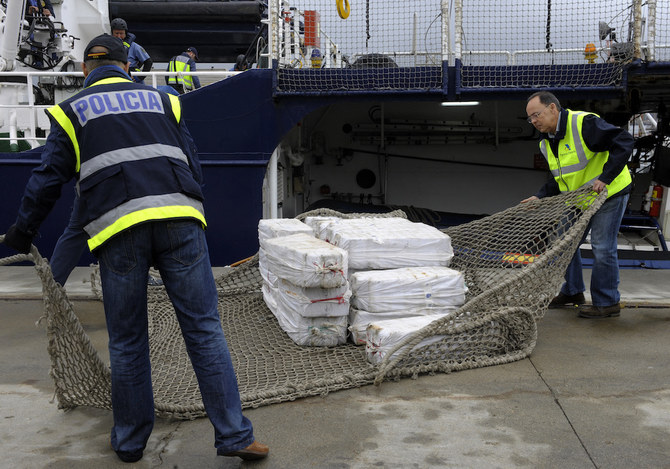
MADRID: Spanish police announced on Saturday the seizure of 4.5 tons of cocaine aboard a Togolese-flagged cargo ship from Latin America which was intercepted off the Canary Islands.
The “Orion V,” which had been trailed from Colombia and transports cattle from Latin America to the Middle East, had been under surveillance for over two years and had previously been “checked and searched, but no drugs could be found inside, despite the presence of sufficient clues,” police said.
A joint naval and air operation finally made the breakthrough in locating the cocaine, which has an estimated street value of 105 million euros ($114 million), on Tuesday, hidden in a container used to feed the cattle.
The ship had stopped at ports in about a dozen countries before Tuesday’s raid, and police said drug smugglers had started using livestock ships because it was more difficult for police to trace their illicit cargo.
“International organizations are reinventing themselves to transport drugs from Latin America to Europe, using livestock to make the control and localization more difficult,” the Spanish police statement said.
The operation mobilized among others the American Drug Enforcement Administration (DEA), the Maritime Analysis and Operations Center for narcotics (MAOC-N), the Togolese authorities and the Spanish police.
The 28 crew members from nine countries were arrested.
Officers unloaded dozens of boxes containing the cocaine on the port side in Las Palmas on the island of Gran Canaria.
The “Orion V” was similar to another Togolese-flagged vessel, the “Blume,” which was intercepted in mid-January in the same area south-east of the Canary Islands, on which the same amount of cocaine was found.
A total of nine tons of drugs have been seized in January, police said in a statement.
Spain’s proximity to North Africa, a key source of hashish, and its close ties with former colonies in Latin America, the world’s main cocaine-producing region, have made it a gateway into Europe for drugs.
(With AFP and Reuters)
Spanish police seize 4.5 tons of cocaine off Canaries
Short Url
https://arab.news/mqzaj
Spanish police seize 4.5 tons of cocaine off Canaries
- Cocaine was seized during raid on cattle ship off the Canary Islands earlier this week
- Police arrested 28 crew members
Trump Maritime Action Plan eyes levies on China goods to resurrect US shipbuilding
- Maritime prosperity zones proposed to boost investment and workforce training
- Maritime Security Trust Fund to finance shipyard revitalization
WASHINGTON: The Trump administration on Friday released its plan to rebuild US shipbuilding and other maritime businesses, paid for in part by port fees on cargo delivered to the United States on ships made in China — levies the US and China agreed to pause for one year.
The Maritime Action Plan offers a road map for the revival of US shipbuilding, which has shrunk since World War Two and now severely lags China and other nations.
Coming in at more than 30 pages, the plan calls for establishing maritime prosperity zones to bolster investment, reforming workforce training and education, expanding the fleet of US-built and US-flagged commercial ships, establishing a dedicated funding stream through a Maritime Security Trust Fund and reducing regulations.
The Trump administration early last year announced plans to levy fees on China-linked ships to loosen the country’s grip on the global maritime industry and help pay for a US shipbuilding renaissance. The so-called Section 301 penalties followed a US probe that concluded China uses unfair policies and practices to dominate global shipping.
The fees, which sparked intense pushback from the global shipping industry and intensified tensions between the world’s two largest economies, hit on October 14 and were expected to generate an estimated $3.2 billion annually from Chinese-built vessels sailing to US ports.
But China retaliated with its own port fees on US-linked ships and the tit-for-tat fees disrupted global shipping. Soon after, the two sides struck a deal to put the levies on hold for 12 months.
On Friday, Shipyard owners, investors and the bipartisan sponsors of the Shipbuilding and Harbor Infrastructure for Prosperity and Security (SHIPS) for America Act welcomed President Donald Trump’s maritime plan, which landed months later than hoped.
US Senator Todd Young, a Republican from Indiana, said there is substantial overlap between Trump’s vision and the plan in that proposed law, which he reintroduced last year with Democratic Senator Mark Kelly of Arizona and other lawmakers.
Importantly, the SHIPS Act would establish a Maritime Security Trust Fund to reinvest port fee proceeds into maritime security and infrastructure projects such as shipyard revitalization. It has rare backing from both Democratic and Republican lawmakers in Washington, but has not made swift progress.
“The announcement today should serve as a wake-up call for Congress to act quickly on this bill in order to provide the legal authorities and resources necessary to make this plan a reality,” Young said. “It’s time to make American ships again.”
The Maritime Action Plan offers a road map for the revival of US shipbuilding, which has shrunk since World War Two and now severely lags China and other nations.
Coming in at more than 30 pages, the plan calls for establishing maritime prosperity zones to bolster investment, reforming workforce training and education, expanding the fleet of US-built and US-flagged commercial ships, establishing a dedicated funding stream through a Maritime Security Trust Fund and reducing regulations.
The Trump administration early last year announced plans to levy fees on China-linked ships to loosen the country’s grip on the global maritime industry and help pay for a US shipbuilding renaissance. The so-called Section 301 penalties followed a US probe that concluded China uses unfair policies and practices to dominate global shipping.
The fees, which sparked intense pushback from the global shipping industry and intensified tensions between the world’s two largest economies, hit on October 14 and were expected to generate an estimated $3.2 billion annually from Chinese-built vessels sailing to US ports.
But China retaliated with its own port fees on US-linked ships and the tit-for-tat fees disrupted global shipping. Soon after, the two sides struck a deal to put the levies on hold for 12 months.
On Friday, Shipyard owners, investors and the bipartisan sponsors of the Shipbuilding and Harbor Infrastructure for Prosperity and Security (SHIPS) for America Act welcomed President Donald Trump’s maritime plan, which landed months later than hoped.
US Senator Todd Young, a Republican from Indiana, said there is substantial overlap between Trump’s vision and the plan in that proposed law, which he reintroduced last year with Democratic Senator Mark Kelly of Arizona and other lawmakers.
Importantly, the SHIPS Act would establish a Maritime Security Trust Fund to reinvest port fee proceeds into maritime security and infrastructure projects such as shipyard revitalization. It has rare backing from both Democratic and Republican lawmakers in Washington, but has not made swift progress.
“The announcement today should serve as a wake-up call for Congress to act quickly on this bill in order to provide the legal authorities and resources necessary to make this plan a reality,” Young said. “It’s time to make American ships again.”
© 2026 SAUDI RESEARCH & PUBLISHING COMPANY, All Rights Reserved And subject to Terms of Use Agreement.