

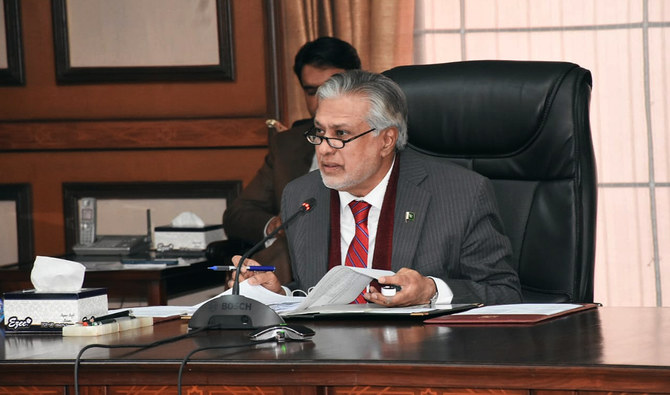
Pakistan finance minister blames ex-PM Khan for current economic meltdown

This handout picture, released by Finance Ministry on January 17, 2023, shows Pakistan's finance minister Ishaq Dar chairing the Economic Coordination Committee in Islamabad. (Photo courtesy: Twitter/FinMinistryPak)
Short Url
Updated 28 January 2023
Follow

Pakistan finance minister blames ex-PM Khan for current economic meltdown

  • Khan on Friday voiced concerns Pakistan’s economic situation could threaten its national security
  • Ishaq Dar says ex-PM Khan ignored public woes, remained busy in ‘political persecution’ in his tenure

ISLAMABAD: Pakistan's Finance Minister Ishaq Dar on Friday blamed ousted prime minister Imran Khan for the present economic turmoil in the South Asian country, saying Khan ignored public problems and remain busy in “political persecution” in his tenure.

Khan, who was ousted in a no-trust vote in April, said he was concerned the country’s deteriorating economic situation was likely to threaten its national security as anyone coming to Pakistan’s financial rescue was likely to “ask for something in return.”

Khan’s statement followed PM Shehbaz Sharif’s announcement on Friday that he was hopeful about a deal with the International Monetary Fund (IMF) in January which would ensure the resumption of Pakistan’s $7 billion loan program pending since September.

In a video statement, Dar slammed Khan for present economic woes of the country, stating inflation numbers and urging the former premier not to “lie” to the masses.

“The country witnessed a storm of inflation because of you... you allowed the rupee to float freely, you didn’t care about Pakistan’s economy, you were busy in political persecution and you didn’t care about public problems,” the finance minister said.

“We formed the government under Mian Nawaz Sharif’s leadership at 8.6 percent [consumer price index] in 2013 and you were handed over the government at 4.68 percent CPI in five years, and food inflation was at 2 percent.”

Dar noted that when Khan was ousted from power in April last year, inflation had reached 12.2 percent in the South Asian country.

Pakistan is currently grappling with a host of economic issues, including decades-high inflation, depleting forex reserves and its currency losing more than 12 percent value over the last two days.

The IMF announced on Thursday it was sending its mission to Pakistan on January 31 to discuss a $6 billion loan program, originally signed in 2019 by Khan’s administration, which was topped up with another $1 billion last year.

The country desperately needs next IMF loan tranche to shore up its dwindling forex reserves that have dropped below $4 billion — barely enough to cover three weeks of imports.

The IMF stalled disbursements last year since the government was reluctant to implement stringent economic reforms, such as removal of various subsidies, amid soaring inflation in the country.


Pakistan plans 3,000 EV charging stations as green mobility push gathers pace

Updated 14 January 2026
Follow

Pakistan plans 3,000 EV charging stations as green mobility push gathers pace

  • Roadmap unveiled by energy efficiency regulator and a private conglomerate amid early-stage EV rollout
  • New EV Policy and related plans aim to install 3,000 EV stations by 2030, including 240 stations in current fiscal year

ISLAMABAD: Pakistan’s energy efficiency regulator and a private conglomerate have unveiled an approved roadmap to establish 3,000 electric vehicle (EV) charging stations across the country, state-run Associated Press of Pakistan (APP) reported on Tuesday.

The announcement comes as Pakistan looks to build out basic EV charging infrastructure, which remains limited and unevenly distributed, largely concentrated in major cities. Despite policy commitments to promote electric mobility as part of climate and energy-efficiency goals, the absence of a nationwide charging network has slowed broader EV adoption.

Pakistan’s EV ecosystem is still at a formative stage, with progress constrained by regulatory approvals, grid connectivity issues and coordination challenges among utilities, regulators and fuel retailers. Expanding charging infrastructure is widely seen as a prerequisite for scaling electric transport for both private and commercial use.

According to APP, the roadmap was presented during a meeting between Malik Group Chief Executive Officer Malik Khuda Baksh and National Energy Efficiency and Conservation Authority Managing Director and Additional Secretary Humayon Khan.

“Baksh ... in a meeting with Khan, unveiled the approved roadmap for establishing 3,000 electric vehicle charging stations across Pakistan,” APP reported. “Khan reaffirmed the authority’s full institutional backing and pledged to expand the initiative to 6,000 EV charging stations nationwide.”

The discussion reviewed hurdles delaying the rollout, including EV charger imports, customs duties, regulatory documentation and inter-agency coordination.

APP said Khan welcomed the proposal and sought recommendations for “internationally compliant EV charger brands,” while asking for a detailed “issue-and-solutions report within three days” to facilitate timely implementation of the national green mobility initiative.

Despite the issuance of 13 licenses by NEECA and the arrival of five EV charging units at designated sites, progress has been slowed by procedural bottlenecks, officials said. These include delays in electricity connections, prolonged installation of separate meters and pending no-objection certificates from power distribution companies and oil marketing firms, which continue to stall operational readiness.

Pakistan’s electric vehicle ecosystem is still in its early stages, with charging infrastructure far behind levels seen in more advanced markets. The government’s New Energy Vehicle Policy and related plans aim to install 3,000 EV charging stations by 2030, including 240 stations planned in the current fiscal year, but actual deployment remains limited and uneven, mostly clustered in major cities and along key urban corridors.

Despite regulatory backing, including the 2024 Electric Vehicles Charging Infrastructure and Battery Swapping Stations framework, progress has been slow. Many proposed stations have yet to become operational due to delays in grid connections and approvals, and public maps of nationwide charging coverage are not yet available.

Private players are beginning to install more chargers, and there are over 20 public EV charging points reported in urban centers, offering both slower AC chargers and faster DC options. However, such infrastructure is still sparse compared with the growing number of electric vehicles and the government’s long-term targets.