

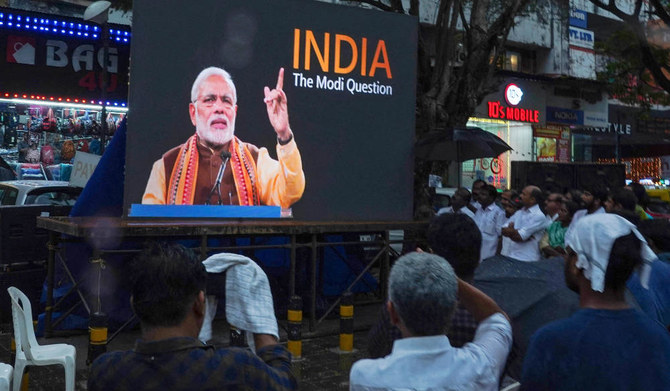

NEW DELHI: Indian students are defying a ban on a BBC program examining Prime Minister Narendra Modi’s past, despite arrests and attempts by authorities to prevent them from organizing screenings.
The two-part program, “India: The Modi Question,” examines claims about Modi’s role in the 2002 riots in Gujarat that left more than 1,000 dead, most of them Muslims.
Modi was serving as chief minister of the western state when the violence broke out.
The government banned the documentary over the weekend using emergency powers under information technology laws, but students continued to organize screenings across the country.
At least 13 students of Jamia Millia Islamia in New Delhi were detained for 24 hours on Wednesday, after they tried to show the documentary at their campus.
HIGHLIGHTS
• Documentary investigates Narendra Modi’s role in the deadly Gujarat riots in 2002.
• Government sees the British broadcaster’s program as ‘manipulation by foreign power.’
“We were handed over to the police by the proctor of Jamia Islamia University. On Friday, the Jamia authorities shut down all the facilities for students,” one of the arrested, Azeez Shareef from the Students Federation of India, told Arab News.
“We grew up with a certain idea of India, with secular values and democratic principles, but this government has attacked everything.”
Earlier this week, authorities cut off electricity at Jawaharlal Nehru University when students gathered to screen the documentary.
“We wanted to screen the documentary so that youth can form their own opinion,” said Aishe Ghosh, president of Jawaharlal Nehru Students Union.
“The new generation does not remember what happened in Gujarat in 2002 because they were too young. But when we see today’s reality, it’s important for the young generation to make the link that the same political party that is in power in Delhi was responsible in some form or another in manufacturing a pogrom in the state of Gujarat.”
She added that universities are where students should have “space to debate and discuss and differ.”
As the government ban means the film cannot be streamed or shared on social media — and Twitter and YouTube have complied with a government request to take down links to the documentary — students argue there is no explicit ban on screenings.
“Where is the order to ban the documentary?” said Abhisek Nandan, president of the Student Union of the University of Hyderabad, which has organized a screening and discussion on the first episode of the program.
“The documentary carries the truth about Gujarati riots that journalists and civil society groups have been telling for the last 20 years.”
Modi’s ruling Bharatiya Janata Party sees the British broadcaster’s film as manipulation and an assault on India’s judicial system.
“A foreign power undermining the judicial system of India is not the right thing to do. The entire episode of the Gujarat riot has minutely been scrutinized by all, including the judiciary,” BJP spokesperson Sudhanshu Mittal told Arab News.
In 2013, a court in Gujarat found Modi not directly responsible for the riots. The Supreme Court upheld the ruling in 2022.
“The documentary is an assault on the judicial system of this country. That’s why it is not permitted,” Mittal said.
“The country is right in not allowing manipulation by a foreign power.”
The film could undermine Modi’s reputation at a time when India is chairing the Group of 20 largest economies and will host the G20 summit this year.
“It’s obvious that PM Modi realized that the documentary had the potential to hurt his reputation at a time when he could least afford it,” political analyst Sanjay Kapoor told Arab News.
“For him, the G20 platform provided him an opportunity to showcase himself as a world leader, and he didn’t want his image to be sullied as someone who was complicit in the Gujarat genocide.”


