

Iran cleric ‘opposes use of violence to impose hijab’

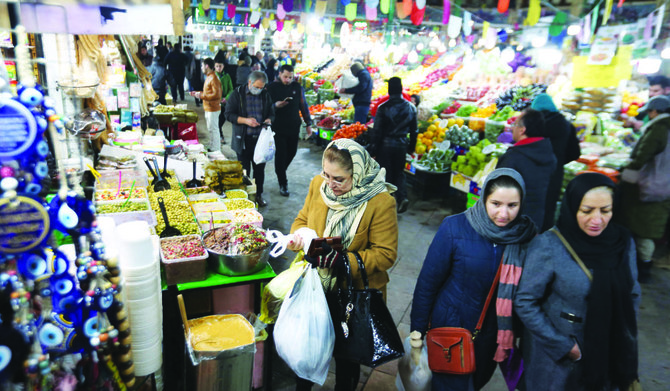
Iranians shop at Tajrish bazaar in northern Tehran. Iran has been rocked by protests since the Sept. 16 death of Mahsa Amini, a 22-year-old ethnic Kurd. (AFP)
Short Url
Updated 28 January 2023
Follow

Iran cleric ‘opposes use of violence to impose hijab’

  • Iran has accused its foreign foes, including the US and Israel, of fomenting the protests that erupted over Amini’s death in the custody of the country’s morality police

TEHRAN: One of Iran’s top clerics, Nasser Makarem, has spoken out against the use of violence to force women into wearing the veil.
Iran has witnessed a wave of nationwide protests since the Sept. 16 death of Mahsa Amini, a 22-year-old ethnic Kurd, after her arrest for an alleged breach of the regime’s dress code for women.
Hundreds of people have been killed, including dozens of security personnel, and thousands have been arrested in the protests, which authorities generally refer to a “riots.”
Makarem, a prominent cleric, said that he “does not consider violence and pressure to be effective in the hijab issue.”
“The president and ministers should know that they are in a difficult situation; it is true the enemy is very active, but not all avenues are closed,” he said, quoted by the IRNA news agency.

FASTFACT

Iran’s Tourism and Heritage Minister Ezzatollah Zarghami earlier called for greater tolerance toward women not wearing mandatory headscarves.

“The hijab issue is currently linked to political issues, and some people say that if they can remove the veil, the regime’s system will be weakened,” the cleric added.
Iran’s Tourism and Heritage Minister Ezzatollah Zarghami earlier called for greater tolerance toward women not wearing mandatory headscarves.
Earlier this month, however, Iran’s prosecutor general had called for police to “firmly punish any hijab violators.”
Iran has accused its foreign foes, including the US and Israel, of fomenting the protests that erupted over Amini’s death in the custody of the country’s morality police.
The cleric’s remarks came as Israeli President Isaac Herzog urged the NATO military alliance to toughen its approach to Iran, as Tehran supplies drones to Russia for its war on Ukraine.
“The crisis there goes beyond the boundaries of Ukraine, with the Iranian threat now at Europe’s doorstep,” Herzog said on a visit to NATO headquarters in Brussels.
“The illusion of distance can no longer hold. NATO must take the strongest possible stance against the Iranian regime including through economic, legal and political sanctions and credible military deterrence.”
The figurehead leader became on Thursday the first Israeli president to brief NATO’s main decision-making body.
“A terrible war continues to cause needless human suffering and compromise the well-being and welfare of millions,” Herzog said.
“Our hearts continue to go out to the people of Ukraine as they defend their homes and their country,” he said.
NATO chief Jens Stoltenberg said he had discussed “our support for Ukraine” with Herzog.
“The Ukrainian people are bravely defending their homeland and NATO allies and partners are helping to support their right to self defence,” he said.
The NATO secretary general said Herzog’s visit was a sign of the US-led alliance’s “deepening partnership” with Israel.
Herzog pointed to bolstering cooperation on cyber-security, threats from space, drones, and energy resilience.
He said the two sides were slated to sign a new cooperation agreement “in just a couple of months, which lengthens the period of cooperation and expands it reach.”


Ceasefire with Kurdish-led force extended for another 15 days, Syrian army says

Updated 25 January 2026
Follow

Ceasefire with Kurdish-led force extended for another 15 days, Syrian army says

  • The defense ministry said the extension was in support of an operation by US forces to transfer accused Daesh militants to Iraq
  • The Kurdish-led Syrian Democratic Forces confirmed the ceasefire extension

RAQQA, Syria: Hours after the expiration of a four-day truce between the Syrian government and Kurdish-led fighters Saturday, Syria’s defense ministry announced the ceasefire had been extended by another 15 days.
The defense ministry said in a statement that the extension was in support of an operation by US forces to transfer accused Daesh militants who had been held in prisons in northeastern Syria to detention centers in Iraq.
The Kurdish-led Syrian Democratic Forces confirmed the ceasefire extension.
“Our forces affirm their commitment to the agreement and their dedication to respecting it, which contributes to de-escalation, the protection of civilians, and the creation of the necessary conditions for stability,” the group said in a statement.
Over the past three weeks, there have been intense clashes between government forces and the SDF, in which the SDF lost large parts of the area they once controlled.
Earlier in the day, the Kurdish-led force called on the international community to prevent any escalation.
The end of the truce came as government forces have been sending reinforcements to Syria’s northeast.
Syria’s interim government signed an agreement last March with the SDF for it to hand over territory and to eventually merge its fighters with government forces. In early January, a new round of talks failed to make progress over the merger, leading to renewed fighting between the two sides.
A new version of the accord was signed last weekend, and a four-day ceasefire was declared Tuesday. Part of the new deal is that SDF members will have to merge into the army and police forces as individuals.
The SDF said in a statement Saturday that military buildups and logistical movements by government forces have been observed, “clearly indicating an intent to escalate and push the region toward a new confrontation.” The SDF said it will continue to abide by the truce.
On Saturday, state TV said authorities on Saturday released 126 boys under the age of 18 who were held at the Al-Aqtan prison near the northern city of Raqqa that was taken by government forces Friday. The teenagers were taken to the city of Raqqa where they were handed over to their families, the TV station said.
The prison is also home to some of the 9,000 members of the Daesh group who are held in northeastern Syria. Most of them remain held in jails run by the SDF. Government forces have so far taken control of two prisons while the rest are still run by the SDF.
Earlier this week, the US military said that some 7,000 Daesh detainees will be transferred to detention centers in neighboring Iraq.
On Wednesday, the US military said that 150 prisoners have been taken to Iraq.