

Official says two factories sealed after 18 dead from ‘inhaling toxic gas’ in Karachi

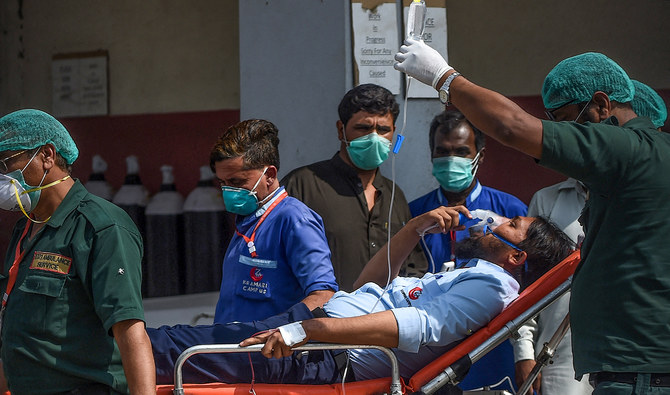
Paramedics personnel shift a patient on a stretcher into the hospital in Karachi on February 18, 2020, after a toxic gas leak in a coastal residential area in Pakistan's port city of Karachi. (AFP/File)
Short Url
Updated 27 January 2023
Follow

Official says two factories sealed after 18 dead from ‘inhaling toxic gas’ in Karachi

  • The deaths in a port side village had occurred between January 11 and January 25, 2023
  • Incidents of gas leakages and fire are common in Karachi where many factories operate illegally

KARACHI: Two factories were sealed in Pakistan’s commercial capital of Karachi on Friday, a senior government officer said, after at least eighteen people died in little over two weeks from, according to health officials, inhaling toxic chemicals omitted by the industrial units.

A Sindh health department handout said the deaths had occurred between January 11 and January 25, 2023. The eighteen dead had developed initial symptoms of fever, sore throat, and shortness of breath before they passed away.

Incidents of gas leakages and fires are common in Karachi, where many factories operate illegally and without proper safety measures. Many are located inside or near residential areas without following security protocols. 

In February 2020, at least fourteen people died in a toxic gas leak in the city’s Keemari portside district of Karachi. In December, four more people died of a mysterious gas in the same locality. In 2013, a fire inside a garment factory in Karachi killed 258 people.

“Two factories that caused the deaths have been sealed,” Qasim Soomro, Parliamentary Secretary Sindh told Arab News, saying the factories were illegally operating in a residential area.

“According to initial investigation, the factories had burnt something that created fume. A forensic examination will determine the name and nature of the substance,” he added.

Senior Sindh health official Dr. Abdul Hameed Jumani said laboratory tests and X-rays showed that the deaths had occurred due to chemicals discharged by two factories in the Ali Muhammad Goth village.

“People who died had no prior history of the disease and they are from different age groups,” he said. 

He said no one had died after the factories were closed. 

“Some members of the team of doctors which visited the neighborhood on Thursday vomited when they returned from the field. But when we visited the neighborhood today [Friday], the situation had improved,” Jumani said, adding that the number of patients had also dropped to 26 on Friday from 50 on Thursday. 

Local elders also said they believed the deaths were caused by leakages from nearby factories.

“There was a certain smell, and it was something discharged by the factory which caused the deaths,” Abdul Hafeez told Arab News, adding that the people of the area regularly felt suffocated. 

Dr. Rana Jawad Asghar, who specializes in infectious diseases, however said Sindh health officials needed to conduct an epidemiological test before reaching a conclusion. 

“The Sindh health department has experts who may conduct a proper epidemiological examination for reaching the true causes,” Asghar said. 


Pakistan high court pauses tree-cutting in Islamabad until Feb. 2

Updated 16 January 2026
Follow

Pakistan high court pauses tree-cutting in Islamabad until Feb. 2

  • Islamabad High Court asks CDA to ‘explain and justify’ tree-cutting at next hearing
  • CDA officials say 29,000 trees were cut due to allergies, deny felling in green belts

ISLAMABAD: The Islamabad High Court has ordered an immediate halt to tree-cutting in the federal capital until Feb. 2, seeking justification from civic authorities over the legality of a large-scale felling drive that has seen thousands of trees removed in recent months.

The interim order, issued by a single-judge bench led by Justice Khadim Hussain Soomro, came during proceedings on a petition challenging the Capital Development Authority’s (CDA) tree-cutting operations in Islamabad’s Shakarparian area and H-8 sector.

At the outset of the hearing, the petitioner’s counsel argued that trees were being felled in violation of the Pakistan Environmental Protection Act 1997, the Islamabad Wildlife Ordinance 1979 and the city’s master plan.

“Respondents shall not cut trees till the next date of hearing,” Justice Soomro said in the court order released on Friday while referring to CDA officials.

“Respondents are directed to come fully prepared and to file paragraph-wise comments before the next date of hearing, along with a comprehensive report explaining the justification and legal basis for the cutting of trees,” he added.

According to the court order, the petitioner maintained that the CDA had not made any public disclosure regarding the legal basis for the operation and that the felling was causing environmental harm.

The petition sought access to the official record of tree-cutting activities and called for the penalization of CDA officials responsible for the act under relevant criminal and environmental laws.

It also urged the court to impose a moratorium on infrastructure projects in Islamabad, order large-scale replanting as compensation and constitute a judicial commission headed by a retired Supreme Court judge to probe the alleged violations.

CDA officials acknowledge around 29,000 paper mulberry trees have been cut in the capital in recent months, arguing that the species triggers seasonal allergies such as sneezing, itchy eyes and nasal congestion.

They also maintain that no trees have been removed from designated green belts and that the number of replacement trees planted exceeds those felled.

Designed in the 1960s by Greek architect Constantinos Doxiadis, Islamabad was conceived as a low-density city with green belts and protected natural zones at its core.

Critics, however, say the recent felling has extended beyond paper mulberry trees and question whether authorities are adhering to the city’s master plan and the legal protections governing forested and green areas.

The court has adjourned its hearing until Feb. 2, 2026.