

Pakistani rupee drops to record low amid hopes for IMF funds

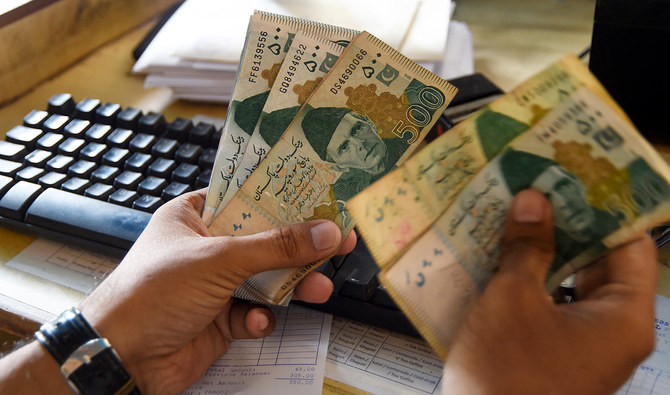
A Pakistani man counts Pakistan's rupees at his shop in Karachi on May 16, 2019. (Photo courtesy: AFP)
Short Url
Updated 27 January 2023
Follow

Pakistani rupee drops to record low amid hopes for IMF funds

  • The Pakistani rupee fell 9.6 percent against the dollar on Thursday in the inter-bank market
  • IMF plans to send a delegation to Pakistan from Jan 31 to Feb 9 to discuss a stalled loan package

KARACHI: The Pakistani rupee fell 2.7 percent against the US dollar on Friday to a record low after a steep slide on Thursday, with hopes raised by an International Monetary Fund (IMF) team visiting Islamabad next week to discuss unlocking a suspended bail-out package.

The rupee closed at 262.6 per dollar in the interbank market against a close of 255 on Thursday.


Earlier in the day, the Pakistani rupee showed signs of steadying after steep decline over the previous two days.

On Thursday, the Pakistani rupee fell 9.6 percent against the dollar in the inter-bank market, the biggest one-day drop in over two decades, a day after foreign exchange companies removed a cap on the exchange rate.

Hours after the rupee was left to the market forces to decide its worth, the IMF announced that its delegation will be visiting Pakistan from Jan 31 to Feb 9 to discuss its 9th review of a bailout package agreed for $6 billion in 2019, and topped up to $7 billion last year.

“As we have seen the announcement, and the IMF program is resumed, we should be, God willing, good,” former finance minister Miftah Ismail told Geo TV, adding that it will head off the risk of Pakistan defaulting on its external obligations.

Disbursements from the package were suspended in November, due the lack of progress on fiscal consolidation, hastening Pakistan’s slide deeper into a balance of payments crisis, with foreign exchange reserves currently only able to cover three weeks imports.


Pakistan reaffirms commitment to clamp down on informal sector to encourage investment

Updated 6 sec ago
Follow

Pakistan reaffirms commitment to clamp down on informal sector to encourage investment

  • Nestlé delegation briefs Finance Minister Muhammad Aurangzeb on localization, efficiency enhancements in Pakistan
  • Improved compliance, transparency, strengthened tax ecosystem central to economic recovery, stresses finance minister

KARACHI: Pakistan’s Finance Minister Muhammad Aurangzeb reaffirmed the government’s commitment to clamp down on the informal sector on Monday, the Finance Division said, citing transparency and a strengthened tax ecosystem as central to the country’s economic recovery. 

Pakistan’s government has cracked down on smuggled items and tightened enforcement in poorly taxed sectors, such as tobacco, in recent months as it pushes ahead with its efforts to maximize tax collection by discouraging the formal sector. Informal sector comprises businesses that operate outside the tax net, avoid registration and as a result, neglect regulatory oversight and violate quality, safety or labor standards. 

Aurangzeb met a delegation from Nestlé Pakistan at the Finance Division, where the two sides discussed the multinational’s efforts to strengthen its operations in the country through localization, portfolio adjustments and efficiency enhancements. 

“Emphasizing the government’s resolve to clamp down on the informal sector, an effort that has already begun yielding visible results in multiple industries, the finance minister noted that improved compliance, transparency and a strengthened tax ecosystem are central to Pakistan’s economic recovery,” the Finance Division said in a statement. 

Nestlé Pakistan Chief Executive Officer Jason Avancena provided an overview of the organization’s operations, claiming it had strengthened them through localization, portfolio adjustments, advanced automation, efficiency enhancements and continued innovation across product categories. 

Avancena said Nestlé is implementing solar and biomass energy systems, digital dashboards, environmentally improved packaging, and supply-chain automation in Pakistan. The delegation highlighted that Nestlé’s localization efforts have materially strengthened its resilience. 

“They noted that through sustained efforts to localize raw materials and reconfigure product portfolios, Nestlé Pakistan has reduced its import volumes by nearly half over the past three years from around $150 million to approximately $76–80 million, thereby minimizing exposure to foreign-exchange pressures and deepening integration with Pakistan’s agricultural and manufacturing base,” the Finance Division said. 

Aurangzeb commended the multinational for its efforts and underscored the government’s intention to facilitate greater formalization and enhanced tax equity across the food and beverages sector. He noted that informal players have “rapidly expanded” their market share by operating outside the tax net in sectors such as food and beverages. 

The delegation also discussed export performance, including the company’s presence in markets such as the United States, Canada, the Gulf, and the United Kingdom, sharing insights into challenges related to regional trade, particularly the Afghanistan corridor. 

Aurangzeb advised Nestlé to explore logistics partnerships to expand access to Central Asian markets, reiterating that Islamabad remains committed to enabling export-oriented industry growth.