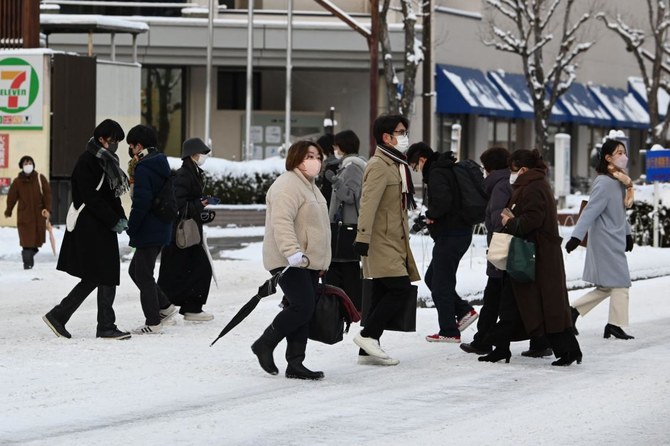
NAGANGO: Tourists revelled in wintry scenes across Japan on Wednesday, as much of the country was blanketed by snow in a cold snap that has killed at least one person and disrupted travel.
“These temperatures are some of the coldest we’ve seen in a decade,” Japan Meteorological Agency official Takafumi Umeda said.
Record lows were logged in several locations, including one area of southern Kumamoto, where the mercury hit -9 degrees Celsius, the coldest logged there since 1977 when that observation site began keeping track.
Top government spokesman Hirokazu Matsuno said one person had died in the cold snap, while meteorologists warned of blizzards, high waves and traffic snarl-ups due to icy roads.
Authorities were also investigating whether two other deaths were related to the freezing weather across much of the archipelago, Matsuno told reporters.
Hundreds of flights were canceled due to the snowstorm, while delays and cancelations disrupted both local trains and long-distance Shinkansen services. Vehicles on major roads in several locations were left stranded, local media said.
At the seventh-century Zenkoji Temple in the mountainous region of Nagano, north of Tokyo, a chilly calm descended with trees, old-fashioned lamp posts and the place of worship itself covered in layers of powdery snow.
Visitors included some who were there for skiing but had been forced off the slopes by blizzard conditions.
“I came to ski, but the snow was incredibly heavy so I cut my plan short and instead decided to do a bit of sightseeing,” 30-year-old Akiko Sotobori said.
“The blizzard (at the ski resort) was such that I couldn’t see anything three meters ahead.”
There were picturesque scenes in the former capital, tourist favorite Kyoto, where the shining walls of the famous Golden Pavilion contrasted with the temporary bright-white brilliance of its tiered roofs.
The country’s Sea of Japan coast was hit hardest by the overnight blizzard, with Tokyo and its surrounding regions spared the snow but seeing unseasonably low temperatures.

One dead as heavy snow and record cold hit Japan
https://arab.news/z5fu3
One dead as heavy snow and record cold hit Japan
2025 among world’s three hottest years on record, WMO says
- All eight datasets confirmed that the last three years were the planet’s three hottest since records began, the WMO said
- The slight differences in the datasets’ rankings reflect their different methodologies and types of measurements
BRUSSELS: Last year was among the planet’s three warmest on record, the World Meteorological Organization said on Wednesday, as EU scientists also confirmed average temperatures have now exceeded 1.5 degrees Celsius of global warming for the longest since records began.
The WMO, which consolidates eight climate datasets from around the world, said six of them — including the European Union’s European Center for Medium-Range Weather Forecasts (ECMWF) and the British national weather service — had ranked 2025 as the third warmest, while two placed it as the second warmest in the 176-year record.
All eight datasets confirmed that the last three years were the planet’s three hottest since records began, the WMO said. The warmest year on record was 2024.
THREE-YEAR PERIOD ABOVE 1.5 C AVERAGE WARMING LEVEL
The slight differences in the datasets’ rankings reflect their different methodologies and types of measurements — which include satellite data and readings from weather stations.
ECMWF said 2025 also rounded out the first three-year period in which the average global temperature was 1.5 C above the pre-industrial era — the limit beyond which scientists expect global warming will unleash severe impacts, some of them irreversible.
“1.5 C is not a cliff edge. However, we know that every fraction of a degree matters, particularly for worsening extreme weather events,” said Samantha Burgess, strategic lead for climate at ECMWF.
Burgess said she expected 2026 to be among the planet’s five warmest years.
CHOICE OF HOW TO MANAGE TEMPERATURE OVERSHOOT
Governments pledged under the 2015 Paris Agreement to try to avoid exceeding 1.5 C of global warming, measured as a decades-long average temperature compared with pre-industrial temperatures.
But their failure to reduce greenhouse gas emissions means that target could now be breached before 2030 — a decade earlier than had been predicted when the Paris accord was signed in 2015, ECMWF said. “We are bound to pass it,” said Carlo Buontempo, director of the EU’s Copernicus Climate Change Service. “The choice we now have is how to best manage the inevitable overshoot and its consequences on societies and natural systems.”
Currently, the world’s long-term warming level is about 1.4 C above the pre-industrial era, ECMWF said. Measured on a short-term basis, average annual temperatures breached 1.5 C for the first time in 2024.
EXTREME WEATHER
Exceeding the long-term 1.5 C limit would lead to more extreme and widespread impacts, including hotter and longer heatwaves, and more powerful storms and floods. Already in 2025, wildfires in Europe produced the highest total emissions on record, while scientific studies confirmed specific weather events were made worse by climate change, including Hurricane Melissa in the Caribbean and monsoon rains in Pakistan which killed more than 1,000 people in floods.
Despite these worsening impacts, climate science is facing political pushback. US President Donald Trump, who has called climate change “the greatest con job,” last week withdrew from dozens of UN entities including the scientific Intergovernmental Panel on Climate Change.
The long-established consensus among the world’s scientists is that climate change is real, mostly caused by humans, and getting worse. Its main cause is greenhouse gas emissions from burning fossil fuels like coal, oil and gas, which trap heat in the atmosphere.


