

What We Are Reading Today: ‘Nine Things Successful People Do Differently’

Photo/Supplied
Short Url
Updated 25 January 2023
Follow

What We Are Reading Today: ‘Nine Things Successful People Do Differently’

Author: Heidi Grant Halvorson

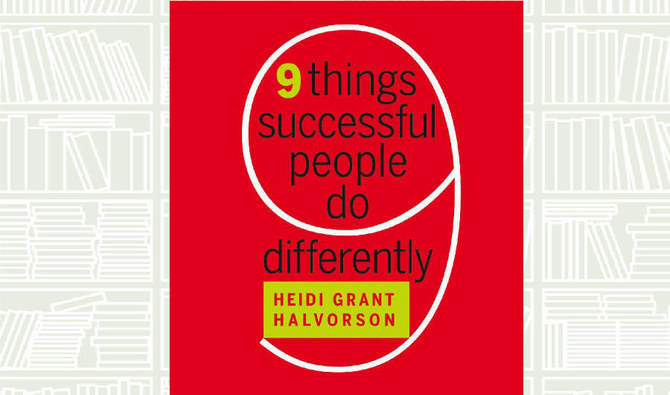
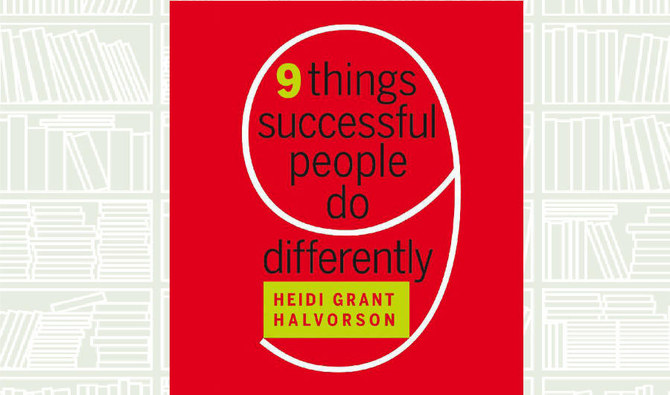
“Nine Things Successful People Do Differently” is a self-help book written by Heidi Grant Halvorson.

An easy read, the book highlights the key attributes of high achievers in helping them to achieve their goals.

It cites research showing that people achieve things not because of who they are, but because of what they do, and identifies nine strategies used by successful people to hit their targets.

They include being specific, seizing the moment, being a realistic optimist, focusing on getting better rather than getting good, showing determination, and focusing only on what needs to be done.

Halvorson explains the importance of knowing exactly what must be accomplished and keeping track of every action toward that set goal.

On being a realistic optimist, she points out the need to aim high, have a clear plan, and stay motivated.

And thoughts and ideas should be written down and acted upon as soon as possible.

A psychologist, researcher, and author, Halvorson has written for Forbes, Harvard Business Review, Business Insider, The Huffington Post, and Psychology Today, and was one of Thinkers50 most influential management thinkers.

She is director of research and development for EY Americas Learning, and associate director of the Motivation Science Center at Columbia University.


What We Are Reading Today: A Capital’s Capital

Updated 16 February 2026
Follow

What We Are Reading Today: A Capital’s Capital

Authors: Gilles  Postel-Vinay and Jean-Laurent Rosenthal

Successful economies sustain capital accumulation across generations, and capital accumulation leads to large increases in private wealth. In this book, Gilles Postel-Vinay and Jean-Laurent Rosenthal map the fluctuations in wealth and its distribution in Paris between 1807 and 1977. 

Drawing on a unique dataset of the bequests of almost 800,000 Parisians, they show that real wealth per decedent varied immensely during this period while inequality began high and declined only slowly. 

Parisians’ portfolios document startling changes in the geography and types of wealth over time.

Postel-Vinay and Rosenthal’s account reveals the impact of economic factors (large shocks, technological changes, differential returns to wealth), political factors (changes in taxation), and demographic and social factors (age and gender) on wealth and inequality.

Before World War I, private wealth was highly predictive of other indicators of welfare, including different forms of human capital, age at death, and access to local public goods.