

Tensions rise in Lebanon after judge investigating Beirut blast takes aim at top officials

1 / 2
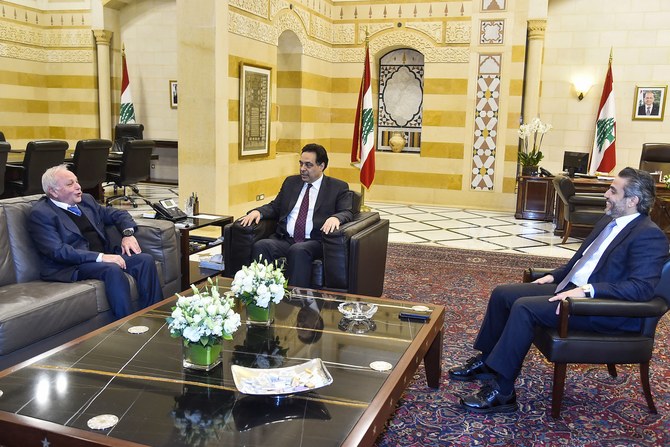
A handout picture provided by the Lebanese photo agency Dalati and Nohra shows Lebanese Judge Ghassan Ouweidat (L) meeting with Lebanese Prime Minister Hassan Diab (C) and Judge Mahmoud Makieh at the governmental palace in Beirut on January 28, 2020. (AFP)
2 / 2
The judge Tarek Bitar leading the investigation into Beirut's massive 2020 port blast resumed his work Monday, Jan. 23, 2023 after a nearly 13-month halt. The judge began his work by ordering the release of some detainees and plans to file charges against eight people including two top generals, judicial officials said. (AP)
Short Url
Updated 24 January 2023
Follow

Tensions rise in Lebanon after judge investigating Beirut blast takes aim at top officials

  • Top prosecutor Ghassan Oueidat rejected Judge Tarek Bitar’s decision to resume his probe and charge several leading figures, including Oueidat

BEIRUT: The fallout continued on Tuesday after Tarek Bitar, the Lebanese judge investigating the devastating explosion at Beirut’s port in August 2020, charged the country’s top prosecutor, Ghassan Oueidat, and seven other officials in connection with the blast. They reportedly face allegations of homicide, arson and other crimes.

Bitar surprised many people on Monday when he first announced he was resuming his investigation, which had been suspended for more a year amid political and legal opposition, and then said he would be filing charges against leading security and judicial officials, Oueidat included.

The announcement heightened long-running tensions between Bitar and the public prosecution office. Oueidat rejected the decision and said Bitar “has been removed from the case.”

More than a dozen senior officials are now in Bitar’s sights in connection with the explosion, including Abbas Ibrahim, the head of Lebanese General Security; Tony Saliba, the director-general of State Security; and judges Ghassan Khoury, Carla Shawah and Jad Maalouf.

The explosion on Aug. 4, 2020, destroyed most of Beirut’s port and neighboring parts of the capital, killing more than 215 people and injuring more than 6,500.

Information leaked by the Bar Association revealed that Bitar has filed charges against Oueidat, the country’s highest judicial authority and member of the Supreme Judicial Council; Brig. Gen. Assaad Toufaili, chairman of the Supreme Council of Customs; Gracia Al-Azzi, a member of the Supreme Council of Customs; Brig. Gen. Camille Daher, the former head of military intelligence; Jawdat Oueidat, a former senior military intelligence officer; and Gen. Jean Kahwaji, a former army commander.

Bitar has also subpoenaed former Prime Minister Hassan Diab, MPs Ghazi Zeaiter and Ali Hassan Khalil, and former MP Nohad Machnouk. They responded by filing complaints against Bitar and calling for his removal from the case.

Bitar intends to interview them in the coming month about their alleged roles in “possible intentional killing” and “functional negligence.” On Tuesday, he notified Diab, Machnouk and Zeaiter of the dates on which they are expected to appear for questioning and displayed the summons sent to them.

The judge said he based his decision to resume his inquiry on a judicial study that found he was permitted to resume his judicial work 13 months after it was suspended as a result of complaints filed against him.

His announcements were welcomed by the families of the victims of the explosion, and of those detained in connection with it, who expect Bitar to question senior officials suspected of blame.

But Hatem Madi, a former prosecutor general, told Arab News: “I am worried about the weak image and fragile reputation of the judiciary. The study that Bitar relied on to resume work is a fatal error.”

Bitar’s move revived political debates and fears of escalating tensions on the streets, as dozens of protesters blocked a road in the Al-Shiah-Ain Al-Rummaneh area of Beirut with burning tires.

Previous protests, reportedly instigated by Hezbollah and the Amal Movement, demanding Bitar’s removal from the case escalated into a bloody confrontation with residents of a Christian-majority area.

A parliamentary committee meeting on Tuesday that was due to discuss laws on the independence of the judiciary descended into squabbling and heated exchanges between representatives of Hezbollah and the Amal Movement, who accused Bitar of “implementing foreign agendas,” and MPs from parties that oppose Hezbollah, who support the judge and his work.

Oweidat issued a statement on Tuesday saying that Bitar had “ignored us and considered that we do not exist as the public prosecution, and in return we will consider him non-existent.”

He denied that he intended to sue Bitar and added: “This matter is out of the question. Judge Bitar has his hands tied and the decision to return to work is illegal.”

In addition to announcing the charges against top officials, Bitar had also requested the release, without bail, of five people detained in connection with the case and that they be prevented from traveling. In light of row over his decisions, the detainees have not been released. A total of 17 people are currently in custody.

In a message posted on its official Twitter account, the US embassy in Lebanon wrote: “We support and urge Lebanese authorities to complete a swift and transparent investigation into the horrific explosion at the Port of Beirut.”


US says it destroyed 16 mine-laying vessels as Iran threatens to block Gulf oil exports

Updated 4 sec ago
Follow

US says it destroyed 16 mine-laying vessels as Iran threatens to block Gulf oil exports

DUBAI, United Arab Emirates: The US said it took out more than a dozen mine-laying Iranian vessels Tuesday, and the Islamic Republic vowed to block the region’s oil exports, saying it would not allow “even a single liter” to be shipped to its enemies.
As concerns grew about the war’s effect on a strategic waterway, the American military said it destroyed 16 minelayers, though President Donald Trump said in social media posts that there were no reports of Iran planting explosives in the Strait of Hormuz, through which 20 percent of the world’s oil is shipped.
The American military released the figure, along with unclassified footage of some of the vessels, after Trump threatened to hit Iran at “a level never seen before” if the country failed to immediately remove any mines it might have deployed in the channel.
Both sides sharpened their rhetoric as the war entered its 11th day. US Defense Secretary Pete Hegseth promised the most intense strikes yet while the Pentagon detailed the broader toll of injuries sustained by US troops.
The conflict’s effects rippled across the Middle East and beyond. Iranian leaders ruled out talks, threatened Trump and launched new attacks against Israel and Gulf Arab countries.
In Iran, residents of Tehran said they experienced some of the war’s heaviest strikes. A woman said she saw a residential building get hit. She and others reached by The Associated Press spoke on condition of anonymity to prevent reprisals. Tens of thousands of Iranians have sought shelter in the countryside.
Lebanon reports more deaths
Multiple Israeli strikes across southern Lebanon killed seven people, the Lebanese Health Ministry said early Wednesday.
Other deaths included a Red Cross member who died early Wednesday after an Israeli strike targeted his team Monday while they were rescuing people following an earlier attack, the health ministry said. On Tuesday, Israeli airstrikes killed four people, including a paramedic who worked for the Hezbollah-affiliated Islamic Health Authority who was treating the wounded.
Also Tuesday, an Israeli strike killed a Lebanese soldier, the Lebanese army said, bringing the number of troops killed there to five since the conflict began.
Israel said it was working to intercept missiles from Iran and Hezbollah, which began firing on Israel after the start of the war.
Saudi Arabia’s Defense Ministry said early Wednesday that it intercepted multiple missiles launched toward several sites, including Prince Sultan Air Base, a major US- and Saudi-operated air facility. The ministry said it also destroyed drones near two major cities and more headed toward the kingdom’s vast Shaybah oil field in the Empty Quarter desert.
In Iraq, drones targeted military bases inside Baghdad International Airport late Tuesday, two security officials told AP on condition of anonymity because they were not authorized to speak to the press. Some drones fell near Iraqi security positions, while others landed near logistical support sites used by US-led coalition forces, one official said.
The United Arab Emirates said early Wednesday that its air defenses were firing at incoming Iranian fire. The wealthy Gulf nation — home to the business and travel hub of Dubai — said Iranian attacks have killed six people and wounded 122 others.
Bahrain sounded sirens early Wednesday, warning of an incoming Iranian attack. The warnings came a day after an Iranian attack hit a residential building in the capital, Manama, and killed a 29-year-old woman and wounding eight people.
Pentagon says 140 US troops wounded since war began
Gen. Dan Caine, chairman of the Joint Chiefs of Staff, said US forces hit more than 5,000 targets.
The Pentagon separately said Tuesday that about 140 US service members have been wounded in the war, and the “vast majority” of the injuries were minor, with 108 service members already back on duty. Eight US service members suffered severe injuries, and seven have been killed.
In Iran, at least 1,230 people have been killed, while the death toll is more than 480 in Lebanon and 12 in Israel, according to officials.
Iran’s leaders have remained defiant after days of heavy strikes targeting the country’s leadership, military, ballistic missiles and its disputed nuclear program. Iran’s parliament speaker, Mohammad Bagher Qalibaf, said on X that Iran was “definitely not looking for a ceasefire.”
“We believe that the aggressor should be punched in the mouth so that he learns a lesson so that he will never think of attacking our beloved Iran again,” he said.
A top Iranian security official, Ali Larijani, posted a warning to Trump, writing on X that “Even those bigger than you couldn’t eliminate Iran. Be careful not to get eliminated yourself.” Iran has been accused of plotting attempts to kill Trump in the past.
The Trump administration, meanwhile, faced growing scrutiny at home about the war.
“I’m not sure what the end game is, or what their plans are,” Democratic Sen. Jacky Rosen of Nevada said after a classified briefing that the Trump administration held Tuesday for some lawmakers.
Saudi Arabia’s oil giant says tankers being rerouted to avoid Strait of Hormuz
Iran has repeatedly targeted energy infrastructure with attacks that appear aimed at generating enough global economic pain to pressure the US and Israel to end their strikes. It has also fired on Israel and US military bases in the region.
The US stock market held steadier Tuesday as Wall Street waited for the next clue on when the war with Iran may end.
Oil prices, meanwhile, remained well below their peaks hit on Monday. Such spikes have been rocking financial markets worldwide because of worries that the war could block the global flow of oil and natural gas for a long time.
Iran’s paramilitary Revolutionary Guard said it “will not allow the export of even a single liter of oil from the region to the hostile side and its partners until further notice.”
Amin Nasser, the president and CEO of Saudi Arabia’s oil giant Aramco, said tankers were being rerouted to avoid the strait, and that the company’s east-west pipeline would reach its full capacity this week of 7 million barrels a day being brought to the Red Sea port of the Yanbu.
“The situation at the Strait of Hormuz is blocking sizable volumes of oil from the whole region,” he said. “If this takes a long time, that will have serious impact on the global economy.”
Foreign nationals get out of region
The UN refugee agency said Tuesday that more than 667,000 people in Lebanon had registered as displaced — an increase of over 100,000 since a day earlier — and more than 85,000 people from Lebanon, mostly Syrians, had entered neighboring Syria.
The British government said the number of commercial flights from the UAE to the UK is returning to normal levels, with 32 flights operated Monday from Dubai to Britain and another 36 scheduled Tuesday. British Airways, however, said it suspended flights to and from Jordan, Bahrain, Qatar, Dubai and Tel Aviv until later this month.
Many foreign nationals have been getting out of the Arabian Gulf region since the war began, including over 45,000 UK citizens, the British Foreign Office said. Some 40,000 people returned to the United States, according to the State Department.