Lewis Hamilton recalls bullying, racial abuse during school years

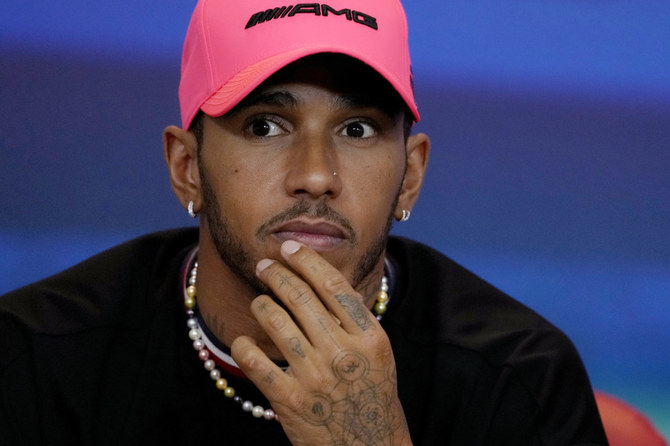
Lewis Hamilton in a press conference ahead of the Grand Prix of Abu Dhabi on Nov. 17, 2022. Hamilton experienced bullying when he was only 6 years old and said he had bananas thrown at him when he was racially abused at school. (File/AP)
Short Url
Updated 24 January 2023
Follow

Lewis Hamilton recalls bullying, racial abuse during school years

  • The F1 great described how racial abuse continued during his school years, along with the utter isolation and confusion he felt

LONDON: Formula One great Lewis Hamilton experienced bullying when he was only 6 years old and said he had bananas thrown at him when he was racially abused at school.

The seven-time champion, who is the only Black driver in F1, called his schooldays the most traumatic of times.

“For me, school was probably the most traumatizing and most difficult part of my life,” Hamilton said in an interview for the On Purpose podcast, which was released Monday. “I already was being bullied at the age of 6 ... I think at the time, (at) that particular school, I was probably one of three kids of color and just bigger, stronger, bullying kids were throwing me around a lot of the time.”

Born and educated in Stevenage, England, Hamilton described how racial abuse continued during his school years, along with the utter isolation and confusion he felt.

“And then constant jabs (jibes), the things that are thrown at you, like bananas, people that would use the N-word just so relaxed. People calling you half-caste and just really not knowing where you fit in,” the 38-year-old Hamilton told the podcast show. “That for me was difficult, and then when you go into history class and everything you learn in history there are no people of color in the history they were teaching us. So I was thinking, ‘Where are the people who look like me?’”

Hamilton said even figures of authority would pick on him.

“There were only around six or seven black kids out of 1,200 kids and three of us were put outside the headmaster’s office all the time,” he said. “The headmaster just had it out for us and particularly for me I would say.

“I was put in all the lowest sets at school and told that if you do well you can progress. They never ever let me progress, no matter how hard I tried,” Hamilton added. “I really felt the system was up against me and I was swimming against the tide.”

Hamilton said he felt the bitter pain of exclusion, even at recreation times.

“I was always the last picked, you know when you are standing in a line, when they are picking teams for football (soccer). I was always the last one chosen or not even chosen. Even if I was better than somebody else,” he said. “Just juggling all these emotions that you’re feeling, plus I struggled at school. I didn’t find out until I was 16 that I was dyslexic.”

Hamilton described how he bottled up his pain and put on a brave face when he got home.

“There were a lot of things that I suppressed. I didn’t feel I could go home and tell my parents that these kids kept calling me the N-word today, (that) I got bullied, beaten up at school today, or I wasn’t able to defend myself,” he said. “I didn’t want my dad to think I was not strong and so if I had tears I would hold them back, if I had emotions it would be in a quiet place. It wasn’t really until I started racing that I was able to channel this emotion that I had into my driving.”

Hamilton is F1’s record-holder with 103 Grand Prix wins and 103 pole positions, and shares the record for most F1 titles with fellow great Michael Schumacher. The Mercedes star, who did not win a Grand Prix last season, begins his quest for an eighth F1 title when the season begins in Bahrain on March 5.

In recent years, Hamilton has distinguished himself away from the track, campaigning tirelessly to fight racism and urging others in F1 to speak out more.

Hamilton set up “The Hamilton Commission” to improve F1′s diversity, and has also been outspoken on human rights abuses in countries where F1 goes racing.

Last year, Hamilton said ” archaic mindsets ” have to change after retired champion Nelson Piquet reportedly used a racial slur against him.


‘Fantastic 3 days’: Over 3,500 young footballers play in Manchester City Abu Dhabi Cup

Updated 6 sec ago
Follow

‘Fantastic 3 days’: Over 3,500 young footballers play in Manchester City Abu Dhabi Cup

  • Record-breaking seventh edition of region’s largest youth tournament attracted more than 8,000 people across 3 days
  • U-16 Boys Cup winners Oman’s Al-Seeb win a trip to a City Football Group club, while U-14 Girls Plate winners, Singapore’s Resistencia, earn a 3-day coaching clinic from City Football Schools coaches in lucky draw

ABU DHABI: The seventh Manchester City Abu Dhabi Cup has been hailed as a “fantastic three days” by a former club stalwart, with over 3,500 young boys and girls taking part at Zayed Sports City.

The region’s biggest annual youth football tournament had more than 244 teams from 18 countries including professional clubs Al-Jazira, Baniyas, Al-Wahda, Al-Ain, Melbourne City, and Manchester City.

Almost 8,000 spectators witnessed the action in the five age groups for boys, and three for girls.

Nedum Onuoha, former Manchester City defender and Manchester City Abu Dhabi Cup ambassador, said: “It was a fantastic three days at the Manchester City Abu Dhabi Cup 2026.

“So many young boys and girls from around the world enjoyed this growing youth football platform. Beyond the results, the competitors played with smiles, expressing themselves, supporting one another, and creating memories that will stay with them long after the final whistle.

The eight cup competition winners were then placed in a draw to claim a trip to a City Football Group club, where they will train, and watch the first team in action.

Boys’ under-16 winners Al-Seeb were the lucky team drawn. It was a repeat success for the Oman team that won the same age group last year, and won a trip to Manchester, where they trained at the Etihad Campus and watched the men’s first team play.

Additionally, following a lucky draw, the under-14 Girls Plate winners —Singapore’s Resistencia FC — will receive a three-day football clinic from City Football Schools coaches.

For the first time, the tournament expanded to three days to accommodate the increasing demand from around the world, and delivered 2,562 goals in 1,435 matches.

Another expansion for this edition was the participation of 44 girls’ teams across three age groups, which showcased the game’s growth in the UAE, Middle East, and globally.

“The standard of football was exceptionally high,” Onuoha added. “As a former professional, I understand the importance of grassroots football.

“Tournaments like the Abu Dhabi Cup play a vital role in nurturing the next generation of footballers, providing young players with valuable opportunities to learn, grow, and test themselves in a competitive environment.”

Players, coaches, and families also got the chance to watch Manchester City’s 10-1 victory against Exeter City in the FA Cup third-round clash.

Simon Hewitt, head of operations in the Middle East and North Africa, City Football Group and the tournament director, said the contest shows how the game “unites people from all over the world.

“Young people of varying ages and nationalities came together, had fun, learned about different cultures, and played some great football.”