KARACHI: Pakistan's energy minister said on Monday power would be restored "by tonight," after the national grid suffered a major breakdown, leaving millions of people across the country, from the financial capital of Karachi in the south to Peshawar city in the north, without electricity.
The day-long outage, the second major one in three months, has raised concerns about infrastructural weakness and the urgent need to upgrade an aging grid in a nation of 220 million people.
While Pakistan has enough installed power capacity to meet demand, it lacks adequate resources to run its oil-and-gas powered plants. The energy sector is also heavily in debt and cannot afford to invest in new infrastructure and power lines.
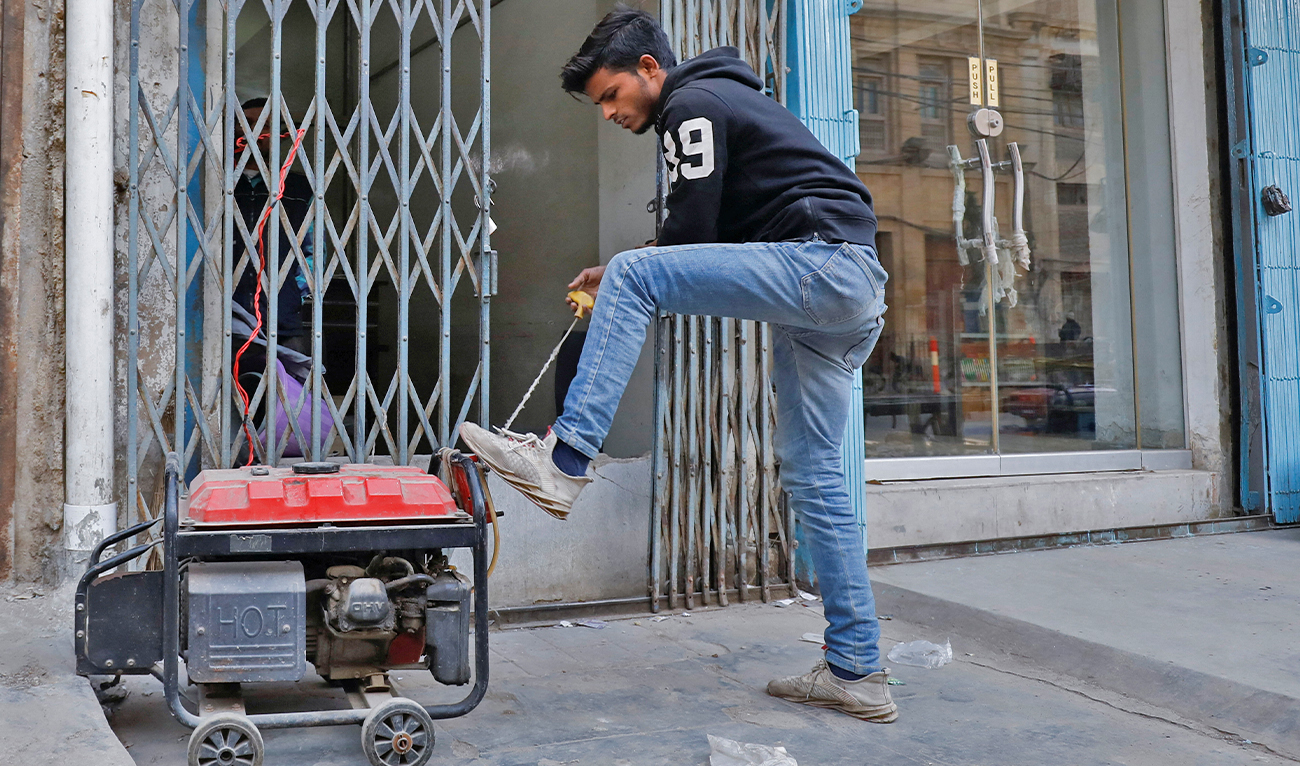
A man starts a generator outside his shop during a country-wide power breakdown in Karachi, Pakistan on January 23, 2023. (REUTERS)
The latest breakdown, which occurred at around 730am, also comes as the Pakistan economy is in a tailspin, with foreign reserves running out, inflation at decades-high levels and industrial growth slowing down.
“God willing, power will be restored to the whole country by tonight,” Energy Minister Khurrum Dastagir Khan said at a media briefing.
He had earlier told media the grid would be fully functioning by 10pm (1700 GMT).
As part of an energy saving move, electricity is turned off across Pakistan during low usage hours overnight to conserve fuel. Technicians were unable to boot up the system all at once after daybreak, the energy minister said in a separate statement released on Monday morning.
“There is no major fault … In winter the system is closed due to low demand at night and is switched on in the morning,” Khan said.
“Today morning, when the system was switched on, a huge breakdown occurred due to a drop in frequency between Jamshoro and Dadu,” he added, referring to two southern regions.
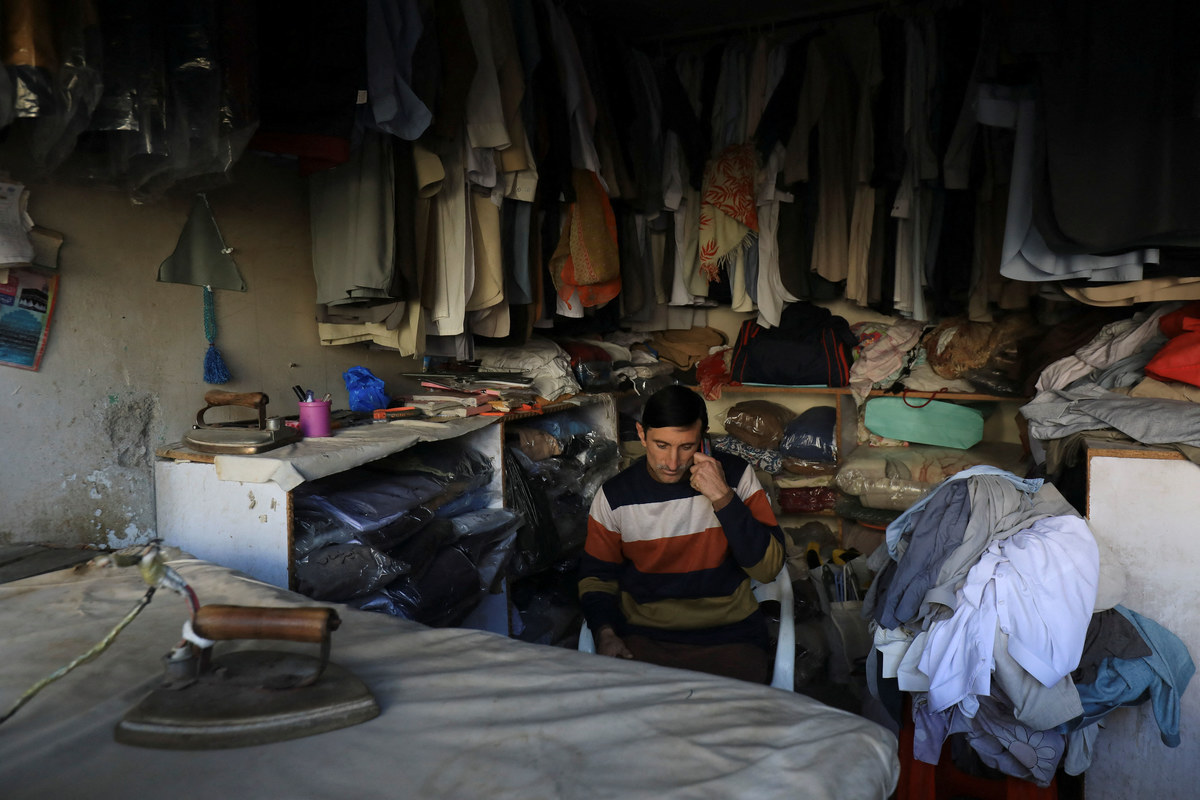
A laundryman uses cell phone as he sits at his shop during country-wide power breakdown in Peshawar, Pakistan January 23, 2023. (REUTERS)
Prime minister Shehbaz Sharif ordered an investigation into the breakdown and summoned an "immediate report" from the energy minister.
"Why did such a massive crisis of electricity arise?" the PM was quoted as asking in a statement. "Those responsible should be identified ... The difficulties of masses are intolerable."
Monday’s outrage reminded of one in Pakistan’s southern regions in October, when it took a whole day for power to be restored in major urban centers like Karachi, Hyderabad, Quetta and other areas of the Sindh and Balochistan provinces.
The outage was also reminiscent of a massive blackout in January 2021, attributed at the time to a technical fault in the country’s power generation and distribution system.
In Karachi, Pakistan’s commercial capital and home to the stock exchange, the central bank and a giant port, there was no power over nine hours after the morning outage.
“Work is underway on restoring the power in Karachi. Power is being supplied on priority basis to strategic installations like airports, hospitals, Karachi port,” said Imran Rana, the spokesperson for Karachi-based utility K-Electric. “The leadership of K-Electric is directly supervising the restoration process.”
Chaudhry Amin, the chief executive of the Lahore Electric Supply Company (LESCO), which supplies power to some of Pakistan’s most populous cities in Punjab province, said electricity would be restored in Lahore and its adjoining areas "soon."
He confirmed that all LESCO grid stations had tripped, “depriving industrial, commercial and domestic consumers of electricity.”

An Orange Line metro train is parked at a station following a power breakdown across the country, in Lahore, Pakistan, on January 23, 2023. (AP)
The Orange Line Metro Train service was also suspended in Lahore, depriving millions of commuters of their usual mode of public transportation.
“Suddenly I felt a jolt that shook the train. The train became slow and lights, heaters and air conditioner were off,” Chaudhry Nauman Arif, a university student, told Arab News, saying passengers waited in the train for 40 minutes and were finally safely offloaded.
A spokesperson for the Pakistan Civil Aviation Authority (PCAA) said airports were not facing any power issues.
“The situation is under control as alternate systems of power supply are functional. We are using standby power to provide uninterrupted electricity to all the airports,” the PCAA said.
The national highways and motorway police also said traffic signals in most areas of the country were not working due to the power outage.
“There are unconfirmed reports of restoration varying from 15-20 hours,” a statement by the highway police said. “If electricity is not restored until darkness, keeping in mind the law and order situation, kindly make sure your car and house doors are locked properly to avoid any incident.”
Pakistan gets at least 60% of its electricity from fossil fuels and nearly 27% from hydropower. The contribution of nuclear and solar power to the nation’s grid is about 10%.