

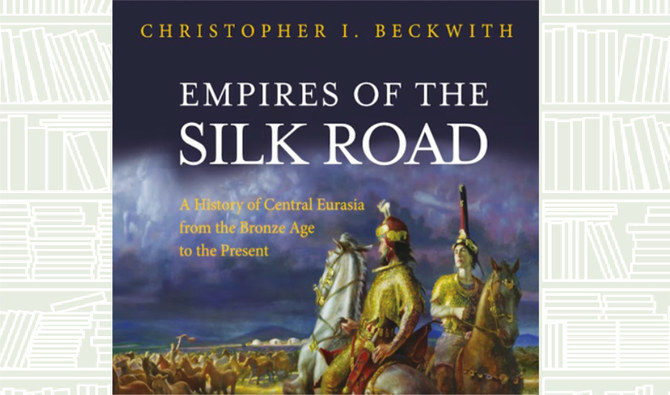
What We Are Reading Today: Empires of the Silk Road

Photo/Supplied
Short Url
Updated 21 January 2023
Follow

What We Are Reading Today: Empires of the Silk Road

Author: Christopher I. Beckwith

The first complete history of Central Eurasia from ancient times to the present day, “Empires of the Silk Road” represents a fundamental rethinking of the origins, history, and significance of this major world region. Christopher Beckwith describes the rise and fall of the great Central Eurasian empires, including those of the Scythians, Attila the Hun, the Turks and Tibetans, and Genghis Khan and the Mongols.

In addition, he explains why the heartland of Central Eurasia led the world economically, scientifically, and artistically for many centuries despite invasions by Persians, Greeks, Arabs, Chinese, and others. In retelling the story of the Old World from the perspective of Central Eurasia, Beckwith provides a new understanding of the internal and external dynamics of the Central Eurasian states and shows how their people repeatedly revolutionized Eurasian civilization.
Beckwith recounts the Indo-Europeans’ migration out of Central Eurasia, their mixture with local peoples, and the resulting development of the Graeco-Roman, Persian, Indian, and Chinese civilizations.


Book Review: ‘The Mastery of Love’ by Don Miguel Ruiz

Updated 22 January 2026
Follow

Book Review: ‘The Mastery of Love’ by Don Miguel Ruiz

I picked up “The Mastery of Love” at a time when the word “love” seemed to be everywhere yet it felt strangely confusing. Between social media advice, relationship trends and constant conversations about self-worth, I found myself questioning what healthy love looks like.

Don Miguel Ruiz’s book did not offer quick answers or romantic cliches. Instead, it gently asked me to look inward, and that is where its real impact began.

What resonated with me most is Ruiz’s insistence that love starts with the self. I became aware of how often I seek validation externally, whether through relationships, family expectations or even professional success.

Ruiz’s message is simple but challenging: If you do not feel worthy on your own, no relationship can truly fill that gap. This idea stayed with me long after I closed the book, especially in moments when I noticed myself being overly critical or emotionally reactive.

The chapters on family love felt deeply personal. Ruiz explains how our early experiences shape the way we give and receive love, and I found myself reflecting on childhood patterns I had never consciously questioned.

His emphasis on forgiveness is not about excusing hurt but about freeing yourself from carrying it forward. That perspective helped me rethink certain family dynamics with more compassion, both toward others and myself.

When it comes to romantic relationships, Ruiz strips away fantasy and replaces it with responsibility and awareness. He writes about communication, trust and emotional honesty in a way that feels grounded and realistic.

What stood out was his reminder that love is not something that simply happens, but something we choose daily through our actions and words. That idea made me reflect on how often love is tested in small, everyday moments rather than dramatic ones.

Beyond personal relationships, “The Mastery of Love” also changed how I view my relationship with life itself. Ruiz encourages approaching the world with openness instead of fear, and that shift in mindset feels especially relevant in a time when negativity travels faster than empathy.

This book is not about becoming perfect in love, but about becoming more aware. For me, it served as both a mirror and a guide.

I would recommend “The Mastery of Love” to anyone willing to question their patterns, unlearn emotional habits and build relationships rooted in honesty, self-respect and compassion. It is a quiet but powerful reminder that love, in all its forms, begins within.
