

NEOM CEO says 20 percent infrastructure works already completed 

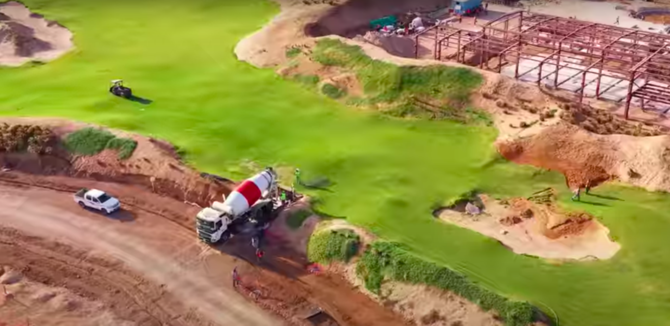
The video includes real-world footage of the large-scale constructions across NEOM regions (NEOM)
Short Url
Updated 19 January 2023
Follow

NEOM CEO says 20 percent infrastructure works already completed 

RIYADH: Nearly 20 percent of infrastructure works at NEOM, Saudi Arabia’s $500 billion megacity, have been completed, according to a top official.  

Nadhmi Al-Nasr, NEOM’s CEO, said that works are progressing in the futuristic city as per schedule in an interview with Al Arabiya TV.

The project is set to run on 100 percent renewable energy when completed, and will encompass several megaprojects.

To showcase the works, NEOM released a video earlier this week which shows the rapid progress being made on the project.  

The video includes real-world footage of the large-scale constructions across NEOM regions which includes The Line, Trojena, OXAGON, and the luxury island development project Sindalah.  


Crown Prince Mohammed bin Salman launched the Sindalah Island project, which will extend over an area of approximately 840,000 sq. m and the island will act as a main gateway to the Red Sea for guests from early 2024. 

The video sets out the key achievements made in 2022, including the launch of Tonomus, the first company to be established as a full-fledged subsidiary of NEOM that will integrate artificial intelligence technology in the buildings of the mega project.  

The three-minute clip also shows construction workers being deployed to lay the foundations for the megaproject.

“A project unique in scale, already being built in a place with 95 percent of the land protected for nature where rewilding is in motion, bringing animals back to their natural habitat,” the clip said.  

The video also portrayed the works which are currently underway in Trojena, the mountain destination which will host the 2029 Asian Winter Games.  

In December, during an exclusive interview with Arab News, Peter Fitzhardinge, head of Tourism Marketing at NEOM, said that the 2029 Asian winter games at Trojena will showcase how NEOM will use innovation to carry out the event in a meticulous manner.  

“NEOM is all about innovation. I think now, not only we have to launch Trojena to show the vision, but we have to also showcase how we can bring Asian winter games into reality for people to come and participate in winter sports in NEOM,” said Fitzhardinge. 

The clip also shows the works that are going on in OXAGON, a futuristic industrial city touted to be the largest floating industrial complex in the world upon completion.  

While speaking to Arab News at the World Travel and Tourism Council Global Summit in Riyadh on Nov. 30 Al-Nasr had noted that OXAGON also has all the potential to become a world-class tourist destination, where visitors can come and see how the future will be. 

“It is in OXAGON where all industries will be, and it is the port of NEOM. Yet, we would like to see tourists spending a day or two in OXAGON. They will see the future of industries in OXAGON. Everything in NEOM is built for the future era. We want them to come and see how future sea ports will operate,” said Al-Nasr. 

Another subsidiary that was launched in 2022 was Enowa, responsible for managing NEOM’S sustainable energy and water systems. Enowa will also have the world’s largest green hydrogen plant which will catalyze NEOM’s sustainability journey.  

“At NEOM, we are addressing some of the most pressing challenges facing humanity by bringing together a community of the brightest minds committed to reimagining what a sustainable future will look like in 20 to 30 years, and building it today. We are redefining the future now. NEOM is open for business,” Al-Nasr said in a separate statement. 

It also highlighted NEOM’s $175 million investment in “Volocopter, the next generation of transport.”

“It’s why athletes from 25 countries participated in the NEOM Beach Games and it’s why the planet’s fastest growing lifestyle brand, Ennismore, has become the first hotel partner for Trojena,” said the narrator in the video.

Saudi Arabia’s national carrier Saudia now also offers direct flights to NEOM from London and Dubai.

The video also highlighted NEOM’s growing media sector, which has supported 25 productions in 18 months, working with names such as the BBC, Apple TV and NBC.

NEOM also partnered with McLaren to drive innovation and talent development in electrical motorsport. The megacity, in cooperation with the Asian Football Confederation, also launched the Shuhub Community Program to “develop the next generation of Saudi footballers.”

The video also highlighted NEOM’s efforts to “protect the secrets hidden at the bottom of the Red Sea”  with OceanX.


F1 in the GCC: How motorsport is driving tourism, investment and city branding

Updated 7 sec ago
Follow

F1 in the GCC: How motorsport is driving tourism, investment and city branding

  • Govts are leveraging the sport’s global reach to drive hotel occupancy

CAIRO: Across the Gulf, Formula 1 has become more than a race on the calendar. 

It is a tourism accelerator, a branding machine and, increasingly, a tool of economic strategy. 

From Jeddah to Abu Dhabi, governments are leveraging the sport’s global reach to drive hotel occupancy, attract high-spending visitors and position their cities as world-class destinations.

The bigger question is no longer whether F1 creates a race-week boost. It is whether that boost can translate into long-term value.

Jeddah’s race-week surge

In Saudi Arabia, the impact is visible in the numbers, with the Grand Prix in April delivering record-high hotel performance in Jeddah. 

According to CoStar, occupancy climbed to 82.5 percent, up 21.1 percent year on year. Average daily rates rose nearly 10 percent to SR833.79 ($222.30), pushing revenue per available room up 32.7 percent to SR688.

On peak nights, occupancy reportedly reached 96.5 percent, with room rates climbing as high as SR1,604. In Al-Balad, Jeddah’s UNESCO-listed historic district, boutique properties and tour operators reported increased demand linked directly to Grand Prix visitors.

The race has become a catalyst event as many visitors arrive for Formula 1 but stay to explore the surrounding area. 

A global audience, a premium visitor

Formula 1’s commercial power lies in its audience.

A recent PwC report, “Saudi Arabia’s motorsport ambition – Technology, investment and the future of racing,” noted that F1’s global fan base reached 826.5 million, with viewership climbing to 1.6 billion in 2024. The sport sits at the center of a global motorsport industry valued at $145 billion and projected to grow steadily in the coming years.

For host cities, that scale matters. It means global exposure and a specific kind of traveler — one who spends more.

Glenn Harwood, CEO and co-founder of AlgoDriven, said the sport’s popularity has expanded well beyond traditional racing fans.

“The combination of publicity from TV shows like Drive to Survive to movies such as F1, continue to captivate the public’s imagination and grow the sports following,” he told Arab News.

In Saudi Arabia, he said, the Grand Prix serves as a gateway. 

Long-term value increases when countries build domestic racing series and technical capacity.

Peter Thompson, founder of Formula 4 Saudi Arabia

“As the Kingdom expands its tourism ambitions, the Grand Prix acts as a high-impact anchor event, attracting international visitors who may not have previously considered Saudi as a destination,” Harwood said. “Many are using the race as the catalyst to visit and explore the country more broadly.”

As Formula 1 positions itself as a premium sporting property, the visitor mix reflects that with high-net-worth individuals, corporate guests, and affluent leisure travelers, he added.

“These visitors typically have a higher propensity to spend — not just on tickets and hospitality, but across hotels, fine dining, retail, entertainment, and luxury experiences,” said Harwood.

Building a domestic motorsport ecosystem

Saudi Arabia’s ambition goes beyond hosting a single annual race.

Since 2021, the Kingdom has committed more than $6 billion to its sports sector as part of Vision 2030, which seeks to diversify the economy and expand non-oil activity.

Peter Thompson, founder of Formula 4 Saudi Arabia and motor racing team Meritus.GP, said the real opportunity lies in developing a year-round motorsport ecosystem.

“Major events generate economic activity across tourism, hospitality, logistics, engineering and media production,” he told Arab News, adding: “But long-term value increases when countries build domestic racing series and technical capacity.”

By establishing FIA-certified championships and structured training programs, Saudi Arabia can extend economic impact beyond race weekend into engineering, operations, education and advanced technology fields, Thompson argued..

“Motorsport development supports the training of Saudi engineers, mechanics and media professionals. It also strengthens local supply chains and enables knowledge transfer in advanced fuels, composites and mobility technologies,” said.

Integrated with national industry partners, Thompson continued, saying that motorsport becomes a platform for technology demonstration, tourism growth and international visibility. In that model, the Grand Prix is not the end point but an entry point.

Infrastructure as a signal

The Kingdom’s long-term positioning is also visible in infrastructure.

The $480 million Qiddiya Speed Park near Riyadh is being designed to host multiple Grade 1 events as soon as 2027. With integrated entertainment zones and elevated track sections, it is planned as a year-round destination rather than a standalone circuit. 

The Grand Prix acts as a high-impact anchor event.

Glenn Harwood, CEO and co-founder of AlgoDriven

There are plans to relocate the Saudi Arabian Grand Prix from Jeddah to Qiddiya City between 2027 and 2029, embedding motorsport within a broader entertainment and urban development strategy.

These investments send a signal to investors and global partners that Formula 1 is part of a sustained commitment, not a one-off spectacle.

Abu Dhabi’s formula

In the UAE, Abu Dhabi demonstrates how motorsport can be woven into a mature tourism strategy.

Ahmed Abdraboh, director of sales and marketing at Al Raha Beach Resort & Spa in Abu Dhabi, said the Grand Prix has evolved into a central pillar of the emirate’s destination positioning.

“In Abu Dhabi specifically, the Grand Prix has grown from a sporting event into a cornerstone of our destination strategy,” he told Arab News.

He said about 70 percent of attendees come from overseas, many experiencing the UAE for the first time.

“Recent data shows that the F1 weekend spending reached record levels, totalling over AED 1.25 billion ($340 million),” Abdraboh said, noting that international visitor spending rose more than 30 percent compared to previous years.

He added that F1 consistently attracts higher-value travelers, including international Visa cardholders from the US, the UK, Kazakhstan and Saudi Arabia.

For Abu Dhabi, the branding dividend is just as important.

“The global broadcast reach of Formula 1 is an invaluable asset for tourism branding,” Abdraboh told Arab News. “That kind of exposure is hard to replicate through traditional tourism marketing alone.”

A perception shift

Beyond data and infrastructure, there is another layer to Formula 1’s impact: perception.

Gwen Wunderlich, CEO of the WNDR Group, first visited Saudi Arabia for the inaugural race in Jeddah in 2021. She described the experience as a moment of accelerated discovery.

“F1 really did compress discovery into a single weekend,” she told Arab News. “People came for the race and left having experienced an entire country.”

Visitors encountered large-scale production and ambitious development. But what stayed with them, she said, was the human experience.

“I say this all the time because it’s what everyone says after visiting: the hospitality of Saudi and its people is unmatched,” Wunderlich said. “It’s the warmth. The generosity. The way you’re welcomed in. It’s genuine.”

She added: “You might arrive curious. You leave changed.” 

According to Wunderlich, that emotional shift is where long-term value begins.

“That human experience is what transforms tourism from a transaction into a relationship,” she told Arab News, adding: “F1 didn’t just bring spectators. It created ambassadors.”

The long race

Across the Gulf Cooperation Council region, Formula 1 is being deployed as a strategic lever. It fills hotels, boosts retail and delivers cinematic global exposure. It also brings decision-makers, investors and brand partners into direct contact with emerging markets.

For Saudi Arabia and its neighbors, the challenge now is to convert that momentum into sustained tourism flows, local industry growth and repeat visitation.