

Advances in space exploration ‘out of this world,’ Davos forum told

Programs include journeys to the International Space Station, where ESA cooperates with NASA and other space agency partners, as well as missions to the moon and Mars. (WEF)
Short Url
Updated 19 January 2023
Follow

Advances in space exploration ‘out of this world,’ Davos forum told

  • The ESA plans to install a new space station orbiting the moon
  • Argonaut is expected to be ready for launch by the end of 2030

DUBAI: Space technology is being used to explore and explain the creation of the universe, Josef Aschbacher, director-general of the European Space Agency, told the World Economic Forum in Davos, Switzerland.

Speaking in a discussion on how space technology is helping humankind understand its beginnings, Aschbacher on Thursday said that the James Webb Space Telescope, for example, is “looking back at the very origins of the universe.”

He added: “This is as close as we can get to really explore, see, the creation of the universe, or how it looked like in the very early days, and therefore better understand where we come from.”

Aschbacher displayed an image of the Pillars of Creation, revealing vast trunks of interstellar gas and dust in a distant nebula.

The photograph, taken by NASA, the European Space Agency and Canadian Space Agency using the James Webb Space Telescope, shows that “space is international,” he said.

Aschbacher said that record funding for the ESA shows that EU government ministers recognize space exploration as a strategic activity where investment is crucial.

Programs include journeys to the International Space Station, where ESA cooperates with NASA and other space agency partners, as well as missions to the moon and Mars.

Discussing moon exploration, Matthias Maurer, an ESA astronaut, said: “We need more powerful rockets and we need better technology.”

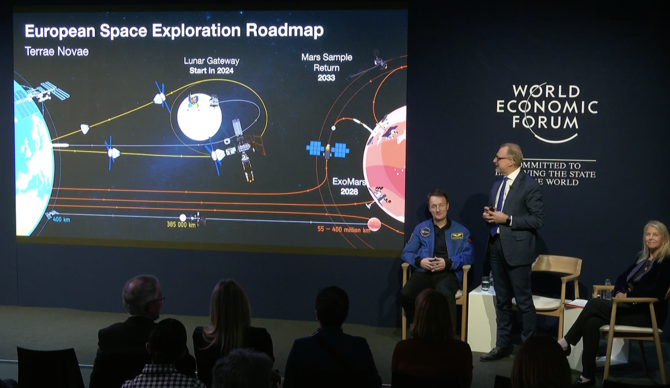
The ESA plans to install a new space station orbiting the moon before landing there, he added.

The space station, known as the Lunar Gateway, will also provide information on future travel to Mars.

“Flying to Mars is, in theory, possible today with the technology we have,” he said.

However, “mastering the moon mission” will be important before moving on to the distant planet, Maurer said.

Aschbacher said that with the planned Argonaut, also known as the “space truck,” astronauts will be able to carry more equipment to the moon in order to establish a base.

“The Argonaut spacecraft can bring 1.5 tons of mass to the moon, which can be equipment, experiments, power generators — whatever you will need in order to establish a base,” he said.

Argonaut is expected to be ready for launch by the end of 2030, he added.


Taiwan to send team to assess US rare earth deposits

Updated 4 sec ago
Follow

Taiwan to send team to assess US rare earth deposits

TAIPEI: Taiwan plans to ‌send officials to assess US rare earths deposits with a goal to have such minerals refined on the island, ​Economy Minister Kung Ming-hsin said on Wednesday.
President Donald Trump’s administration has stepped up efforts to secure US supplies of critical minerals after China rattled senior officials and global markets last year by withholding rare earths required by American automakers and other industrial manufacturers.
Trump last week launched a US ‌strategic stockpile of critical ‌minerals, called Project Vault, ​backed ‌by $10 ⁠billion in ​seed funding ⁠from the US Export-Import Bank and $2 billion in private funding.
While semiconductor powerhouse Taiwan is not formally part of that scheme, it has previously held talks with the United States on how it can help, given Taipei’s concerns about over-reliance on a China-centric ⁠supply chain.
China views Taiwan as its ‌own territory and ‌has stepped up its military threats.
Speaking ​to reporters in Taipei, ‌Kung said the ministry’s Geological Survey and Mining ‌Management Agency would go to the United States to assess rare earths deposits there.
“Specifically, what rare-earth elements they contain and whether they are suitable. In other words, ‌whether those are the rare earths we actually need. So we still need ⁠to investigate,” he ⁠said.
Given Taiwan does not mine such elements itself, it can instead play a role in refining the materials from other countries, Kung added.
“The technology is not an issue; the next step is scaling up,” he said.
Taiwan consumes 1,500 metric tons of rare earth annually, a figure projected to rise to 2,000 metric tons given economic growth, Kung added.
“Our goal is to expand production ​capacity to meet ​half of our demand by then, strengthening the supply chain.