

Our fossil fuel addiction must end, UN chief tells World Economic Forum

1 / 2
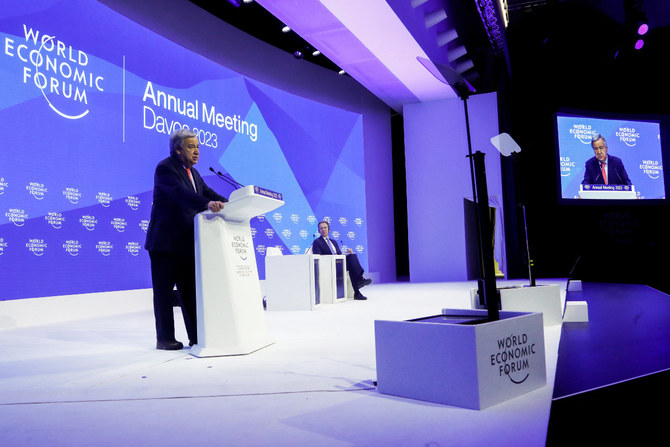
UN Secretary-General Antonio Guterres attending a session of the World Economic Forum (WEF) annual meeting in Davos on January 18, 2023. (AFP)
2 / 2
UN Secretary-General Antonio Guterres addresses the World Economic Forum (WEF) in Davos, Switzerland, on January 18, 2023. (REUTERS)
Short Url
Updated 19 January 2023
Follow

Our fossil fuel addiction must end, UN chief tells World Economic Forum

  • Antonio Guterres warned that the international commitment to limiting global warming to 1.5 C above preindustrial levels is ‘going up in smoke’
  • Net zero transition must be grounded in real emissions cuts, UN chief tells business leaders in Davos 

DAVOS: Antonio Guterres, the UN secretary-general, used his address to the World Economic Forum in Davos, Switzerland, on Wednesday to urge world leaders and businesses to expand their efforts to achieve net-zero carbon emissions.

He also called on business leaders to provide “credible and transparent” plans by the end of the year on how they intend to achieve net-zero.

Guterres warned that many businesses had set their climate targets based on “dubious or murky” criteria, which can “mislead consumers, investors and regulators with false narratives.”

“It feeds a culture of climate misinformation and confusion and leaves the door open to ‘greenwashing,’” he told delegates at the WEF’s Annual Meeting.

“The transition to net-zero must be grounded in real emissions cuts and not rely essentially on carbon credits and shadow markets. That is why we (the UN) created an Expert Group on Net-Zero Emissions Commitments.”
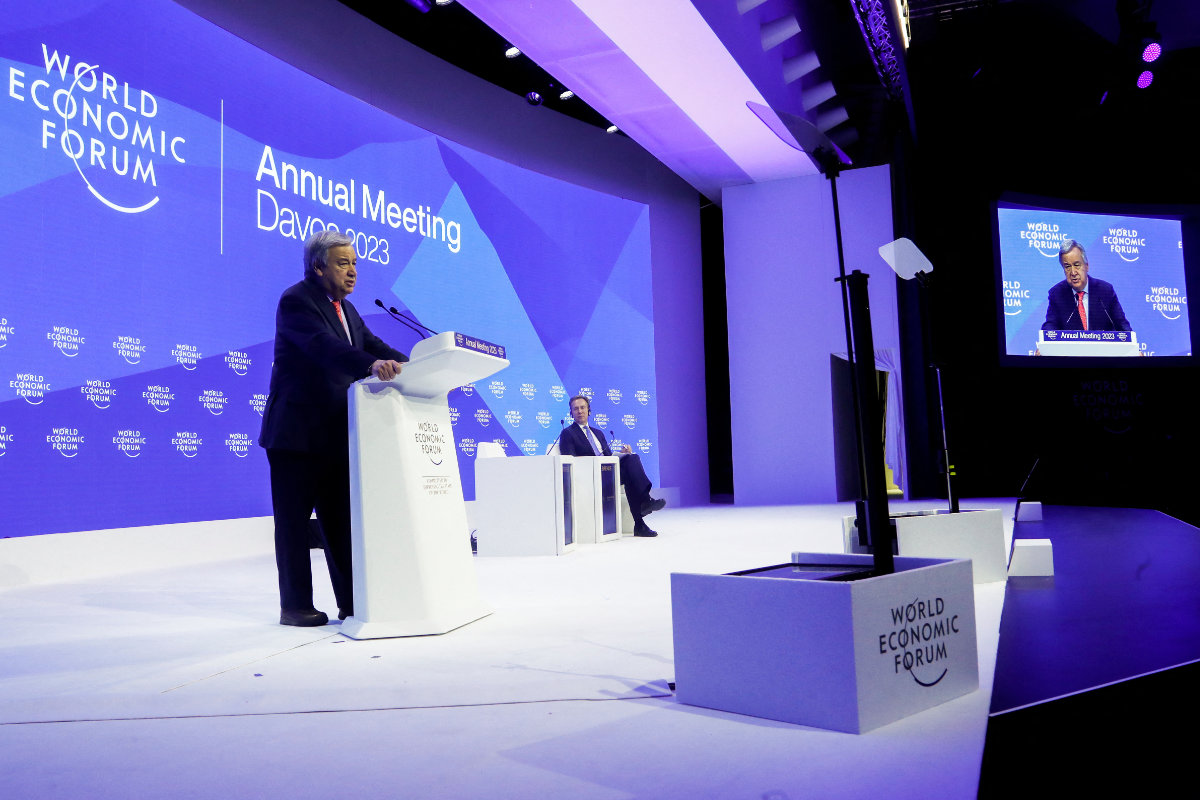


UN Secretary-General Antonio Guterres addresses the World Economic Forum (WEF) in Davos, Switzerland, on January 18, 2023. (REUTERS)

Guterres warned that time is running out to prevent disasters linked to man-made climate from growing in scale and frequency.

“We are looking into the eye of a Category 5 storm,” he added. 

To avert the worst effects of climate change, scientists say any rise in global temperatures must be limited to no more than 1.5 degrees Celsius above pre-industrial levels. The average surface temperature of the planet has already increased by about 1.8 C since the late 1800s.

Guterres urged the world to “end the addiction to fossil fuels,” warning that the aspirational goal of limiting warming to 1.5 C was “going up in smoke.”

“Fossil fuel producers and their enablers are still racing to expand production, knowing full well that this business model is inconsistent with human survival,” he said.

“This insanity belongs in science fiction, yet we know the ecosystem meltdown is cold, hard scientific fact.”

The Paris Agreement, a legally binding international treaty on climate change adopted by 196 countries at the 2015 UN Climate Change Conference, COP21, committed nations to scaling up their efforts to reduce greenhouse gas emissions by 45 percent before 2030.

It also obliged them to build resilience against the adverse effects of climate change, uphold and promote regional and international cooperation in efforts to limit global warming to the 1.5 C target, and to reach net-zero by 2050.

To date, 137 countries have committed to achieving carbon neutrality, as tracked by the Energy and Climate Intelligence Unit, an independent advisory organization in the UK. Of those, 124 have set targets for 2050.

Bhutan and Suriname are the only two nations to date that have achieved carbon neutrality and are, in fact, carbon negative. Twenty-four countries have set their climate targets as official policy. They include Brazil, China, Germany and the US, which are some of the world’s largest emitters. Five countries are preparing legislation, including Canada, South Korea and several EU member states.

However, even if the 193 parties to the Paris Agreement implement their existing commitments, it is estimated that global greenhouse gas emissions would still increase by almost 11 percent by 2030, compared with 2010.


Prabowo, Trump expected to sign Indonesia-US tariff deal in January 2026

Updated 23 December 2025
Follow

Prabowo, Trump expected to sign Indonesia-US tariff deal in January 2026

  • Deal will mean US tariffs on Indonesian products are cut from a threatened 32 percent to 19 percent
  • Jakarta committed to scrap tariffs on more than 99 percent of US goods

JAKARTA: Indonesia expects to sign a tariff deal with the US in early 2026 after reaching an agreement on “all substantive issues,” Jakarta's chief negotiator said on Tuesday.

Indonesia’s Coordinating Minister for Economic Affairs Airlangga Hartarto met with US trade representative Jamieson Greer in Washington this week to finalize an Indonesia-US trade deal, following a series of discussions that took place after the two countries agreed on a framework for negotiations in July.

“All substantive issues laid out in the Agreement on Reciprocal Trade have been agreed upon by the two sides, including both the main and technical issues,” Hartarto said in an online briefing.

Officials from both countries are now working to set up a meeting between Indonesian President Prabowo Subianto and US President Donald Trump. 

It will take place after Indonesian and US technical teams meet in the second week of January for a legal scrubbing, or a final clean-up of an agreement text.

“We are expecting that the upcoming technical process will wrap up in time as scheduled, so that at the end of January 2026 President Prabowo and President Trump can sign the Agreement on Reciprocal Trade,” Hartarto said.  

Indonesian trade negotiators have been in “intensive” talks with their Washington counterparts since Trump threatened to levy a 32 percent duty on Indonesian exports. 

Under the July framework, US tariffs on Indonesian imports were lowered to 19 percent, with Jakarta committing to measures to balance trade with Washington, including removing tariffs on more than 99 percent of American imports and scrapping all non-tariff barriers facing American companies. 

Jakarta also pledged to import $15 billion worth of energy products and $4.5 billion worth of agricultural products such as soybeans, wheat and cotton, from the US. 

“Indonesia will also get tariff exemptions on top Indonesian goods, such as palm oil, coffee, cocoa,” Hartarto said. 

“This is certainly good news, especially for Indonesian industries directly impacted by the tariff policy, especially labor-intensive sectors that employ around 5 million workers.” 

In the past decade, Indonesia has consistently posted trade surpluses with the US, its second-largest export market after China. 

From January to October, data from the Indonesian trade ministry showed two-way trade valued at nearly $36.2 billion, with Jakarta posting a $14.9 billion surplus.