

UN deputy secretary-general in Kabul for talks on women’s education, work

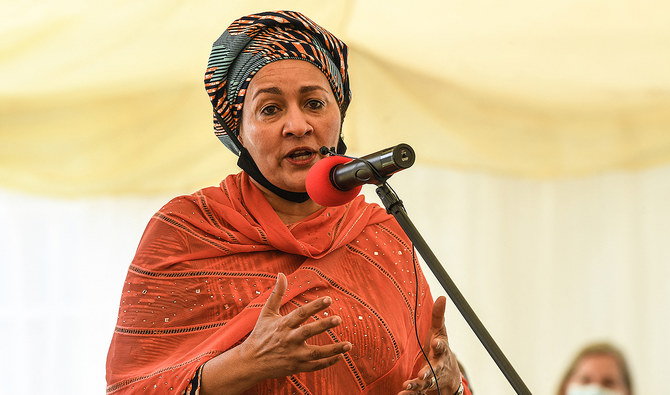
In this file photo taken on March 1, 2022, Deputy Secretary-General of the United Nations Amina Mohammed, gestures as she delivers a speech in Nairobi. (Photo courtesy: AFP/File)
Short Url
Updated 18 January 2023
Follow

UN deputy secretary-general in Kabul for talks on women’s education, work

  • Afghanistan seeks international recognition, removal of banking sanctions and travel restrictions on Taliban leaders
  • Taliban ordered local and foreign aid organizations last month to stop letting female staff work until further notice

KABUL: The UN deputy secretary-general met Afghanistan’s acting foreign minister on Wednesday to discuss women’s education and work after Taliban authorities ordered most female NGO workers to stop work and barred women from attending universities.
Amina Mohammed was in Kabul as part of a series of meetings that had included stops in Turkiye, Qatar, and Pakistan to discuss the situation in Afghanistan with diplomats, the Afghan diaspora, and the Organization of the Islamic Conference (OIC).
“Clear consensus was evident on the issue of women and girls’ rights to work and have access to education,” said a statement from the United Nations, referring to meetings in the lead-up to the Kabul visit.
In Kabul, she met acting foreign minister Amir Khan Muttaqi, according to a foreign affairs ministry spokesperson.
Muttaqi said a lack of formal recognition, travel restrictions on Taliban leaders, and banking sanctions were causing problems and that the international community should address them, according to a foreign ministry statement. He added that women were able to work in health and education.
The Taliban administration last month ordered local and foreign aid organizations to stop letting female staff work until further notice. It said the move, condemned globally, was justified because some women had not adhered to the Taliban’s interpretation of the Islamic dress code. It came days after authorities ordered universities not to allow female students.
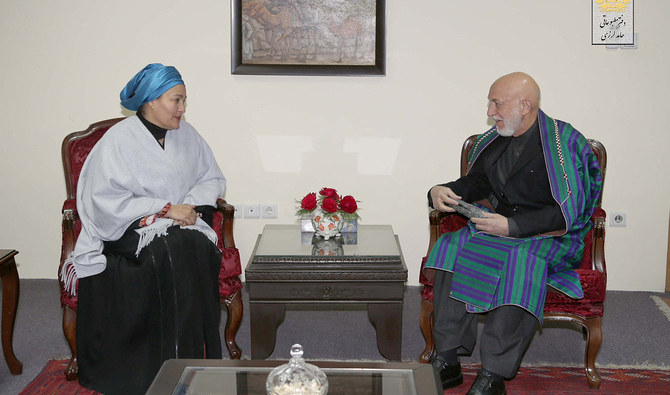


United Nations Deputy Secretary-General Amina Mohammed meets with former Afghan President Hamid Karzai, in Kabul, Afghanistan, in this handout image released January 18, 2023. (Photo courtesy: REUTERS)

Many NGOs, some of whom carry out humanitarian work under contracts with the UN, stopped operations in the wake of the ban. Some said this week they had re-started work in areas such as health in which authorities had assured them female workers could operate.

France, Algeria to resume security cooperation: minister

Updated 9 sec ago
Follow

France, Algeria to resume security cooperation: minister

  • Algeria plays a key role in the latter, sharing borders with junta-led Niger and Mali, both gripped by terrorist violence

ALGIERS: France and Algeria agreed on Tuesday to restart security cooperation during a visit to Algiers by French Interior Minister Laurent Nunez, marking the first sign of a thaw in diplomatic ties.
After meeting with President Abdelmadjid Tebboune, Nunez said both sides had agreed to “reactivate a high-level security cooperation mechanism.”
The visit took place against a backdrop of thorny relations between France and its former colony, frayed since Paris in 2024 officially backed Moroccan sovereignty over the disputed Western Sahara region, where Algeria supports the pro-independence Polisario Front.
Nunez said Monday had been devoted to working sessions aimed at “restoring normal security relations,” including cooperation in judicial matters, policing and intelligence.
He thanked the Algerian president for instructing his services to work with French authorities to “improve cooperation on readmissions.” Algeria has for months refused to take back its nationals living irregularly in France.
The renewed cooperation is expected to take effect “as quickly as possible” and continue “at a very high level,” Nunez confirmed.
According to images released by Algerian authorities, the talks brought together senior security officials from both countries, including France’s domestic intelligence chief and Algeria’s head of internal security.
Invited by his counterpart Said Sayoud, Nunez’s trip had been planned for months but repeatedly delayed.
Both sides have a backlog of issues to tackle. Before traveling, Nunez said he intended to raise “all security issues,” including drug trafficking and counterterrorism.
Algeria plays a key role in the latter, sharing borders with junta-led Niger and Mali, both gripped by terrorist violence.
Ahead of the trip, Nunez had also mentioned the case of Christophe Gleizes, a French sports journalist serving a seven-year sentence for “glorifying terrorism.”
It is unclear whether the matter was discussed with Tebboune, from whom the journalist’s family has requested a pardon.