

Science, technology, investment hold key to ‘future-thinking’ UAE’s success

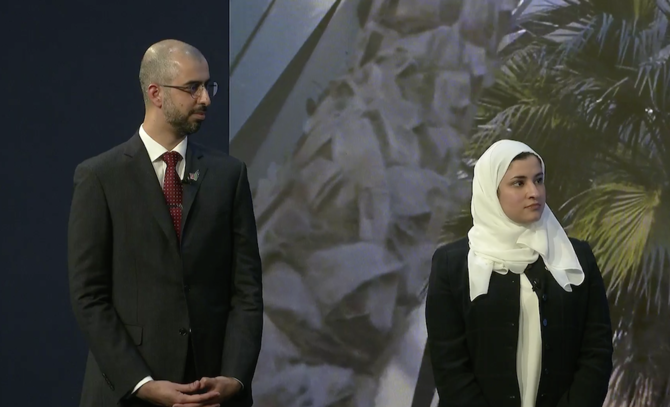
Sarah Al-Amiri (C), the UAE minister for public education and future technology, and Omar Sultan Al-Olama (L), minister for artificial intelligence speaking during the panel. (Screenshot/WEF)
Short Url
Updated 18 January 2023
Follow

Science, technology, investment hold key to ‘future-thinking’ UAE’s success

  • Al-Amiri said the secret behind the UAE’s recent successes had been its skill at harnessing and combining individual human potential and institutional, governmental potential
  • Al-Olama said that attracting global talent is key and that globalization should be welcomed, not shunned

DAVOS: The UAE is utilizing science and technology to “leapfrog” its way to becoming a global leader in various fields, including space travel and tackling climate change, Emirati ministers told a World Economic Forum panel in Davos on Wednesday.

Sarah Al-Amiri, the UAE minister for public education and future technology, and Omar Sultan Al-Olama, minister for artificial intelligence, discussed how, since its independence more than 50 years ago, the UAE has a proven record of design thinking in governance and what lessons it can teach the developing world.

Al-Amiri said the secret behind the UAE’s recent successes had been its skill at harnessing and combining individual human potential and institutional, governmental potential while instilling a sense of urgency among the population to achieve certain goals.

“What drove us? A real sense of urgency, knowing that science and technology is required and a fundamental part of the growth of the future of our economy and the future of our industrial sectors,” she said.

“We have a technology transformation program (in the UAE), developed with and embedded within our industrial strategy. How do you sustainably and effectively increase the impact of your economic sectors?

“We are working closely with key local players to do that, but also fostering more global partnerships so we can create the necessary relevance and impact.”

Al-Olama said that the spirit of advancement has been part of the psyche of Emiratis and the wider Gulf region for millennia.

“We see that there is a constant need to adapt, to reinvent ourselves, and to face all challenges and opportunities equally,” he said.

“With every single era, the people of the UAE choose an industry and they go all in into it. If you look at the (ancient) trade of pearls as an example, it became a key industry, but we did not focus on local markets, we wanted to become global players.

“Moving forward (to today), the UAE has taught 1 million people in the Arab world how to code, and as that program concluded last year, it has ended up creating tens of thousands of companies and business endeavors across the Arab world.”

Al-Olama said that attracting global talent is key and that globalization should be welcomed, not shunned, but added that should a globalized world collapse tomorrow and fall back into global blocs, the UAE would have the talent and “future thinking” required to face that challenge.


RT Arabic opens its first Riyadh studio, inaugurates with first live show

AlRiyadh newspaper signed a memorandum of understanding with RT promising news exchange and joint training cooperation.
Updated 11 February 2026
Follow

RT Arabic opens its first Riyadh studio, inaugurates with first live show

  • Program will broadcast twice a month
  • Will be part of a series of analytical shows focusing on developments broadcast by RT Arabic from various global capitals

RIYADH: Widely regarded in the region as a trusted and reliable news network, RT Arabic (Russia Today) officially opened RT Studio Riyadh on Tuesday, allowing the centennial of Russia-Saudi Arabia diplomatic relations to usher in a new age of media relations as well.

The program will broadcast twice a month and will be part of a series of analytical shows focusing on regional and global developments broadcast by RT Arabic from various capitals around the world, such as “Studio Cairo,” “Studio Beirut,” “Studio Washington,” and “Studio Paris.”

It will be hosted by veteran Saudi journalist Mohammed Al-Rashed, who has more than 20 years of experience.

In his opening remarks, Russian Ambassador to Saudi Arabia Sergey Kozlov spoke of the century-long relationship between the two countries beginning in 1926 when the Soviet Union became the first state to formally recognize the Kingdom of Hejaz and Najd.

Those bilateral ties have evolved into a comprehensive strategic partnership that spans sectors such as energy, agriculture, industry, investment, science and education, culture and media, and humanitarian cooperation.

“Our friendship is built on mutual respect, trust, and a shared vision for the future,” he said.

Recent milestones include a growing tourism exchange, marked by a new mutual visa-exemption agreement in December 2025, and increased air connectivity through direct flights between Moscow-Riyadh and Moscow-Jeddah.

The ambassador also highlighted Crown Prince Mohammed bin Salman’s visit to Moscow in 2017 and President Vladimir Putin’s visit to Riyadh in 2019 as pivotal moments in advancing relations.

RT Studio Riyadh will “strengthen understanding between our peoples and provide viewers with deeper insight into political, cultural, and social developments in both countries,” he said.

Feb. 10 was also Russian Diplomatic Worker’s Day, an occasion that the presenters believe added symbolic significance to the launch.

The Kingdom’s Minister of Media Salman bin Yousef Al-Dosari was also present to celebrate the studio’s inauguration and expressed Saudi Arabia’s eagerness to strengthening its media partnerships.

“We are keen to support international media institutions and provide them with all necessary services to carry out their professional mission with ease and transparency,” he said.

That same evening, Al Riyadh newspaper signed a memorandum of understanding with RT promising news exchange and joint training cooperation.

The managing editor at Al Riyadh, Nawal Aljabr, described Studio Riyadh as a bridge connecting Russian and Arab audiences and an opportunity to explore future cooperation opportunities.

The inaugural guest of the platform was Prince Turki Al-Faisal, chairman of the King Faisal Center for Research and Islamic Studies.

The episode aired live at the opening on Tuesday and discussed topics pertaining to the historical roots of Saudi-Russian relations, the durability of ties amid global geopolitical shifts, and future cooperation prospects, as well as the Kingdom’s role regionally and internationally.

Each episode will run for 26 minutes and feature a discussion between Al-Rashed and a chosen guest on a current affairs topic.

RT Arabic, established in 2007, is the first Russian 24-hour Arabic-language news channel. It has become one of the most prominent and influential media outlets in the Middle East.