Morocco targeting 50% renewable use by 2030, PM tells Davos 

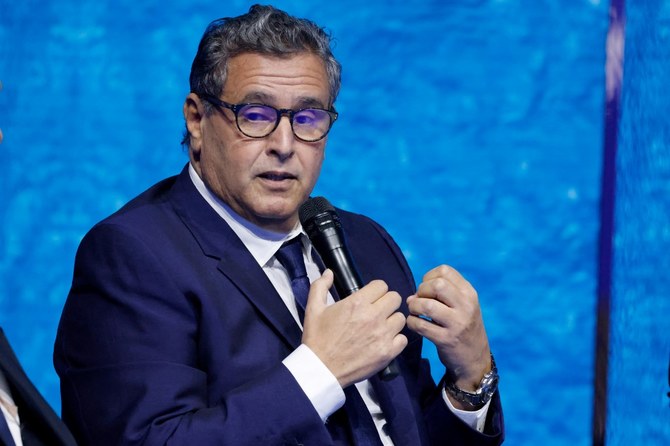
Moroccan Prime Minister Aziz Akhannouch (AFP)
Short Url
Updated 19 January 2023
Follow

Morocco targeting 50% renewable use by 2030, PM tells Davos 

  • Moroccan Prime Minister Aziz Akhannouch spoke during a special address on Wednesday in Davos

DAVOS: Morocco has “become a leader” in sustainable development and is targeting 50 percent reliance on renewable energy by 2030, the country’s prime minister has told a Davos forum.

Moroccan Prime Minister Aziz Akhannouch said during a special address on Wednesday: “Renewable energies now account for 38 percent of our energy mix, and our ambition is to reach 50 or 52 percent by 2030.”

He told the World Economic Forum that the country’s targets were “very possible,” describing Morocco as “very favorable to renewables” due to its climate recording 3,000 hours of sunshine per year.

The country can also “offer to produce energy through wind speed that will provide one of the cheapest renewables in the world,” he added.

Morocco’s strategic position “gives it a place of choice in the value chains of the world,” he said, adding that the country “has one of the most abundant and cheapest resources in the world, which will help in the development of green hydrogen (and) will also play into the de-carbonization of the world.”

WEF President Klaus Schwab described Morocco as “a brick in the connection between nations of the world” through its location in Africa, the continent with the fastest growth worldwide.

Schwab hailed Morocco’s entry into the African Continental Free Trade Area last year, a pact that is considered the world’s largest free trade area.

“Morocco truly believes in a positive future for Africa. Africa can feed the world in the future if farming investments are made. Morocco has vast human resources — it is a very large market,”  Akhannouch said.

“Africa’s trade with the rest of the world is 60 percent and inter-African trade is only 16 percent. This free trade area is a fantastic and transformative initiative for Africa to boost investment and trade.”

Schwab described reform plans in Morocco as “impressive” as they “are not just plans but are delivering results that are already very visible.”

Akhannouch said that Morocco has become a regional model under the leadership of King Mohammed VI.

“In Morocco, we are well aware of the position we wish to occupy in the world, and this is why we have a new investment charter — a new attractive, incentivizing framework for international and national investors, which we are aiming to obtain with our reforms,” he added.

“We have built infrastructure, the best world-class infrastructure, connectivity (via) sea, land and air ... the first high-speed train in Africa, the largest Mediterranean seaport, and very soon, a large seaport on the Atlantic ocean, as well as 14 international airports which provide the ability to travel across Africa.”

“These infrastructures have allowed Morocco to obtain a very attractive tourism sector, a high-performance industry, a fantastic agriculture sector, industry in the automotive and aerospace sectors — and we have also established relations of trust establishing Morocco as a trusted partner in Africa.”


Koshary, a spicy Egyptian staple, wins UNESCO recognition

Updated 6 sec ago
Follow

Koshary, a spicy Egyptian staple, wins UNESCO recognition

CAIRO: Koshary – a spicy dish of lentils, rice and pasta available at countless Egyptian food stalls – won recognition as a cultural treasure from the UN’s cultural agency on Wednesday, as Cairo makes a broad push to promote its cultural and historical identity abroad.
Egypt’s nomination of koshary for UNESCO’s “Intangible Cultural Heritage” list comes a little over a month after its opening of a sprawling new antiquities museum – another move officials hope will highlight the country’s rich history and lure more tourists.
One popular legend claims koshary originated in northern India and was brought to Egypt by soldiers during the British occupation. But the dish’s origins can in fact be traced through a farther-flung, millennia-old lineage of migration, trade and conquest, food researcher and archaeobotanist Hala Barakat said.

EGYPTIAN DISH, WITH GLOBAL INFLUENCES
Lentils arrived from the Fertile Crescent more than 5,800 years ago, and rice was introduced from East Asia. Tomatoes and chilli peppers were brought from the Americas centuries later, while pasta noodles were a more modern addition.
“These components came together over thousands of years,” Barakat said. “Its name may be Indian, but the Egyptian dish has its own form – and even that varies from Alexandria to Aswan.”
“Koshary in its current form is the koshary Egyptians made their own,” she added.
Egypt’s nomination makes note of this diversity, highlighting the fact that yellow lentils are used on the coast, compared with black lentils in Cairo and Upper Egypt. Some households add boiled eggs, while in Sinai a similar dish called ma’dous is common.
Each of these variations is united by “the special flavour provided by condiments such as vinegar, garlic, and hot sauce, which are added according to preference,” the nomination says.

COUSCOUS, CEVICHE ALSO ON LIST
Making the intangible heritage list is mostly symbolic, and does not bring any direct financial benefit. Other dishes such as couscous – common across the Maghreb region – and the South American dish ceviche are on the list. Italian cuisine was also set to be inscribed this year.
Koshary’s popularity surged in the 20th century as restaurants and brightly decorated street carts proliferated near schools and stations. The absence of animal products has also made it a staple among fasting Coptic Christians and younger Egyptians who are going vegetarian.
Today, the dish is one of Egypt’s most recognizable features, according to Ahmed Shaker, the public relations officer at Abou Tarek Koshary, a popular Cairo restaurant that dates back to 1963.
“Any foreigner or visitor who comes to Egypt visits the Pyramids, visits the museum, and comes to Abou Tarek to eat koshary,” Shaker said.
The dish joins Egypt’s 10 previous “inscriptions,” which include tahteeb, an ancient martial art using sticks, and the Sirat Bani Hilal, an epic oral poem.
UNESCO’s new director-general, Khaled El-Enany, previously served as Egypt’s minister of tourism and antiquities, and has vowed to use his tenure to safeguard cultural traditions.