

Bangladesh calls for Rohingya repatriation amid rise in deadly sea journeys

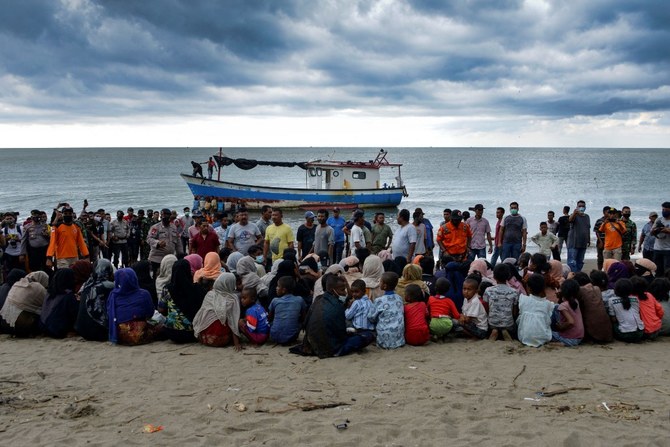
Evacuated Rohingya from Myanmar sit on the shorelines of Lancok village, in Indonesia's North Aceh Regency, after some 100 people were rescued from a wooden boat. (File/AFP)
Short Url
Updated 18 January 2023
Follow

Bangladesh calls for Rohingya repatriation amid rise in deadly sea journeys

  • More than 3,500 refugees attempted perilous sea voyages in 2022, compared with 770 a year earlier
  • UNHCR says increase reflects a ‘crisis’ in international solidarity, responsibility

DHAKA: Bangladeshi authorities on Wednesday renewed calls for international pressure on Myanmar to enable the repatriation of Rohingya refugees amid an alarming increase in deadly boat journeys by sea.

The number of Rohingya attempting to cross the Andaman Sea and the Bay of Bengal has seen a four-fold surge, according to data released by the UNHCR on Tuesday. More than 3,500 people attempted to cross the waters in 2022, compared with 770 a year earlier.

The UNHCR has also recorded “an alarming rise in the death toll,” as more than 340 Rohingya died or went missing at sea in 2022, making it one of the deadliest years since 2017, when hundreds of thousands of Rohingya Muslims fled to Bangladesh to escape a deadly military crackdown in Myanmar’s Rakhine state.

Most of the Rohingya boats in the Andaman Sea and the Bay of Bengal departed from Myanmar and Bangladesh, “highlighting the growing sense of desperation amongst Rohingya in those two countries,” the UNHCR said.

“Those who have disembarked report that they undertook these dangerous sea journeys in an effort to find protection, security, family reunification and livelihoods in other countries.”

While many Rohingya continue to flee Myanmar, those who found refuge in Bangladesh are leaving in search of better living conditions. Mmore than 1.2 million Rohingya live in squalid Bangladeshi camps, most of them in Cox’s Bazar district, a coastal region that with their arrival became the world’s largest refugee settlement.

Despite multiple attempts by Bangladeshi authorities, UN-backed programs for repatriation or resettlement to third countries have failed to take off, which according to the country’s top official for refugees, is fueling the growing crisis.

“The repatriation of the Rohingya is the only solution to this crisis. There is no alternative,” Mizanur Rahman, refugee relief and repatriation commissioner in Cox’s Bazar, told Arab News.

“Our appeal to the international community is to put more pressure on the Myanmar government to take their people back as soon as possible by creating a conducive environment in Rakhine state.”

Rahman said that the number of refugees embarking on perilous sea journeys in search of a better life is likely to further increase given the situation.

Conditions in the camps are deteriorating amid a drop in international aid for refugees since 2020, and Bangladesh, a developing country that itself is facing multiple post-pandemic challenges and spends an estimated $1.2 billion a year to host the Rohingya, is struggling to cope with the surge in numbers.

The UNHCR has called for a “humanitarian responsibility” in the region to evenly distribute the Rohingya among various countries.

“The current crisis in the Bay of Bengal and the Andaman Sea is a crisis of solidarity,” UNHCR spokesperson Shabia Mantoo said on Tuesday.

“The region and the international community need to support efforts to address the root causes of displacement in Myanmar. Until these are resolved, refugees will continue to undertake dangerous journeys in search of safety.”


Somalia denounces Israeli recognition of Somaliland

A man holds a flag of Somaliland in front of the Hargeisa War Memorial monument in Hargeisa on November 7, 2024. (AFP)
Updated 8 sec ago
Follow

Somalia denounces Israeli recognition of Somaliland

  • Israel repeatedly hit targets in Yemen after the Gaza war broke out in October 2023, in response to Houthi attacks on Israel that the rebels said were in solidarity with Palestinians in the Gaza Strip
  • Egypt’s foreign ministry said its top diplomat had spoken with his counterparts from Turkiye, Somalia and Djibouti, who together condemned the move and emphasized “their full support for the unity, sovereignty and territorial integrity of Somalia”

MOGADISHU: Somalia reacted angrily Friday after Israel formally recognized its northern region of Somaliland as an “independent and sovereign state” — the first country country to do so.
Somaliland, which declared independence from Somalia in 1991, has for decades pushed for international recognition, which has been the key priority for president Abdirahman Mohamed Abdullahi since he took office last year.
But a Somali foreign ministry statement warned that the decision was “deliberate attack” on its sovereignty that would undermine peace in the region. Several other countries also condemned Israel’s decision.
Israeli Prime Minister Benjamin Netanyahu’s office said he announced “the official recognition of the Republic of Somaliland as an independent and sovereign state,” making Israel the first country to do so.
“The declaration is in the spirit of the Abraham Accords,” Netanyahu’s office said, referring to several agreements between Israel and Arab countries brokered by US President Donald Trump during his first presidency to normalize ties with Israel.
It said Netanyahu had invited Abdullahi to visit.
Hailing Israel’s decision, Abdullahi said in a post on X that it marked the beginning of a “strategic partnership.”
“This is a historic moment as we warmly welcome” he said, affirming “Somaliland’s readiness to join the Abraham Accords,” he added.
In Hargeisa, the capital of Somaliland, crowds of people took to the streets to celebrate, many carrying the flag of the breakaway state, said sources.

- ‘Illegitimate actions’ -

Somalia’s foreign ministry said: “Illegitimate actions of this nature seriously undermine regional peace and stability, exacerbate political and security tensions, in the Horn of Africa, the Red Sea and Gulf of Aden, the Middle East and the wider region.”
Turkiye, a close ally of Somalia, also condemned the move.
“This initiative by Israel, which aligns with its expansionist policy... constitutes overt interference in Somalia’s domestic affairs,” it said in a foreign ministry statement.
Egypt’s foreign ministry said its top diplomat had spoken with his counterparts from Turkiye, Somalia and Djibouti, who together condemned the move and emphasized “their full support for the unity, sovereignty and territorial integrity of Somalia.”
In video showing Netanyahu speaking to Abdullahi by telephone, the Israeli leader said: “I want you to know that I am signing now as we speak Israel’s official recognition of the Somaliland,” adding that the new relationship would offer economic opportunities.
“I am very, very happy and I am very proud of this day and I want to wish you and the people of Somaliland the very, very best,” he said.
Netanyahu also said that he would communicate to Trump Abdullahi’s “willingness and desire to join the Abraham accords.”
A self-proclaimed republic, Somaliland enjoys a strategic position on the Gulf of Aden, has its own money, passports and army. But since its unilateral declaration of independence in 1991, it has grappled with decades of isolation.

- Strategic -

Analysts say matters of strategy were behind Israel’s drive to recognize Somaliland.
“Israel requires allies in the Red Sea region for many strategic reasons, among them the possibility of a future campaign against the Houthis,” said the Institute for National Security Studies in a paper last month, referring to Yemen’s Iran-backed rebels.
“Somaliland is an ideal candidate for such cooperation as it could offer Israel potential access to an operational area close to the conflict zone,” it said, adding there were also economic motives.
Israel repeatedly hit targets in Yemen after the Gaza war broke out in October 2023, in response to Houthi attacks on Israel that the rebels said were in solidarity with Palestinians in the Gaza Strip.
The Houthis have halted their attacks since a fragile truce began in Gaza in October.
Somaliland’s lack of international recognition has hampered access to foreign loans, aid and investment, and the territory remains deeply impoverished.
A deal between landlocked Ethiopia and Somaliland last year to lease a stretch of coastline for a port and military base enraged Somalia.
Israel has been trying to bolster relations with countries in the Middle East and Africa.
Historic agreements struck late in Trump’s first term in 2020 saw several countries including Muslim-majority United Arab Emirates and Morocco normalize relations with Israel, but wars that have stoked Arab anger, particularly in Gaza, have hampered recent efforts.