

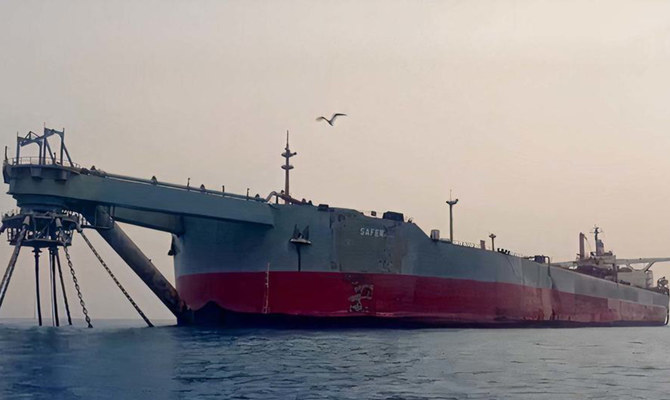
UN has cash for Safer salvage but finding a replacement vessel is proving a challenge

More than 17 countries have contributed to the funds needed for the first phase of the salvage operation, including Saudi Arabia, which donated $10 million. (Photo/UN)
Short Url
Updated 18 January 2023
Follow

UN has cash for Safer salvage but finding a replacement vessel is proving a challenge

  • Spokesman Farhan Haq said that suitable oil tankers have become harder to find and more expensive because of the war in Ukraine
  • The Safer, which contains more than 1.14 million barrels of oil, has been moored in the Red Sea since 2015 with little or no maintenance

NEW YORK CITY: The UN is “closer than ever” to beginning the first phase of the salvage operation on the decaying Safer oil tanker off the coast of Yemen.

However, as a result of the war in Ukraine, it has become harder and more expensive to find and hire a replacement oil tanker, posing yet another challenge for the long-delayed operation.

“Donors have generously pledged more than $84 million of the funding required for the UN-coordinated plan to prevent a major oil spill from the Safer,” UN spokesperson Farhan Haq said on Tuesday. “Additional funding from the private sector is expected soon.”

The vessel, which contains more than 1.14 million barrels of oil, has been moored in the Red Sea off the coast of Yemen for more than seven years. During that time it has had little or no maintenance and its condition has deteriorated to a point where there are growing fears of a catastrophic oil spill.

The planned salvage operation to make it safe has been split into two phases. First, the oil will be transferred from the tanker to another vessel, then moved to a permanent storage facility until the political situation in Yemen allows for it to be sold or transported elsewhere.

Haq said that with $73 million of pledges now received, the UN has been able to begin “essential preparatory work.”

“All of the technical expertise is in place to undertake the procurement for the complex operation,” he said. “This includes a marine management consultancy firm, maritime legal firm, insurance and ship brokers and oil spill experts.

“The contracting of the salvage company that will carry out the emergency operation is at an advanced stage.”

The key challenge now, Haq said, is procuring the use of a large enough oil tanker because “the UN cannot begin the emergency operation until it is certain that a safe crude carrier will be in place to take on the oil.”

However, the availability of suitable ships has decreased in the past six months and prices have doubled since the budget for the operation was prepared, “basically due to events having to do with the war in Ukraine,” he explained.

“So just as we were gearing up for operations, the cost to both lease and purchase this type of a vessel increased. So a very large crude carrier now costs at about 50 percent more than what’s budgeted in the original plan. So we have some additional expenses and it’s a little bit harder finding the right ships but we’re proceeding with the work.

“The UN is working expeditiously with a maritime broker and other partners to find a workable solution and remains confident the work can begin in the coming months.”

If the Safer breaks up and the oil spills into the Red Sea, the clean-up operation could cost an estimated $30 billion. The environmental disaster would affect not only Yemen but neighboring countries including Saudi Arabia, Djibouti, Eritrea and Somalia. In addition, fisheries would be damaged and shipping disrupted.

More than 17 countries have contributed to the funds needed for the first phase of the salvage operation, including Saudi Arabia, which donated $10 million. There have also been contributions from the private sector, public foundations and a crowdfunding campaign set up by the UN. A donation of $7 million from the Netherlands late last year brought the total up to the initial target.

The Houthis control Yemen’s western Red Sea ports, including Ras Issa, close to which the Safer is moored. The UN had been negotiating with the rebel militias for several years in an attempt to gain access to the tanker for a proper inspection. Both sides signed a memorandum of understanding in March last year, which authorized a four-month emergency operation to eliminate the immediate threat by transferring the oil to another vessel.

On Monday, France announced an additional contribution of €1 million ($1.08 million) to the UN salvage fund.

Alexandre Olmedo, deputy political coordinator of France to the UN, said he hopes the first phase of the operation can be “quickly implemented to avoid an ecological disaster.”

“We also call on the Houthis, who are currently in control of the vessel, to fully cooperate with the UN in the implementation of the rescue plan,” he said.


Israel to terminate MSF work in Gaza for failing to provide Palestinian staff list

Updated 27 min 40 sec ago
Follow

Israel to terminate MSF work in Gaza for failing to provide Palestinian staff list

JERUSALEM: Israel announced Sunday it was terminating Doctors Without Borders’ humanitarian operations in Gaza after the charity failed to provide a list of Palestinian staff, a move MSF said was a “pretext” to obstruct aid to the war-devastated territory.
In December, Israel announced it would prevent 37 aid organizations, including MSF, from working in Gaza from March 1 for failing to submit detailed information about their Palestinian employees, drawing widespread condemnation from NGOs and the United Nations.
“The Ministry of Diaspora Affairs and Combating Antisemitism is moving to terminate the activities of Medecins Sans Frontieres (MSF) in the Gaza Strip,” the ministry said on Sunday.
The decision follows “MSF’s failure to submit lists of local employees, a requirement applicable to all humanitarian organizations operating in the region,” it added.
The ministry had earlier alleged that two MSF employees had links with Palestinian militant groups Hamas and Islamic Jihad, which the charity has vehemently denied.
On Sunday, the ministry said MSF had committed in early January to sharing the staff list, but ultimately refrained.
“Subsequently, MSF announced it does not intend to proceed with the registration process at all, contradicting its previous statements and the binding protocol,” the ministry added, saying “MSF will cease its operations and depart the Gaza Strip by February 28.”

- No assurances -

MSF said it had tried for months to engage with Israeli authorities over the issue, but its attempts were unsuccessful.
MSF charged that the ministry’s move was a “pretext to obstruct humanitarian assistance” to Gaza.
“Israeli authorities are forcing humanitarian organizations into an impossible choice between exposing staff to risk or interrupting critical medical care for people in desperate need,” it said in a statement issued on Sunday.
“MSF did not hand over staff names because Israeli authorities failed to provide the concrete assurances required to guarantee our staff’s safety, protect their personal data, and uphold the independence of our medical operation,” it said.
Such demands by Israel will force aid organizations to pull out when “needs are overwhelming and health services are collapsing” in Gaza, it said.
“At a moment when more humanitarian assistance is urgently needed, it is being restricted rather than facilitated,” the charity said, adding that it remained open for dialogue with Israeli authorities to maintain its services in Gaza and the occupied West Bank.
MSF says 15 of its employees have been killed over the course of the Gaza war.
Minister of Diaspora Affairs and Combating Antisemitism Amichai Chikli said the organization had “abruptly changed” its position.
“It appears the organization’s employees do not meet the established criteria,” Chikli said.

- Care at risk -

MSF has long been a key provider of medical and humanitarian aid in Gaza, particularly since the war broke out in October 2023 after Hamas’s attack on Israel.
The charity says it currently provides at least 20 percent of hospital beds in the territory and operates around 20 health centers.
In 2025 alone, it carried out more than 800,000 medical consultations and more than 10,000 infant deliveries, and it also provides drinking water.
Aid groups warn that without international support provided by organizations such as MSF, critical services such as emergency care, maternal health and paediatric treatment could collapse entirely in Gaza, leaving hundreds of thousands of residents without basic medical care.
As they did with MSF, the Israeli authorities have repeatedly accused the UN agency for Palestinian refugees, UNRWA, of providing cover for Hamas militants, claiming that some of its employees even took part in the October 7, 2023 attack.
A series of investigations, including one led by France’s former foreign minister Catherine Colonna, found some “neutrality-related issues” at UNRWA but stressed Israel had not provided conclusive evidence for its headline allegation.
Last month, Israeli authorities began demolishing buildings at UNRWA’s headquarters in east Jerusalem, which the organization described as an “unprecedented attack.”
UNRWA has now been banned from operating in east Jerusalem, but it continues to operate in Gaza and the Israeli-occupied West Bank.