

Pakistan’s top election body defends delay in results of Karachi local polls

Voters stand in a queue outside a polling station to cast vote during local body elections in Karachi, Pakistan, on January 15, 2022. (@qadiryusfzai/Twitter)
Short Url
Updated 16 January 2023
Follow

Pakistan’s top election body defends delay in results of Karachi local polls

  • Political leaders say presiding officers left polling stations without handing over Forms 11 and 12
  • Election official says results currently held by returning officers, will be released by the evening

KARACHI: Pakistan’s election oversight body defended on Monday a delay in release of official results of local government polls in the southern port city of Karachi, denying any irregularities in the electoral exercise that was boycotted by the Muttahida Qaumi Movement-Pakistan (MQM-P) party. 

Several political parties contesting the second phase of the local government polls in the southern Sindh province criticized the Election Commission of Pakistan (ECP) for the delay in results, calling into question the transparency of Sunday’s high-voltage elections. 

The voting process for the local government elections ended Sunday evening, but results of a majority of union councils (UCs) in Karachi and Hyderabad cities have yet to be released by the authorities. 

Ejaz Anwar Chauhan, the provincial election commissioner, attributed the delay to a large number of voters stepping out of homes around Sunday noon and the completion of the voting process at several polling stations past 7pm. 

“Presiding officers prepared and brought all Forms 11 and 12 to the ROs (returning officers) this morning... I can say this with confidence that no officer demonstrated negligence in this,” he told reporters in Karachi. 

“Right now, the results are with our ROs, they are drafting all results and God willing, the results of all 246 union committees in Karachi will be finalized by the evening.” 

The election commission was aware of its constitutional and legal responsibilities, Chauhan added. 

In the absence of any clarity, various political parties claimed they were leading the contest in different parts of the province. 

“I am closely monitoring the results of each polling station, ward and UCs,” former federal shipping minister and president of the Sindh chapter of Pakistan Tehreek-e-Insaf (PTI) party Ali Haider Zaidi said in a Twitter post. 

He also accused the ruling Pakistan Democratic Movement (PDM) alliance of “playing games behind the scenes.” 

“Political engineers should respect public mandate,” he added. 
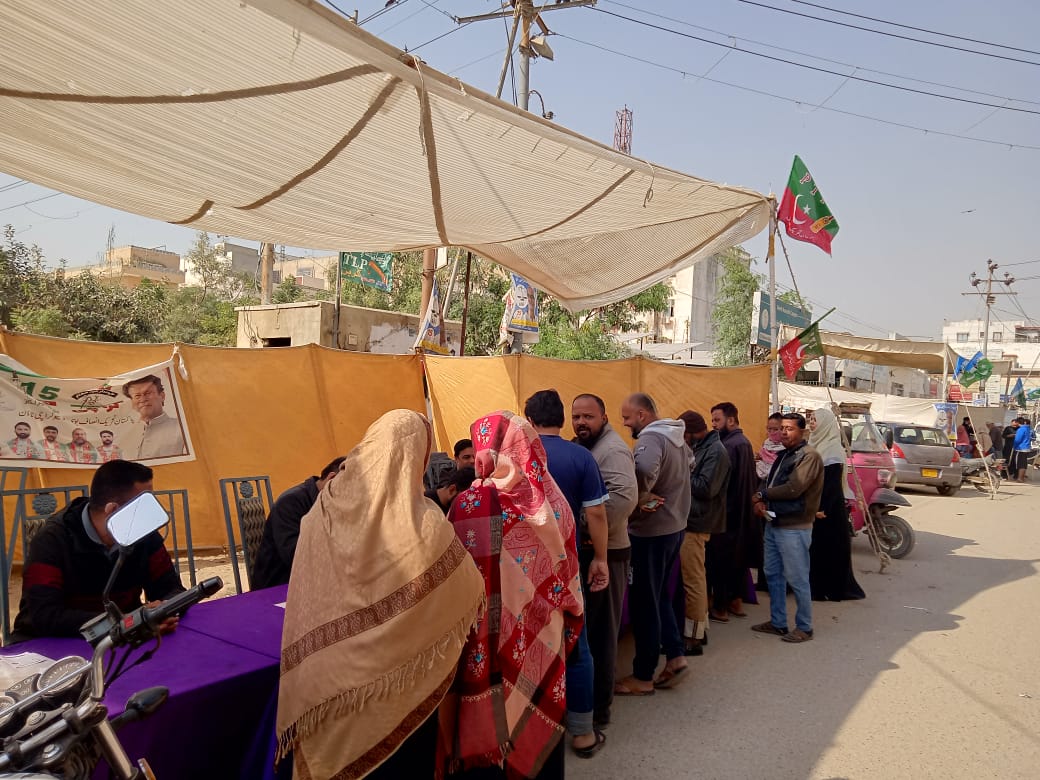


The picture posted on January 15, 2022, shows a polling camp of Pakistan Tehreek-e-Insaf in Karachi, Pakistan. (@PTI_KHI/Twitter)

Addressing a news conference in Karachi past midnight, Hafiz Naeem-ur-Rehman, the chief of Jamaat-e-Islami (JI) party in Sindh, said his political faction had grabbed 100 seats while results on 20 others were withheld after presiding officers disappeared from polling stations. 

“It is the constitutional, democratic, and legal right of the party that election results are handed over to it,” he said, adding the country’s chief election commissioner had issued clear orders to provide Forms 11 and 12 to all parties but the rule had not been followed. 

Defending the delay in results, Sindh Election Commissioner Chauhan said the results took time since returning officers had to look after five union committees. 

“The results are being manually compiled as the RTS [Results Transmission System] hasn’t been used in these polls,” he maintained. “It takes time to compile the results.” 

Murtaza Wahab, a spokesperson of the Sindh government and a senior Pakistan Peoples Party leader, urged the election body to ensure that results were issued on time. 

ECP Deputy Director Sajjad Khattak, in a letter, directed the district returning officers (DROs) to address the concerns of political parties. 

“This office has received various complaints from different political parties and candidates that the presiding officers are not giving copies of Form 11 and Form 12 to their polling agents present at polling stations,” the letter read. 

Local government polls in Sindh were held after the ECP rejected repeated requests of the provincial administration to delay the elections in Karachi and Hyderabad due to concerns raised by the MQM-P over the delimitation of constituencies. 

The party, which has a major presence in these urban centers, raised the allegations of “pre-poll rigging” before announcing not to participate in the voting contest. 


Pakistani PM to attend Board of Peace summit as part of Islamic bloc effort — FO

Updated 6 sec ago
Follow

Pakistani PM to attend Board of Peace summit as part of Islamic bloc effort — FO

  • Board will hold its first meeting on Feb. 19 in Washington to discuss Gaza’s reconstruction
  • Foreign office spokesman says no dates finalized for visit to Pakistan by Saudi Crown Prince 

ISLAMABAD: Pakistan confirmed on Thursday that Prime Minister Shehbaz Sharif will attend the first meeting of President Donald Trump’s newly formed “Board of Peace” in Washington on Feb. 19, positioning Islamabad as part of a joint Islamic diplomatic initiative focused on Gaza.

A UN Security Council resolution, adopted in mid-November, authorized the board and countries working with it to establish an international stabilization force in Gaza, where a fragile ceasefire began in October under a Trump plan on which Israel and Palestinian militant group Hamas signed off.

Under Trump’s Gaza plan, the board was meant to supervise Gaza’s temporary governance. Trump thereafter said the board, with him as chair, would be expanded to tackle global conflicts. The board will hold its first meeting on Feb. 19 in Washington to discuss Gaza’s reconstruction.

Speaking at a weekly press briefing in Islamabad, Foreign Office spokesperson Tahir Andrabi confirmed Sharif’s participation.

“Yes, I can confirm that the prime minister will attend the Board of Peace meeting... He will be accompanied by the deputy prime minister,” Andrabi said, describing Pakistan’s participation as part of a broader collective engagement by Muslim-majority states.

“We have joined the Board of Peace in good faith… We are in it, not in isolation, not as one voice, but as a collective voice of eight Islamic Arab countries,” he said.

“Our collective voice is resonating in the Board of Peace, and we will continue to strive for the right and progress and prosperity of the people of Palestine. And also aimed at the long-term solution of the Palestine issue in order to create a state of Palestine in accordance with the pre-1967 border with Al-Quds Al-Sharif as its capital.”

Pakistan does not recognize Israel and has consistently supported a two-state solution based on pre-1967 borders, with East Jerusalem as the capital of a future Palestinian state.

Responding to reports about a possible visit to Pakistan by Saudi Crown Prince Mohammed bin Salman, Andrabi said no dates had been finalized.

“There was a reference to the visit in one of the joint statements [issued after two visits of Sharif to Saudi Arabia last year] that this visit will take place this year. But I am not aware of its timing as yet,” the FO spokesman said.

Andrabi also addressed Pakistan’s financial engagement with the United Arab Emirates, confirming that Abu Dhabi had rolled over $2 billion in deposits with Pakistan’s central bank.

“The tenure of the rollover is prerogative of the depositor. But what I can assure you is that through the positive role of the Deputy Prime Minister and Foreign Minister [Ishaq Dar], we can say that the rollover is assured,” he said.

Last month, Pakistan’s central bank confirmed the extension of the $2 billion deposit, which has helped support the country’s foreign exchange reserves as Islamabad implements reforms under an ongoing International Monetary Fund bailout program.

Andrabi added that Pakistan currently faces “no external finance gap.”