

New York city mayor says ‘no room’ in his city for migrants
New York city mayor says ‘no room’ in his city for migrants/node/2233136/world
New York city mayor says ‘no room’ in his city for migrants
1 / 2
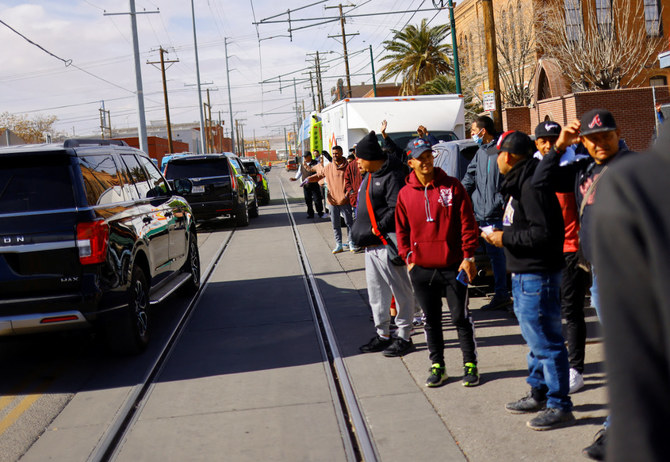
Migrants stand outside a shelter during a visit by New York City Mayor Eric Adams, who discussed immigration with local authorities in El Paso, Texas, on January 15, 2023. (REUTERS)
2 / 2
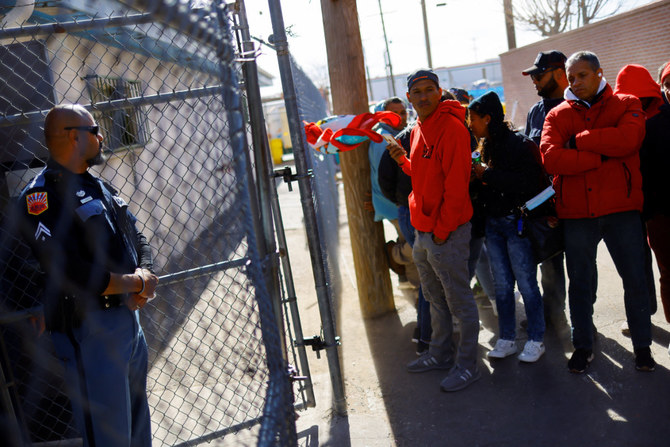
Migrants stand outside a shelter during a visit by New York City Mayor Eric Adams, who discussed immigration with local authorities in El Paso, Texas, on January 15, 2023. (REUTERS)
New York city mayor says ‘no room’ in his city for migrants
Busloads of migrants have been shipped north to New York and other cities by Republican run states
That has exacerbated a housing crisis in New York and a worsening homeless crisis in the city
Updated 16 January 2023
Reuters
LOS ANGELES: The mayor of New York traveled to the Mexican border city of El Paso on Sunday and declared that “there is no room in New York” for busloads of migrants being sent to America’s most populous city.
Eric Adams, a Democrat, was also critical of the administration of Democratic US President Joe Biden, saying “now is the time for the national government to do its job” about the immigrant crisis at America’s southern border.
The visit of a New York mayor to a southern border city about the issue of immigrants is unprecedented.
Busloads of migrants have been shipped north to New York and other cities by Republican run states. That has exacerbated a housing crisis in New York and a worsening homeless crisis in the city.
Adams’s trip to El Paso comes after he said the migrant influx into New York could cost the city as much as $2 billion, at a time when the city is already facing a major budget shortfall.
In recent months the Republican governors of Florida and Texas have sent thousands of migrants seeking sanctuary in the US to cities run by Democratic politicians, including New York, Chicago and Washington, D.C.
Ivory Coast cocoa growers rue ‘curse of brown gold’
Updated 10 sec ago
GUIGLO: Laurent Kone’s wattle-and-daub house, with its tarpaulin roof and no electricity, lies down a bumpy red-earth track in western Ivory Coast. For 30 years, he has been growing cocoa and is typical of the smallholders who have been the backbone in making the west African country the world’s leading producer of the crop. But the country currently faces major difficulties in selling its cocoa, hit by a slowdown in exports amid buyers’ liquidity problems and a drop in global prices. For growers who were already battling to eke out a living, the situation has only added to their plight. In its last report on the sector in 2019, the World Bank estimated that more than half (54.9 percent) of cocoa producers lived on less than 757 CFA francs ($1.36) a day. “I started planting in 1996 and I still don’t have a roof because there’s no money,” 54-year-old Kone told AFP at his home, 20 kilometers (12 miles) from the city of Guiglo. “It’s not dignified,” he said. The Ivorian government insists that conditions for growers are a priority and, following a rise in global prices, increased the amount it pays to producers to a record 2,800 CFA francs per kilogramme. “Producers are standing tall and are able to eat their fill, find housing, get medical treatment, enjoy the benefits of electricity and drinking water, and send their children to school and university,” said in October the country’s agriculture minister, Kobenan Kouassi Adjoumani, who was replaced in a government reshuffle on Friday. But, with the recent fall in exports, the hike in the price paid to producers has not had the desired effect. Some growers say they have not been paid in months.
- ‘Increasingly vulnerable’ -
Near Kone’s house in Betykro, about 50 families live without electricity or a mobile phone network and share a single pump for water. The nearest medical clinic is 10 km away along a rough track and, according to many growers, the universal health coverage put in place by the state does not adequately cover health care costs. “We’re disappointed,” said 64-year-old village chief Boniface Djabia, sounding dejected. “The farmers are the poorest people in Ivory Coast,” he added, showing his threadbare clothes. Farmers are “increasingly vulnerable,” said Oscar Toukpo, a sociologist at Felix Houphouet Boigny University in Abidjan. He blamed lower yields due to soil exhaustion and the rising cost of living. “Smallholders run up debts with cooperatives and sellers of crop protection products to try to improve production” and this worsens the cycle of poverty, he added. In his field, just a stone’s throw from his house, Kone still works only with a machete and wears open-toed shoes. “A bag of fertilizer costs 22,000 CFA francs but there’s no money,” he said. Maintaining production volume still depends on expanding plantations. But the strategy is limited, as Ivory Coast has already lost 90 percent of its forest cover in 60 years.
- Despondency -
According to the World Bank, productivity in Ivorian cocoa groves has stagnated in the past 20 years, at about 450 to 550 kilograms per hectare. The global lender said the cocoa sector was not fulfilling its role as a driver of economic development and suggested that some see “brown gold” as a “curse” due to the destruction of forests and persistent poverty. Additionally, Ivory Coast receives only six percent of the profits from the global cocoa industry. In recent years, the government has invested in cocoa processing facilities to transform the raw material on site. To get by, some producers are diversifying by planting oil palms or hevea trees used to make rubber, which, unlike cocoa’s seasonal harvest, produce 11 months of the year. “We manage with the rubber plantations,” said Alidou Traore, a 24-year-old farmer who has taken over his father’s land. In his village, a few kilometers from Kone’s, the houses look sturdier. But despondency is setting in. “The current situation with cocoa doesn’t give me any motivation,” he added. “I don’t want my children to be planters like me,” added Kone. “It’s a life of suffering.”