

Pakistan launches anti-polio drive targeting 44 million children

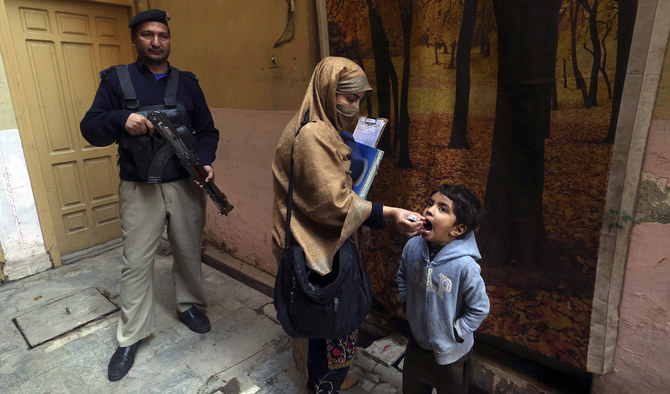
A police officer stands guard while a health worker gives a polio vaccine to a child in Peshawar, Pakistan, on December 5, 2022. (AP/File)
Short Url
Updated 15 January 2023
Follow

Pakistan launches anti-polio drive targeting 44 million children

  • Pakistan, Afghanistan are the only two countries in the world where polio still remains endemic
  • Pakistan confirmed 20 polio cases in North Waziristan last year, but the disease was contained

ISLAMABAD: Pakistan on Sunday launched its first anti-polio campaign of the year, targeting 44.2 million children under the age of five. 

Pakistan and Afghanistan are the only two countries in the world where polio continues to threaten the health and well-being of children. Polio affects the nervous system of children and ultimately leads to paralysis. 

Prime Minister Shehbaz Sharif kicked off the nationwide drive by administering polio drops to children in the capital, Islamabad, saying Pakistan was unfortunately among the few countries that still suffered from the disease. 

Twenty cases were reported in the tribal North Waziristan area last year, though the disease was contained among other children through immunization, Sharif said. 

Around 44 million children in 156 districts will be immunized. 

This includes 22.54 million children in Punjab, 10.1 million in Sindh and 7.4 million in Khyber Pakhtunkhwa provinces. 

Sharif said his government along with other stakeholders, including U.S. billionaire Bill Gates and the World Health Organization, were effectively contributing to polio eradication in Pakistan. 

He gave away appreciation certificates at the launch to frontline polio workers and praised their “invaluable sacrifices”. 

Pakistan has witnessed frequent attacks on polio teams and policemen deployed to protect them. Militants falsely claim that vaccination campaigns are a Western conspiracy to sterilize children. 


Pakistan to promote mineral sector at Saudi forum this month with 13 companies

Updated 02 January 2026
Follow

Pakistan to promote mineral sector at Saudi forum this month with 13 companies

  • Delegation will take part in the Future Minerals Forum in Riyadh from Jan. 13-15
  • Petroleum minister will lead Pakistan, participate in a 90-minute country session

ISLAMABAD: Around 13 Pakistani state-owned and private companies will attend the Future Minerals Forum (FMF) in Saudi Arabia from Jan. 13 to 15, an official statement said on Friday, as the country seeks to ramp up global engagement to develop its mineral resources.

The FMF is an international conference and investment platform for the mining sector, hosted by mineral-rich countries to attract global investors, companies and governments.

Petroleum Minister Ali Pervaiz Malik confirmed Pakistan’s participation in a meeting with the Saudi envoy, Nawaf bin Said Al-Malki.

Pakistan hosts one of the world’s largest copper-gold zones. The Reko Diq mine in southwestern Balochistan, with an estimated 5.9 billion tons of ore, is partly owned by Barrick Gold, which calls it one of the world’s largest underdeveloped copper-gold deposits. Its development is expected to boost Pakistan’s struggling economy.

“Upon an invitation of the Government of the Kingdom of Saudi Arabia, the Federal Minister informed the Ambassador that Pakistan will fully participate in the upcoming Future Minerals Forum (FMF), scheduled to be held in Riyadh later this month,” Pakistan’s Press Information Department (PID) said in an official statement.

The Pakistani minister will lead his country’s delegation at the FMF and take part in a 90-minute country showcase session titled “Unleashing Potential: Accelerating Pakistan’s Mineral Revolution” along with local and foreign investors.

Pakistan will also establish a dedicated pavilion to highlight the vast potential of its rich geological landscape to the global mineral community.

The Saudi envoy welcomed Pakistan’s decision to participate in the forum and discussed enhancing bilateral cooperation in the minerals and energy sectors during the meeting.

According to the statement, he highlighted the potential for cooperation between Saudi Arabia and Pakistan in the minerals and energy sectors, expressing confidence that the FMF would provide a platform to expand collaboration.
Pakistan’s mineral sector, despite its rich reserves of salt, copper, gold and coal, contributes only 3.2 percent to the country’s GDP and just 0.1 percent to global mineral exports.

However, many countries, including the United States, have shown interest in Pakistan’s underdeveloped mineral sector, particularly in copper, gold and other critical resources.

In October, Pakistan dispatched its first-ever shipment of rare earth and critical minerals to the United States, according to a Chicago-based US public relations firm’s report.